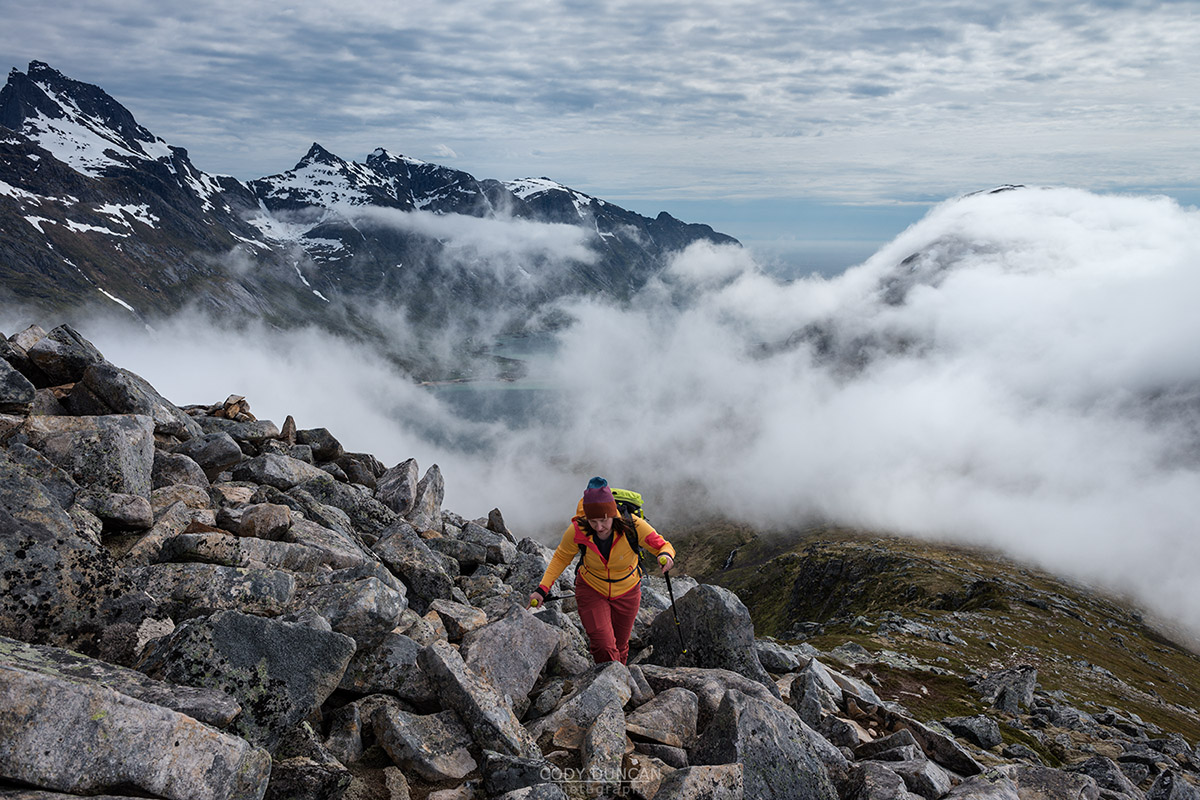
Volandstind, Lofoten Islands, Norway

Photo: Spring hike on Volandstind, Flakstadøy, Lofoten Islands, Norway. May 31, 2016. 14:03

The midnight sun has arrived in the north with the snow is melting fast while the spread of green creeps higher and higher up the mountains. There have been some fantastic summer days in May thus far, and I’ve already complained of the heat on more than one occasion. Perhaps I didn’t more far enough north! 😉

But with summer just around the corner, it is now my time to head into the mountains over the next months and start gathering the data and photos for the next series of hiking guides and ebooks. And now that I’m getting more settled in to life on the islands, I’m finally beginning to realize that I don’t need to rush. There will be another sunny day and the sun won’t set for 6 more weeks.

Heading up Volandstind the other day the weather was a bit wild. Layers of cloud were spinning across the mountains and fjords – with the actual summit of Volandstind just in the cloud, unfortunately. However, the route up was mostly cloud free, which provided a spectacular overview across the surrounding, surreal looking landscape.

Camera Info:
Nikon D800
Nikon 24-70mm f/2.8
28mm
ISO 100
f 7.1
1/600 seconds
WB Daylight
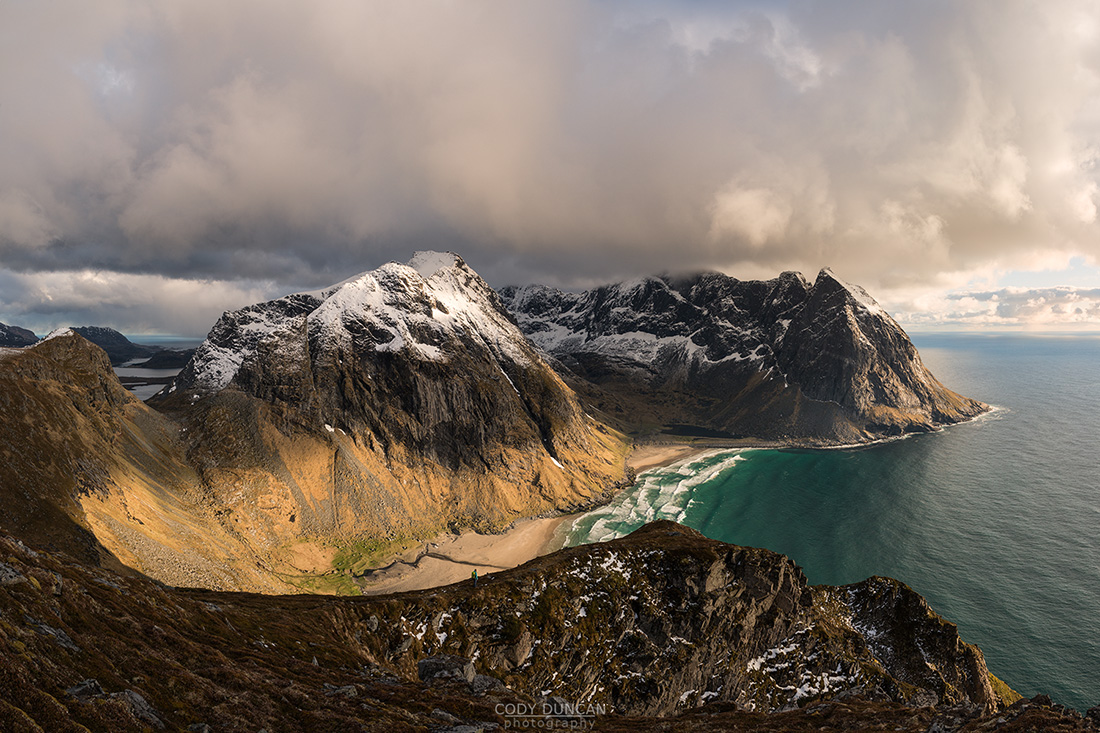
Kvalvika Beach, Lofoten Islands, Norway

Photo: Spring light over Kvalvika beach from Ryten, Moskenesøy, Lofoten Islands, Norway. May 19, 2016. 20:37

May is the month of melting snow and the arrival of the midnight sun over Lofoten. Yet even in the near endless days, winter doesn’t always easily give up its grip over the islands, as experienced on this cold evening on Ryten, with knee deep snow which had fallen over the previous 2-3 days across the higher elevations of the islands. A couple days later, all was gone again.

Even with the sun in the sky for 24 hours as it begins today, the sun’s location in the sky is still an important element while photographing the islands. In my Seasons on Lofoten – Winter eBook I have gone into some detail about the movement of the winter sun and its influence on when to photograph certain locations, so perhaps in the coming days of summer, I will begin to write a bit more about the midnight sun.

Kvalvika beach as viewed from Ryten is a perfect example of this. Even though the sun might not set below the horizon and this sounds like a good location to watch the midnight sun, the beach actually receives the best light, shining directly into the bay, from about 19:00 – 23:00. When the sun reaches its low point on the horizon around 01:00, the beach will be left in shadow, due to the mountains shadowing it from the north.

So, if you’re planning to head up to Ryten for ‘sunset,’ go up a few hours earlier to get the light across the beach as well.

Camera Info:
Nikon D800
Nikon 24-70mm f/2.8
24mm
ISO 320
f 10
1/250 seconds
WB Daylight
5 vertical image pano

April Northern Lights - Lofoten Islands

Photo: Spring Aurora, Flakstadøy, Lofoten Islands, Norway. April 1, 2016. 22:03

This is the final image from my 2016 northern lights season on Lofoten – though there were some displays afterwards, so it wasn’t the last of Lofoten in general.

Overall, having been on Lofoten since early February, I would call in a below average northern lights season for me. There were many clear nights this February and March, but the sky seemed to be quite, something which can be quite frustrating while waiting on top of a mountain in otherwise perfect weather. Perhaps I’m just getting a little more picky in the images I want to create – simply seeing a faint green glow on the horizon no longer excites me – I want to creating dynamic and exciting images of the lights.

With the nights no longer dark, I’ll be eagerly waiting till autumn for my next chances of camping under the dancing sky.

Camera Info:
Nikon D800
Nikon 14-24mm f/2.8
16mm
ISO 1250
f 4
25 seconds
WB Daylight

Andenes Whale Watching

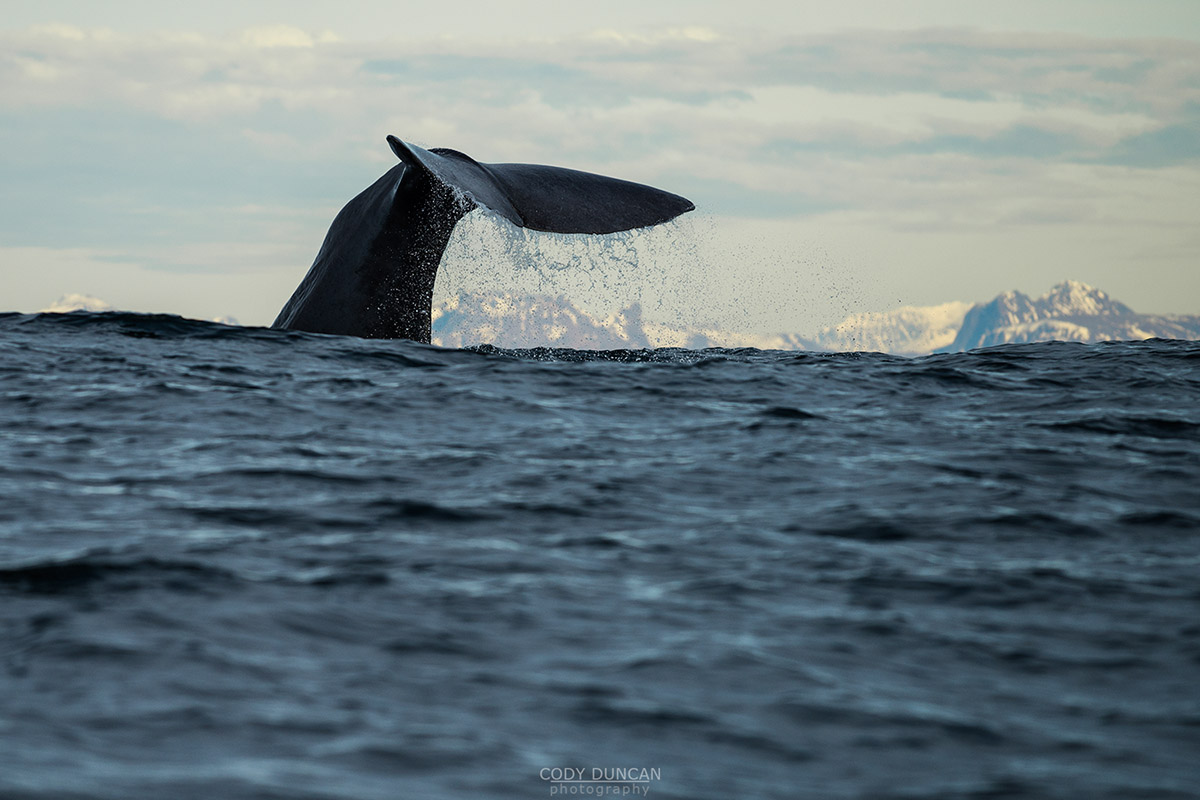
Photo: Whale watching, Andenes, Vesterålen, Norway. May 3, 2016. 19:30

Prior to the other week, I had only seen Andenes from the sea while on a sailing trip to Lofoten in 2014. So when the opportunity came up for me to go do some whale watching with Sea Safari Andenes, I hopped in the van and began the 5 hour drive north from Lofoten – It may look close on a map, but it is quite a ways up there!

I will be guiding a couple Lofoten and Andenes whale watching tours next year – some spots are still available for the January 2017 Muench Workshops tour – so I wanted to see what it was all about first.

Whales are in the area of Andenes year round, however in January and February there can be a bit more action when the killer whales are present. In the spring, it was Sperm whales, diving deep for squid a few kilometers off the coast. Despite what looked to me like a basically flat and open ocean, Marten, the guide, was able to find the first whale within about 20 minutes. And then several more were spotted in the following hours. The RIB boats are fast, and pretty fun in general, but also provide a good, low vantage point of the whale, helping to separate them from the sea as in this photo.

As I am not much of a wildlife photographer, the longest lens I have is a 79-200mm. And this image is a crop from that. I think a 200-400 would have been ideal for the trip I was on, though that won’t be in my budget anytime soon, unfortunately. However, for next winter, I’m hoping 200mm will be long enough for the faster and more active killer whales.

Camera Info:
Nikon D800
Nikon 70-200mm f/4
200mm
ISO 200
f 4.5
1/1600 second
WB Daylight

hiker enjoying view of Kvalvika beach from near summit of Ryten, Moskenesoy, Lofoten Islands, Norway

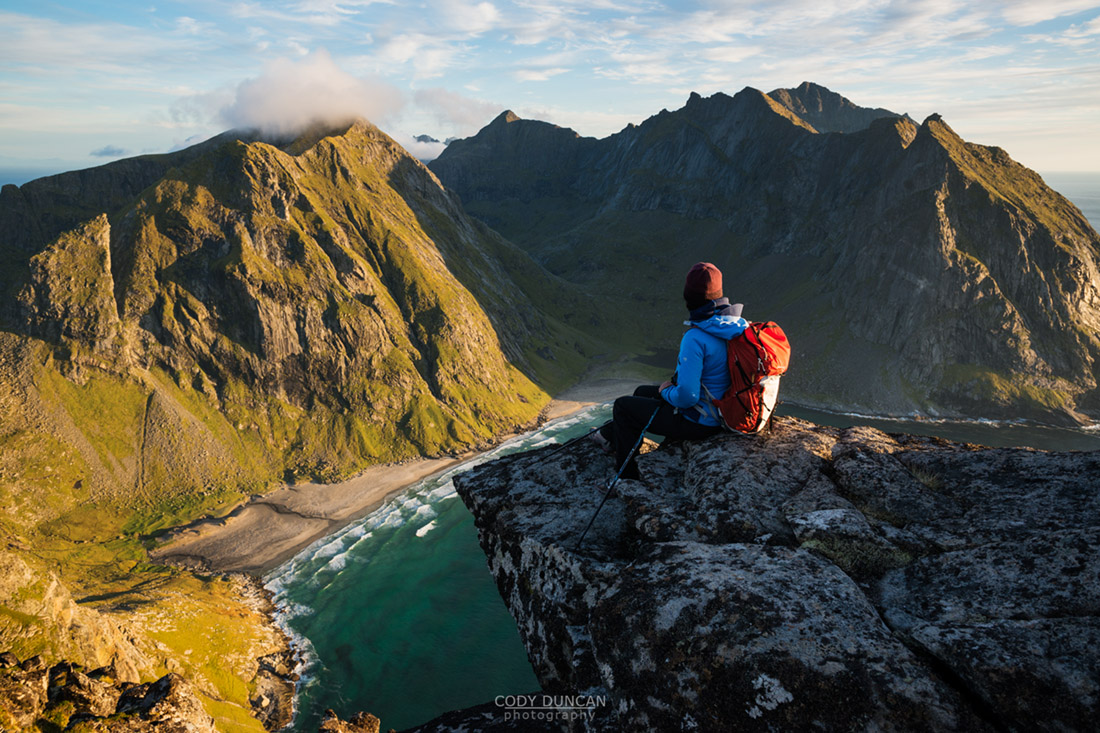
Photo: Evening light over Kvalvika beach from Ryten, Moskenesøy, Lofoten Islands, Noway.  August  30, 2013.  19:53

I think the view from Ryten down to Kvalvika beach is perhaps one of the most spectacular scenes on Lofoten.  I know Reinebringen gets a little more press, mainly because it’s easier to get to, thus climbed more often, but the view from Ryten definitely holds its own in my opinion.

Having been up the mountain a few times now, I’m always left with the dilemma of how early to begin hiking.  I like to catch the afternoon/evening (depending on time of year) sun shining into Kvalvika bay (whale bay bay for you Norwegians 😉 ), yet I also like to try and remain on the summit for sunset.  Unfortunately, these events can be rather far apart, and usually involve a long, cold wait between the two.

This afternoon was one of those cold, windy days.  While the photo and light might look somewhat peaceful, a harsh, bitter wind was raking across the summit.  My partner is sitting down because it was quite possible for her to safely stand!  I could barely focus the image as my eyes were watering up so much every time I looked through the view finder.  And it’s a near miracle I managed any sharp images.

Despite the wind, the light was so nice.  I wanted to remain until sunset, but it was obvious I wouldn’t get any sharp images once I needed longer shutter speeds as my tripod blew over a few times (without my camera) which is never a good sign…

Camera Info:
Nikon D800
Nikon 24-70mm f/2,8
26mm
ISO 250
f 7.1
1/200 second
WB Daylight

Silhouette of landscape photographer on summit of Offersoykammen with Flakstadoy in background, Lofoten Islands, Norway

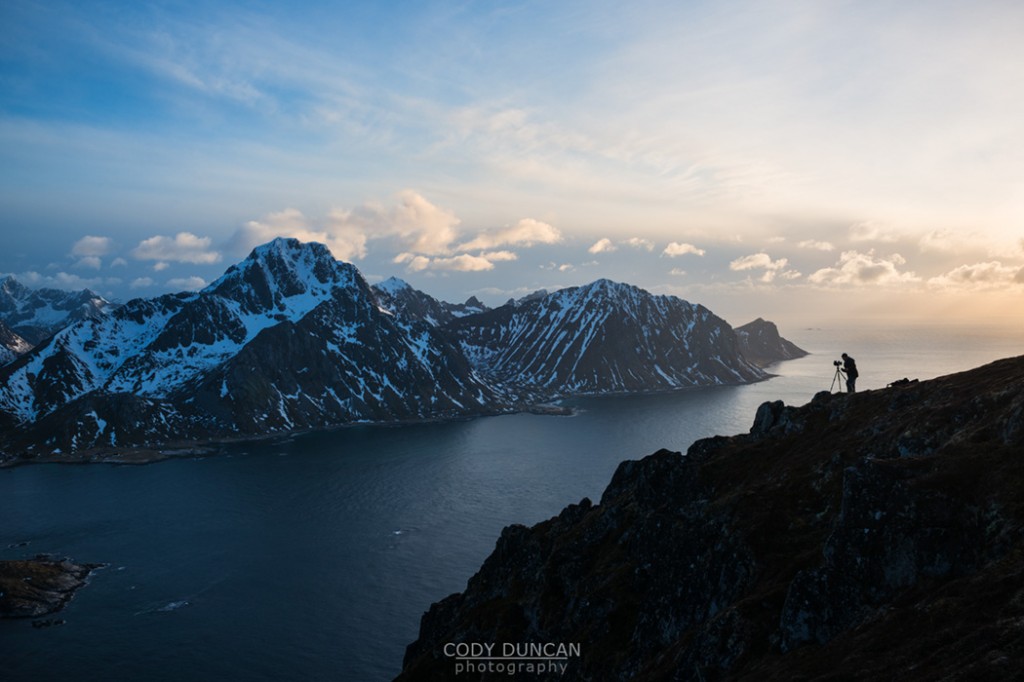
Photo: Photographer at Sunset on Offersøykammen, Vestvågøya, Lofoten Islands, Norway. May 4, 2013. 20:36

[I’m barely squeaking in under this deadline this week. I should probably write these out a day or two in advance to be on the safe side…]

I’ve come the appreciate the small peak of Offersøykammen as a relatively easy spot to reach which provides the willing photographer with a number of possible compositions. The most dramatic of which is perhaps the view towards Flakstadøya, as the wall of mountains rise out of the turbulent waters of the Nappstraumen.

Never knowing exactly what the light might do, I always this it’s best to head up into the hills with a bit of extra time to spare. 10 days into this trip, and any sort of decent sunset had yet to materialize, no matter how brilliant the day, as a perpetual wall of cloud blocked the horizon.

And so the three of us found ourselves sitting on top of the mountain, in the freezing wind, for hours, waiting in hope for the arrival of some light. But alas, as the sun neared the horizon, the clouds took over and the light and color faded in another anticlimactic finish of the day. And so we headed down, slightly defeated, but better than having sat at another beach, again…

Camera Info:
Nikon D800
Nikon 27-70 f 2.8
32mm
ISO 100
f 13
1/100 sec
WB Daylight

Mountain peaks rise above Bunes beach in spring twilight light, Moskenesoy, Lofoten Islands, Norway

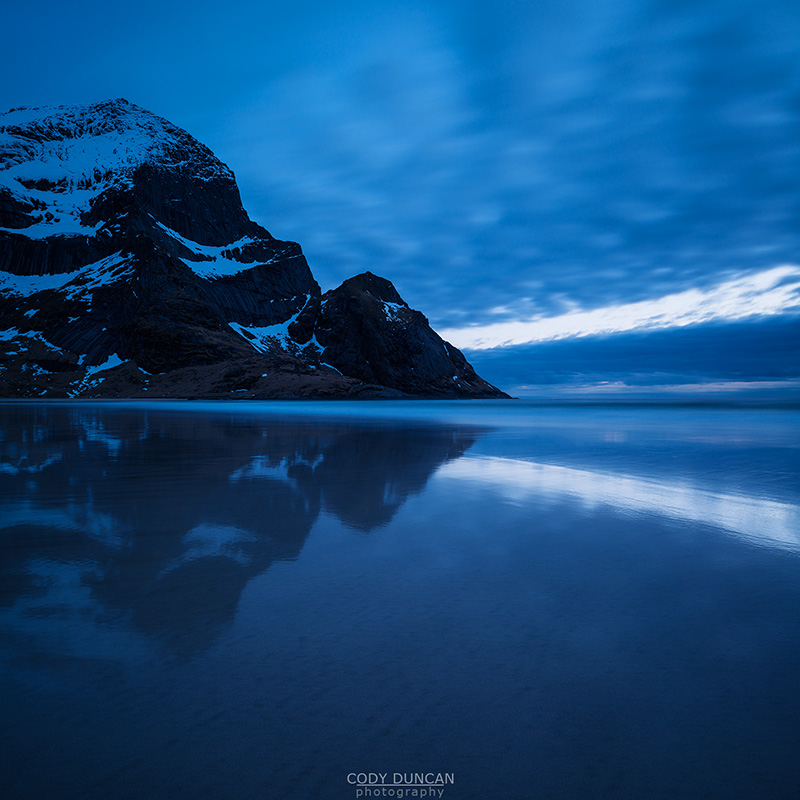
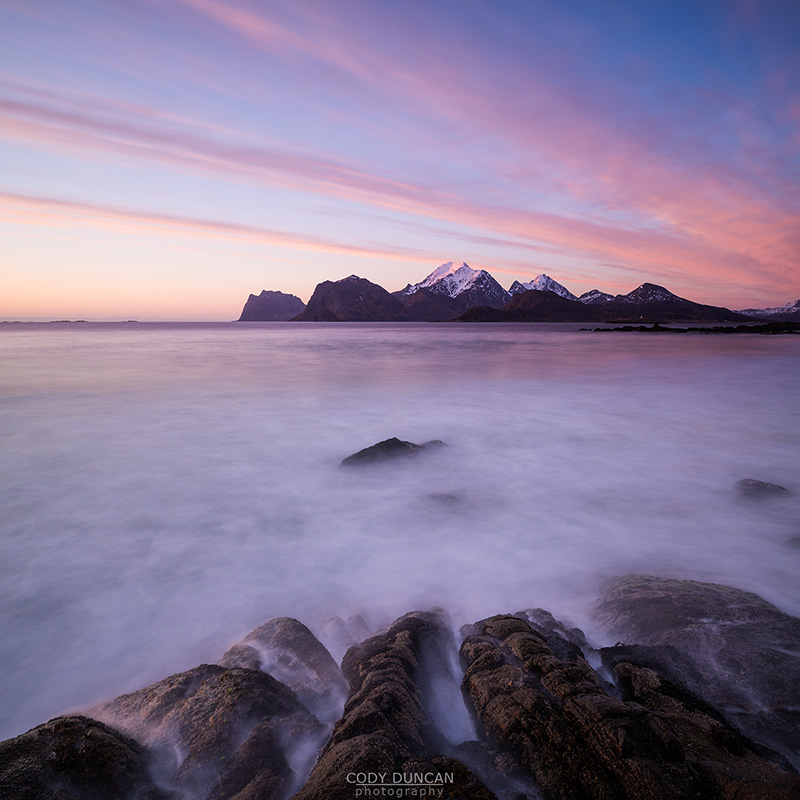
Photo: Mountain reflection on Bunes Beach, Moskenesøya, Lofoten Islands.  Apri 29, 2013.  22:33

After only a few days on Lofoten with my my Aussie travel companions Adam and Rod, I had received the friendly nickname of ‘Captain Wetfoot,’ based upon my proven abilities to almost always end up in the water somehow.  This night shooting on Bunes beach would be no exception.

Shooting with at 24mm tilt-shift lens to end up with a square crop means I need to shoot at least 2 photos.  And with each photo having a 60 second exposure (+noise reduction) means I need to stand in the same place for at least 4 minutes.  The trick is to find the balance point where the highest tide will just barely reach you.  Too far from the sea and the foreground might be a bit dull.  Too close to the sea, and you’ll end up named Captain Wetfoot.

The wet feat I can deal with, especially with the size of the campfire I would build on my return.  But since I generally only carry a light tripod, any incoming waves will tend to shake the tripod or sink the legs into the sand ever so slightly, which is often enough to add blur to the scene.  Thus I sit there anxiously as the seconds tick by on my watch, hoping the water gets close, but not too close.  If the wave is small, no problem.  But if I’m sent running halfway through the second shot, it means I have to start all over again.  So 4 minutes easily turns into a half hour or more for a single photo.

Camera Info:
Nikon D800
Nikon 24mm f/3.5 tilt-shift
24mm
ISO 100
f 11
61 sec
WB Daylight
2 images – top/bottom

Colorful sunset from Storsandnes Beach, Flakstadoy, Lofoten Islands, Norway

Photo: Storsandnes beach sunset.  May 8, 2013.  22:39

After nearly two weeks of spring on Lofoten, including some days of fine and settled weather, this was the first night in which any color arrived.  But unfortunately for me, this was also my last night on the islands for this trip.

Overall, the spring had been on the cold side, but there was a good amount of days with fairly settled weather. Unfortunately though, there seemed to be a perpetual bank of cloud that hung on the northwest horizon, so no matter how much potential for nice light the evening might give, the color would eventually fade away into some dull blueish gray tones as the sun neared the horizon.  Frustrating to say the least.

But finally on my last night on the islands, conditions aligned themselves for a bit of color.  Now I’m not really a ‘sunset’ shooter, that is to say I prefer other, more subtle lighting conditions (usually something dramatic and stormy), but I do appreciate a bit of colour and and then.  And so what seems to be something of a common occurrence for me on Lofoten, the last day always offers me something special.  Perhaps so I leave the islands on a high point and with an eagerness to return; which of course I will, no doubt…

Camera Info:
Nikon D800
Nikon 24mm f/3.5 tilt-shift
24mm
ISO 50
f 11
20 sec
WB Daylight
2 images – top/bottom

campfire at Bunes Beach, Moskenesoy, Lofoten Islands, Norway

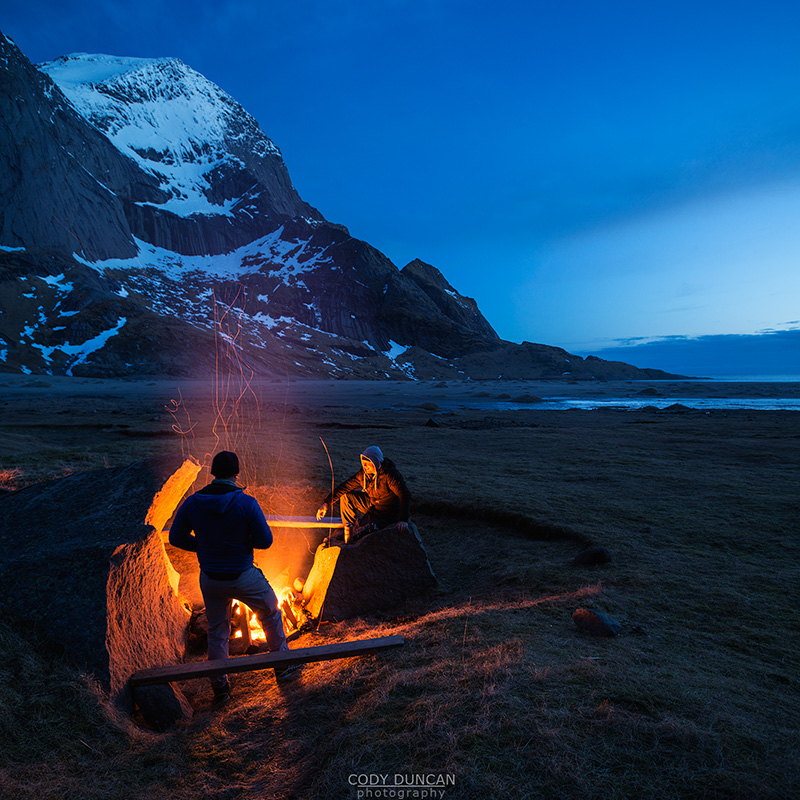
Photo: Driftwood campfire at Bunes Beach, Moskenesøya, Lofoten Islands, Norway.  April 30, 2013.  01:46

As the twilight nights of late April and early May arrive on Lofoten, exhaustion and insomnia become constant companions for the landscape photographer.  And if you’re wanting a few hours around a campfire, it needs to wait for the few hours between sunrise and sunset, an all to late in my opinion.  But after an afternoon of scouring the beach for driftwood, and then shooting until well past midnight, an hour or so by a fire is a welcomed reward.

I’ve written before that Spring, in the normal meaning of the word doesn’t really exist on Lofoten.  It is more of a ‘brown period,’ between the melting of the snow on the lower elevations and the return of green, in mid May.  But over these few weeks, the nights disappear in their entirety and suddenly you will find yourself surrounded by Summer.

With a couple Australian landscape photographers as my companions (I’ll write more on this later), I took the opportunity of a stable weather forecast to head out to Bunes beach and camp for a night.  I was still exhausted from my nearly 40 hours of travel to the islands, having arrived just a few days prior, so I think I slept most of the afternoon away as well, but as the evening came, it was time to head out for some photography.

It wasn’t until after 01:00 am that we were finally back at the tents and finally finished with the night.  Of course I can never let a campfire go to waste as a photo opportunity as well…

Camera Info:
Nikon D800
Nikon 24mm f/3.5 tilt-shift
24mm
ISO 200
f 5.6
5 sec
WB Daylight
2 images – top/bottom