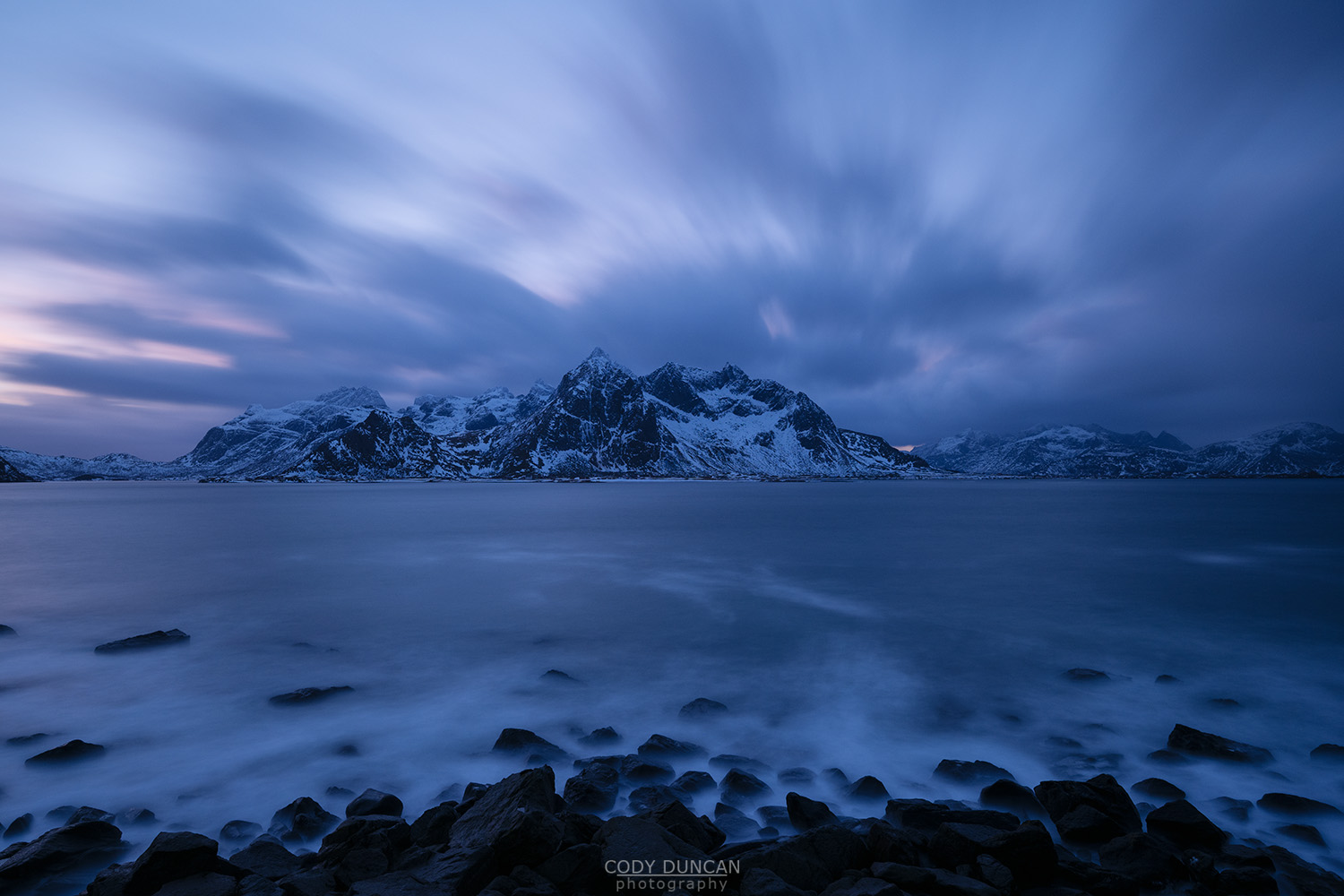
Photo: Long shadows over snowy November mountain landscape, Lofoten Islands, Norway. November 19, 2023. 12:12

Having spent the last month in sunny Spain, returning to a November version of Lofoten is like hitting a wall of darkness. The change of scenery was made even more apparent after flight delays didn’t see me back in Leknes until 23:15, at which point I had a 2km walk to where my van was parked at a friend’s house. Nervously watching the weather radar as I arrived, I lucky made it to my van between the frequent passing sleet showers. As I neared home 20 minutes later I was greeted with a full arctic blizzard. Perhaps I should have stayed in Spain…

By all accounts, this year was a good November to have missed. Looking at the weather history, it has rained or snowed 28 of the last 30 days, with no shortage of severe wind and storms included. As I write now, my house is once again rumbling in gale force winds.

With the polar night still two weeks away, the sun is already quite low on the horizon, with all day golden hour – should the sun actually emerge from the clouds. By now, many locations across the northern side of Lofoten will have long since seen the last direct sunlight of the year, even before the start of the polar night.

From my house, I can look from the shadows across to the distant mountains of Himmeltindan, Veggen, Mannen, and Ristind as they rise into the mid November sun. Sun that won’t reach me again until late February. But soon enough, even these mountains won’t be high enough to reach the winter sun and the whole world will be twilight and darkness.

Camera Info:
Nikon Z8
Nikon 24-120mm f/4
83mm
ISO 50
f 8
20 Seconds
WB Daylight
10 Stop ND filter

Photo: November afternoon sunset from Ballstadheia, Vestvågøy, Lofoten Islands, Norway. November 25, 2022. 13:09

November is that middle ground between no longer autumn and still not winter. Although as far as the sun is concerned, the daylight hours are similar to January and early February. So if you’re heading to the mountain for a sunset hike like I was on this afternoon up on Ballstadheia – you probably need to start hiking before lunch! Quite a difference from my after dinner hikes of summer, which was not that long ago.

In the last couple Friday photo posts, I’ve showed images of 2023’s cold November, with a -1.6˚c average temperature, was the coldest month of the whole winter – 28 out of 30 days dropped below 0˚c. November 2022, when this photo was taken, was quite a bit milder, having an average of 3.8˚c and only dropping below 0˚c on 12 days.

What both 2023 and 2022 have in common is that they were both relatively dry, with less that 50% of average rainfall for the month. Now compare this with November 2021 in which there was above average rainfall and precipitation on 29 out of 30 days – I remember it as a grey and misty month when I was struggling to get some final images for my Northern Light ebook. I would have much preferred the weather of 2022 or 2023!

So where am I going with all this? Nowhere really. Just an example of how there’s no predicting much of anything outside of general trends when it comes to Lofoten’s weather.

Camera Info:
Nikon Z7 II
Nikon 14-30mm f/4
20mm
ISO 100
f 14
1/25 Second
WB Daylight

Photo: The morning’s high tide line washed into the snow covered sand of Vik beach, Vestvågøy, Lofoten Islands, Norway. November 20, 2023. 09:23

Not every year is it possible to photograph snow covered beaches already in November. If I was just shown this image and asked to guess when it was taken, my first guess would be January or February, followed by March. November wouldn’t be in my top three guesses, but here it is.

I already wrote a bit of an overview last week (Friday Photo #617) about November 2023 being colder than average, and in fact, the coldest month of the whole winter. This day, November 20th, was a particularly chilly day at -3.8˚c. Lucky for me, the cold temperature actually made this image possible, as the beach remained frozen enough that even a light dusting of snow was able to remain. Had it been closer to even 0˚c, then it is more likely the snow would have melted away before my arrival.

I would have rather photographed the scene closer to high tide, but with sunrise around 10:00 in late November, the timing wouldn’t work. And the snow was nice enough anyhow!

Camera Info:
Nikon Z8
Sigma 14mm f/1.8
14mm
ISO 2000
f 2
1.6 Seconds
WB Daylight

Photo: November deep freeze over mountains of Vestvågøy, Lofoten Islands, Norway. November 10, 2023. 08:51

It was a frozen morning with temperatures dropping to -5.8˚c in which I caught the morning light over Ristind and Himmeltindan mountains rising over the frosty landscape. I had actually camped somewhere further east on my way back from Evenes airport after a photo workshop in Scotland, arriving to my van frozen like a block of ice in the cold darkness. This time I at least remembered to put my window scraper in the van, and even then, quite of bit of effort was required before I could drive.

Usually November is a bit more mild with maybe a short cold snap or two bringing a bit of snow. November 2023 was not that! With a -1.6˚c average temperature, it the coldest month of the whole winter. 28 out of 30 days dropped below 0˚c at some point and 21 days had a below 0˚c average temperature. It was cold!

The cold also brought many clear and calm days, and only 40% of average rainfall for the month. Visually it was probably the best ‘winter’ month of the entire winter. If every November was like this, I would schedule 1/2 my photo workshops then. Unfortunately, there is no way to know and it is just as likely, if not more to end up with November 2021 weather, where it rained/snowed 29 out of 30 days.

What will this year be like? I don’t know. But coming off a windy and wet October, I suspect the stormy weather will be quite frequent. Though maybe I’ll be pleasantly surprised by clear and calm days and nice full of dancing aurora. We will see…

Camera Info:
Nikon Z8
Nikon 24-120mm f/4
98mm
ISO 100
f 6.3
1/80 Second
WB Daylight

Photo: Northern lights shine in sky over icy Myrlandsveien road, Flakstadøy, Lofoten Islands, Norway. November 27, 2023. 22:13

Already in October, a Finnish tour bus full of passengers slid off Lofoten’s ice roads and multiple other cars have made it to the infamous ‘bil i grofta’ newspaper headline. Even a police car up in Finnmark while still driving with summer tires ended up sliding on ice: which according to Norwegian police themselves – no matter what the season, it is the driver’s responsibility to have appropriate tires for road conditions. In Nordland, Troms, and Finnmark the period for winter tires is October 16 – April 30. However, should icy/snowy conditions present themselves outside of this period, it is your responsibility to have correct tires. If it was you or I off the road with inappropriate tires for conditions, we would have a temporary loss of our driving license. The police have said they will investigate themselves about the incident… 😉

So, with November, and increasingly winter driving conditions just around the corner for Lofoten, this is my yearly reference to winter driving and safety on Lofoten. You can find the follow article below:

Winter Driving On Lofoten

With all the hype around the solar maximum this year, the coming winter is probably going to be the busiest ever on Lofoten. And that means many inexperienced winter drivers on Lofoten’s narrow and winding roads. I would roughly guess that a majority of traffic in western Lofoten will be tourists in rental cars, and probably basically every car driving around at night as people hunt for northern lights – rain or clear weather, snow or storms. And it will probably be sometime in mid February when I wonder why I work terribly long hours as a photo guide, when I could earn just as much money in a few hours driving a tow truck picking up rental cars from the side of the road.

If you are reading this, please drive safely! There might be some days during your trip where it is simply not safe to be on the roads. There is no shame in sitting around your cabin or hotel and waiting for conditions to improve. And if the weather is that bad, you’re probably not missing out on much anyhow. Weather caused travel disruptions are frequent throughout winter on Lofoten, so be aware that you might need a plan B, C, or D if severe weather hits at an in opportune time in your travel.

I almost forgot to write about the photo! With a nice full moon light I had been photographing the aurora over Nappstaumen and Himmeltindan looking towards the northeast. As the activity slowly increased and the aurora rose overhead, Looking west down the road from my current location provided a nice shot without having to drive anywhere else. Without the moonlight, I don’t think this image would have worked, is I feel in needs the bright snow to balance out the foreground and mountain. Ideally I should have been in a better location with a cleaner view to the west, but at the moment, this was the best I could do.

Camera Info:
Nikon Z8
Sigma 14mm f/1.8
14mm
ISO 2000
f 2
1.6 Seconds
WB Daylight

Photo: Snow covered roof tiles, Reine, Lofoten Islands, Norway. March 14, 2024. 10:05

Gentle snow had been falling all morning, brining winter back to what had previously been a dry looking Lofoten. Walking out of my cabin mid-morning, I noticed the snow had created a nice abstract patter on the roof of the cabin opposite mine.

I first shot a wider angle version, but switched to a telephoto lens for a more detailed shot, which I like better – as there is too much visible in the wider shot. Its a bit more abstract than what I usually post here.

As the snow continued to fall, the gaps between the tiles became filled in and the roof was eventually entirely white, and uninteresting.

Camera Info:
Nikon z8
Nikon 100-400mm f/4.5-5.6
290mm
ISO 100
f 6.3
1/250 Second
WB Daylight

Photo: Snow blows across Haukland beach, Vestvågøy, Lofoten Islands, Norway. March 24, 2024. 08:59

There is somewhat of a joke about Lofoten actually having 12 seasons during the year, instead of 4. And you can probably guess already, that most of the additional seasons are due to the long winters, and our optimistic hope that a nice and calm sunny day might mean winter is finally over. But nope, it isn’t over…

The 12 seasons of Lofoten are:
Winter
Fool’s Spring
Second Winter
Spring of Deception
Third Winter
Allergy Season
Real Spring
Summer-ish
Actual Summer
False Autumn
Second Summer
Actual Autumn

Today’s photo of a snowy Haukland beach at the end of March is when Second winter made a return. Just a few days earlier the landscape of Lofoten looked hopeless and dry, and largely barren of snow. On the calmer, sunny days it was even enough to walk around in a sweatshirt most of the time. Fool’s spring.

Now the temperatures have dropped and the coldest day of the last month was -9.5˚c on March 28. Good news for all the ski tourists here for the long Easter holiday week. Bad news for everyone else that is waiting for the first signs of green and the long days of summer.

Now with the long days of April, Winter is long from over here on Lofoten, and the snow will likely continue to fall for the next weeks and into May. Eventually the snow will stop falling and we’ll have Spring here in the north, yet never quite sure if another Winter is waiting around the corner.

Camera Info:
Nikon z8
Nikon 14-30mm f/4
16mm
ISO 200
f 8
1/200 Second
WB Daylight

Photo: Last workshop aurora of 2024 winter season, Gimsøy, Lofoten Islands, Norway. March, 24, 2024. 22:44

After 7 back to back workshops starting on January 31st, my winter guiding season has finally come to an end as I dropped off my last guests at Evenes airport of Tuesday, narrowly missing a multi-hour road closure on my drive home due to a truck stuck on the road in heavy snow around the Lødingen area. Now I can sleep!

As usual, this winter gave us all the varieties of weather. The most significant of which was the storm ‘Ingunn’ on the 1st of February, the most powerful storm to hit Lofoten in decades. My group was supposed to drive from Tromsø to Senja on this day, but we delayed the drive day, as it would simply not be safe to be on the roads in a full blizzard.

The rest of the winter was also filled with the occasional delayed or canceled flights from the ‘normal’ winter conditions, some closed roads here and there, snow, rain, more snow, and more rain and a seemingly endless amount of clouds. There is no predicting the winter weather and some groups got lucky with a full week of ideal winter weather, while other groups were stuck with wind, sideways rain, and a flat grey sky.

The northern lights were also somewhat shy this year – though this is largely related to cloudiness of this winter. While I managed to get every group a glimpse of the aurora, with one group it was down to the final hours before departure. Other weeks were more lucky, particularly my Senja group in early March, which had some amazing dancing auroras on several nights. Again, no predicting, just luck…

Despite a not-great weather forecast, my last group was on the lucky side, with aurora on 4 nights out of 8. Though only one of these nights was fully clear. On this last night, we headed out to GImsøy to hopefully find some clear sky as it had clouded over in Kabelvåg where we had started the night. Luckily a nice hole in the clouds opened up just as the aurora began to rain a curtain of light down on us. Shortly after the aurora faded and the clouds closed in.

Camera Info:
Nikon z8
Sigma 14mm f/1.8
14mm
ISO 1600
f 2
2 Seconds
WB Daylight

Photo: Snow patterns form on the sea outside Reine Rorbuer, Moskenesøy, Lofoten Islands, Norway. March 14, 2024. 15:05

In contrast to the deep cold of March 2023, March 2024 has been a largely mild and dry month. As of my writing, only two days this march will have had an average temperature below 0˚c, with most days a few degrees above. Compared to 2023 when March had an average temperate of -3.3˚c, these feel like two different seasons all together. And why it is so difficult to make any predictions about the weather in Lofoten.

During my second to last workshop of the winter, a spring-like looking Lofoten changed to a winter wonderland over the course of a single day of heavy snowfall and low winds. Here, later in the afternoon, the snow can been seen freezing on the top of the sea in Reine harbour, just outside our cabins at Reine Rorbuer. While earlier in the winter there were some days of the sea surface freezing itself in the low temperatures, that was not the case here, as the temperature was only around 0˚c and not enough for the sea to freeze. The patterns on the water here are from a combination of the heavy snow and still wind. More wind or less snow and this scene would not have existed.

And so while this was a bit of an indoor day for this group, the result on the following day was well worth it, as we headed out the door at 05:00 for sunrise on a summit to sea snow covered landscape, which had not existed on Lofoten for several weeks at this point. But that is how winter on Lofoten is these days, less predicable than ever, while one hopes for the best…

Camera Info:
Nikon z8
Nikon 14-30mm f/4
20mm
ISO 200
f 8
100 Second
WB Daylight

Photo: Twilight aurora over Myland, Flakstadøy, Lofoten Islands, Norway. March 10, 2024. 20:29

It has been a sometimes difficult northern lights season so far this year. When I have more time, I will write a longer article about all the fake news of 2024/2025 being the ‘best aurora season in years,’ and the solar maximum, etc. At the moment, I only have the time to say: Don’t believe all the hype.

I was guiding every day in February without a single day off. And I must say it has been a tough winter this year. Hurricanes, wind, more wind, blizzards, rain, more rain, and even more rain. Though for the previous week we had an early glimpse of spring, with lots of sunshine and mild temperatures. Mild temperatures which means Lofoten has been low on snow for the last weeks, looking more like April or May than March. Which leads me to this weeks photo.

A German TV documentary crew was shooting a bit of footage about me and life on Lofoten, northern lights, ect. And this is supposed to be during winter – which at sea level, Lofoten is not looking very wintry at the moment. So, I decided to take them up to the mountains over my house, as at least that would provide a better winter landscape. Still a little tired from a long winter guiding season, I would have probably just spent the evening sitting around the house. So thankfully, I had the motivation to head up into the mountains, to a location that I’ve always thought to visit for aurora, but never actually done so.

And luckily for us, Miss Aurora cooperated as well, already showing up in the evening twilight of mid March. The aurora got much brighter as time passed, but I actually like this image of earlier in the night, with a little glow still on the northwestern horizon. Overall, it was a fantastic winter night in the mountains, and even more special to be looking down at my little village in the valley below.

Camera Info:
Nikon z8
Nikon 20mm f/1.8
20mm
ISO 1600
f 2
10 Seconds
WB Daylight