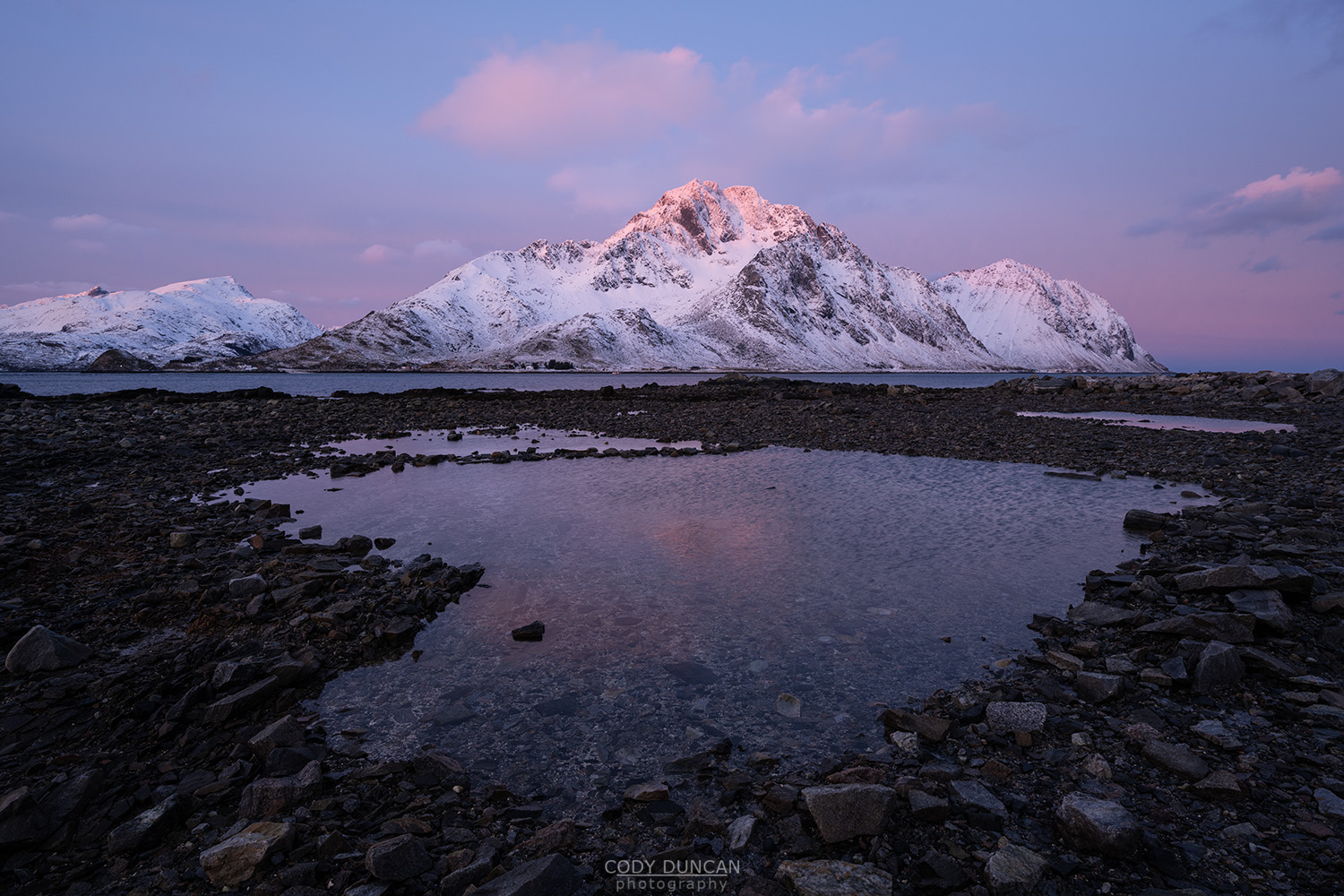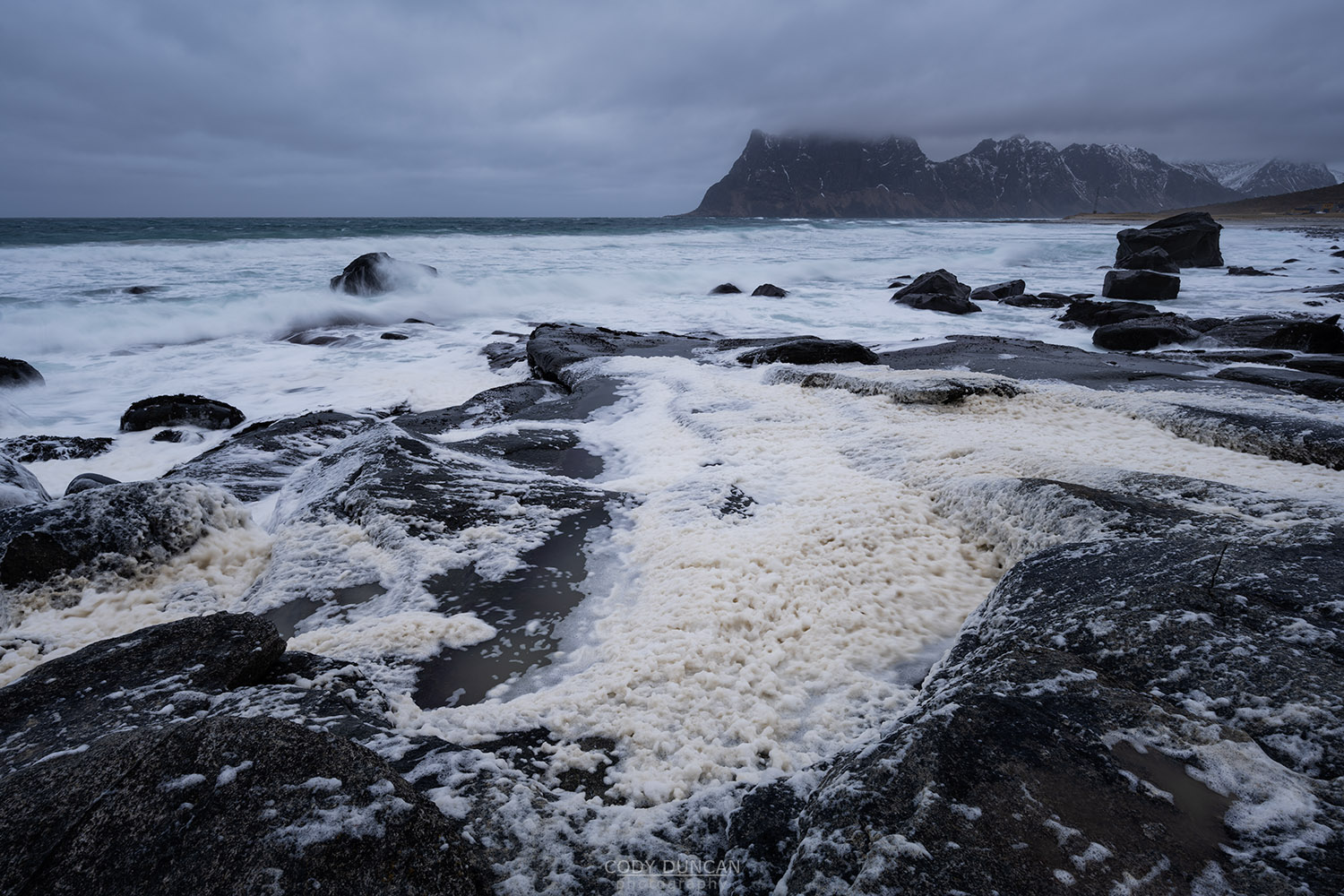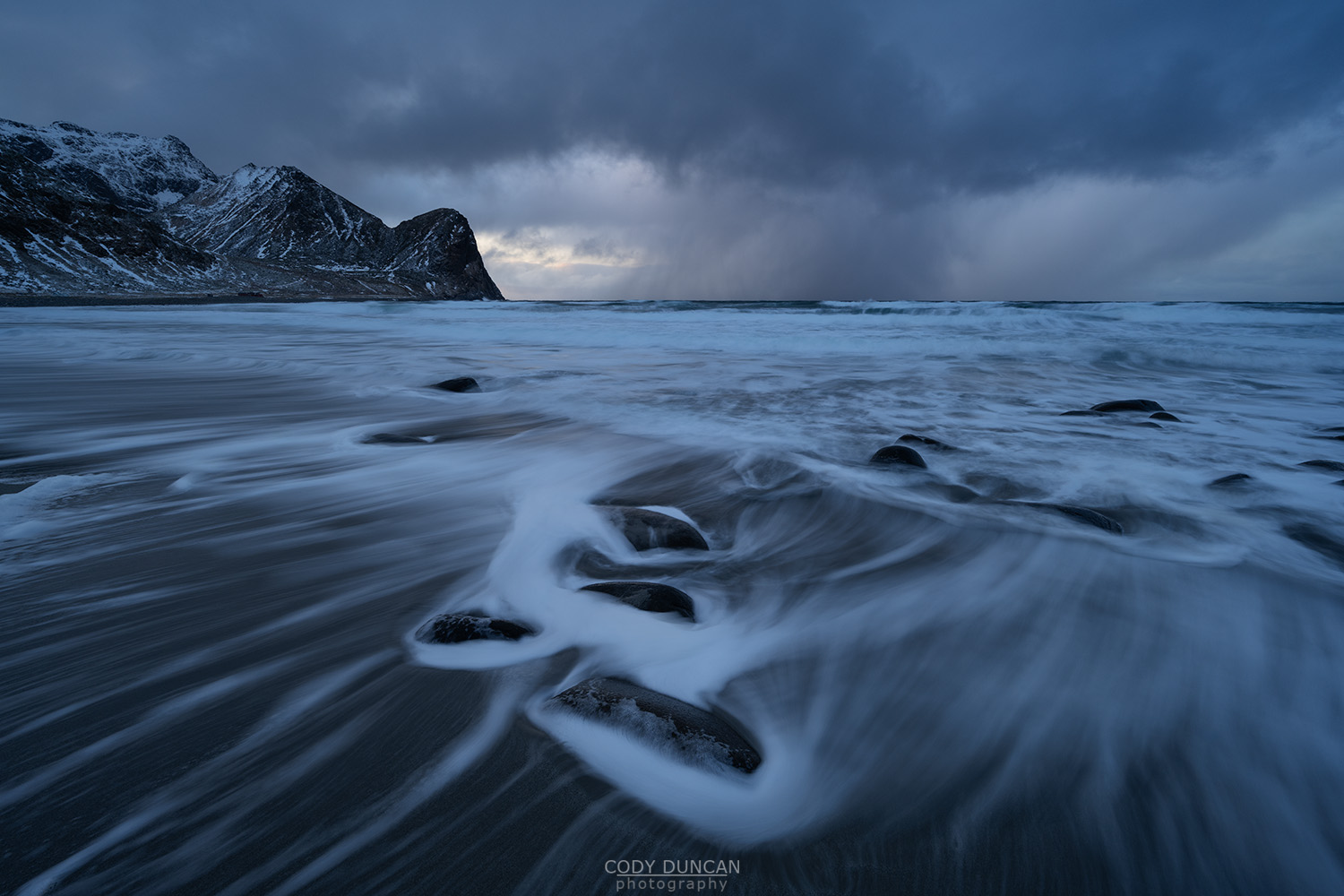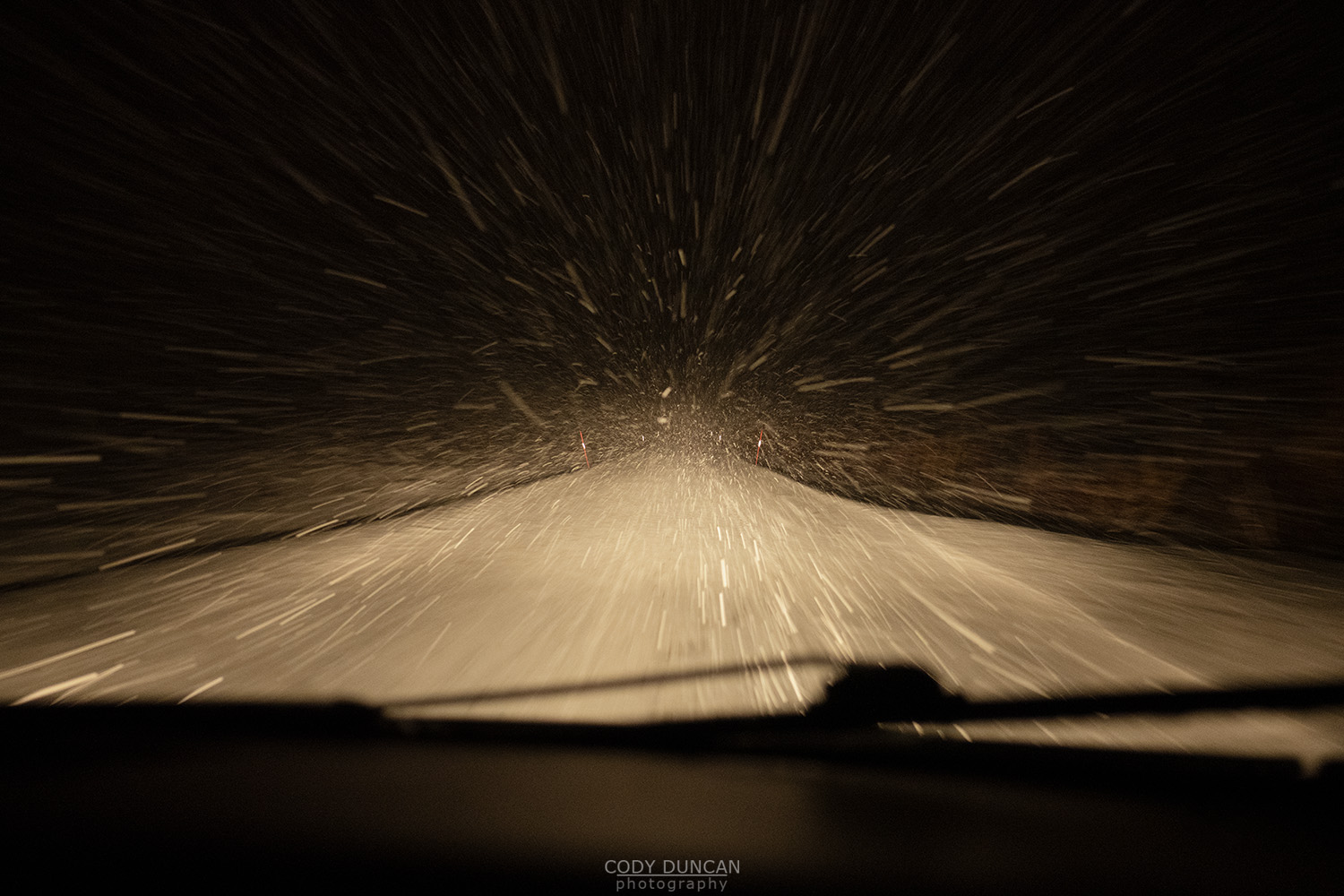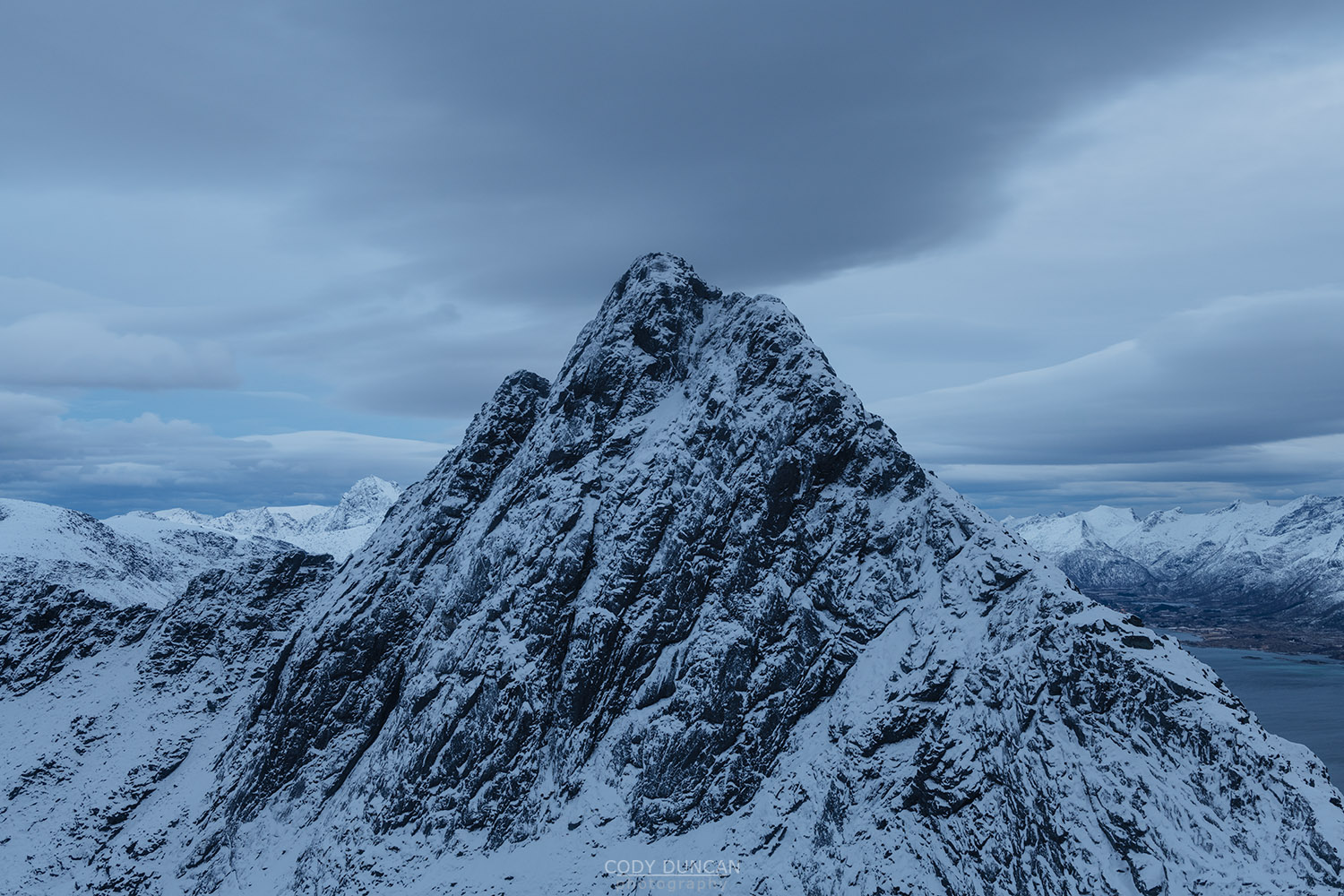
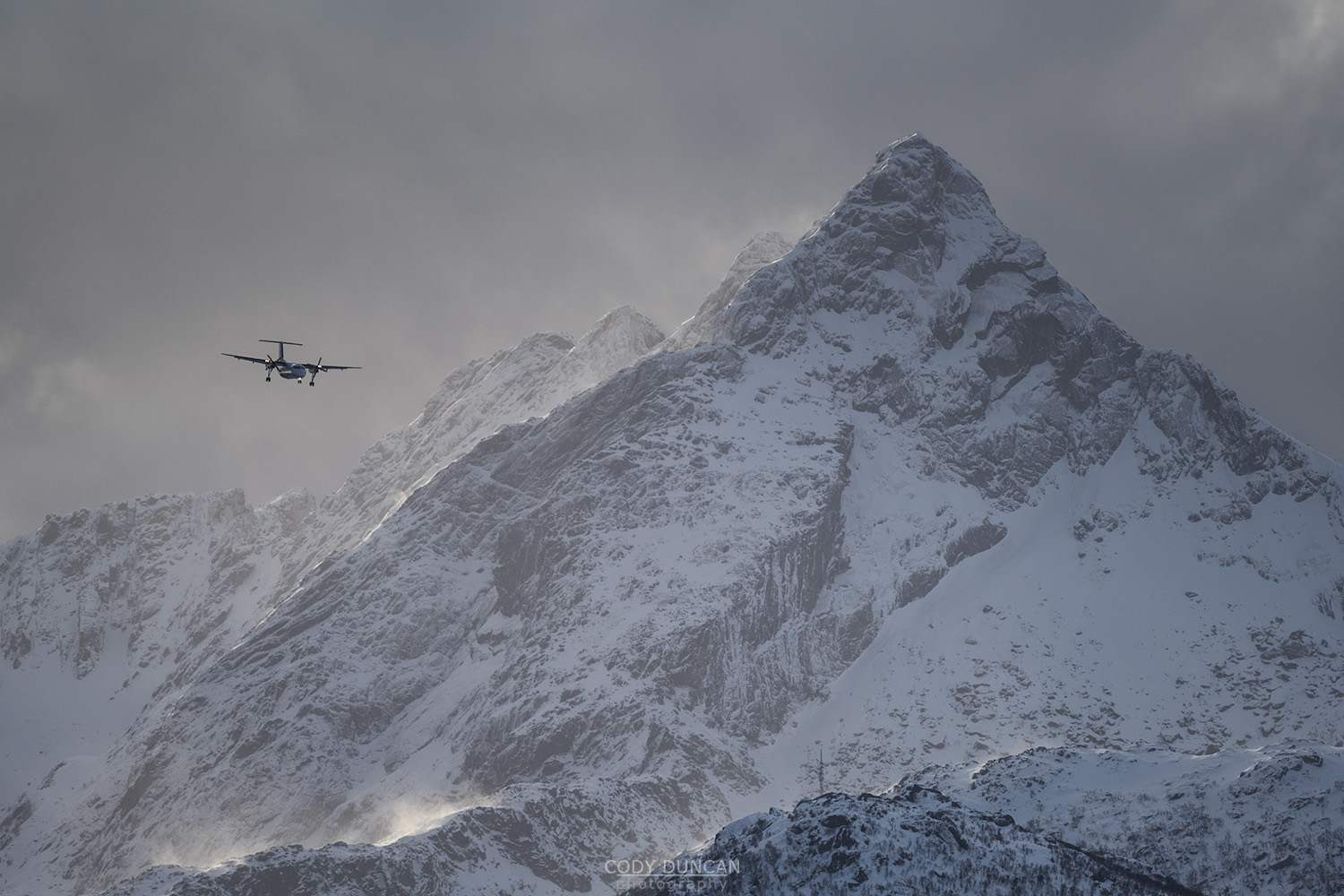
Photo: Vikjordtinden mountain peak rises into the cold twilight of the arctic polar night, Vestvågøy, Lofoten Islands, Norway. December 28, 2020. 13:19

Even starting by headlamp in the morning darkness is often not enough to reach some summits during the polar night. Even more slow with slow progress though deep snow and rocky hillsides. Add in a layer of heavy clouds, and this is what it looks like by early afternoon. Our goal of the day was the mountain in this picture, Vikfjordtind, but it was obvious we would not summit until well after dark. So we turned around.

An icy cold east wind also helped in the decision to turn around and the sky became more ominous looking with time. Even from this middle high point, it was still several cold hours back to the van, navigating the last sections of frozen bog by headlamp.

With a heavy backpack full of camera gear, I also find it a little hard to keep motivated in weather when I’m not likely to get many photos. And while it’s nice to reach the summit, my many goal is always just to take an interesting photo, wherever on the mountain that might be. I actually figured this photo of the mountain would likely be more interesting than a photo from the mountain. Though I haven’t been back since this only attempt on Vikjordtind, perhaps I’ll choose sometime in summer or autumn for another try.

Head over to my Instagram account for (almost) daily postings of the local conditions here on Lofoten: @distant.north

Camera Info:
Nikon D850
Nikon 24-70mm f/2.8
36mm
ISO 100
f 10
1.3 Second
WB Daylight

Photo: Christmas twilight over snow covered landscape, Flakstadøy, Lofoten Islands, Norway. December 25, 2022

Today is the Winter Solstice – the shortest day of the year. But as Lofoten is in the middle of the polar night, and there is no daylight, it is simply the darkest ‘day’ of the year, with the sun reaching a maximum elevation of -0.87˚ below the horizon. And while there are many months of snow and winter ahead in the north, the sun will now rise higher in the sky for the next 6 months. I’m already looking forwards to the long summer days.

How dark the polar night is on Lofoten depends on a multitude of factors. The two most import for any given day are weather – cloud cover, and snow. A clear sky with fresh snow will be much brighter than heavy clouds and no snow. It sounds pretty obvious as I write it, of course it’s darker when cloudy. But when the brightest it gets is twilight, then a heavy layer of clouds can make quite a difference in the few hours of light which exist.

Location on the islands is also important. This image, taken on Christmas afternoon on a nice clear day is about as light as it gets on the Yttersia – the northern side of Lofoten during this time of year. Whereas if I were on the southern side of Lofoten, looking south across the Vestfjord, there would have been a nice colourful glow in the sky.

There are a few locations across Lofoten that have the best of both; fully open to the north for the midnight sun and south for colourful winter twilight. Having to choose though, I prefer the north and the midnight sun. It’s not like I’m going to spend a lot of time sitting in my backyard in the middle of winter anyhow, so I can survive a few months without direct sunlight. Or even better, head down to Spain!

Head over to my Instagram account for (almost) daily postings of the local conditions here on Lofoten: @distant.north

Camera Info:
Nikon z7 II
Nikon 24-120mm f/4
28mm
ISO 100
f 8
1/5 Second
WB Daylight

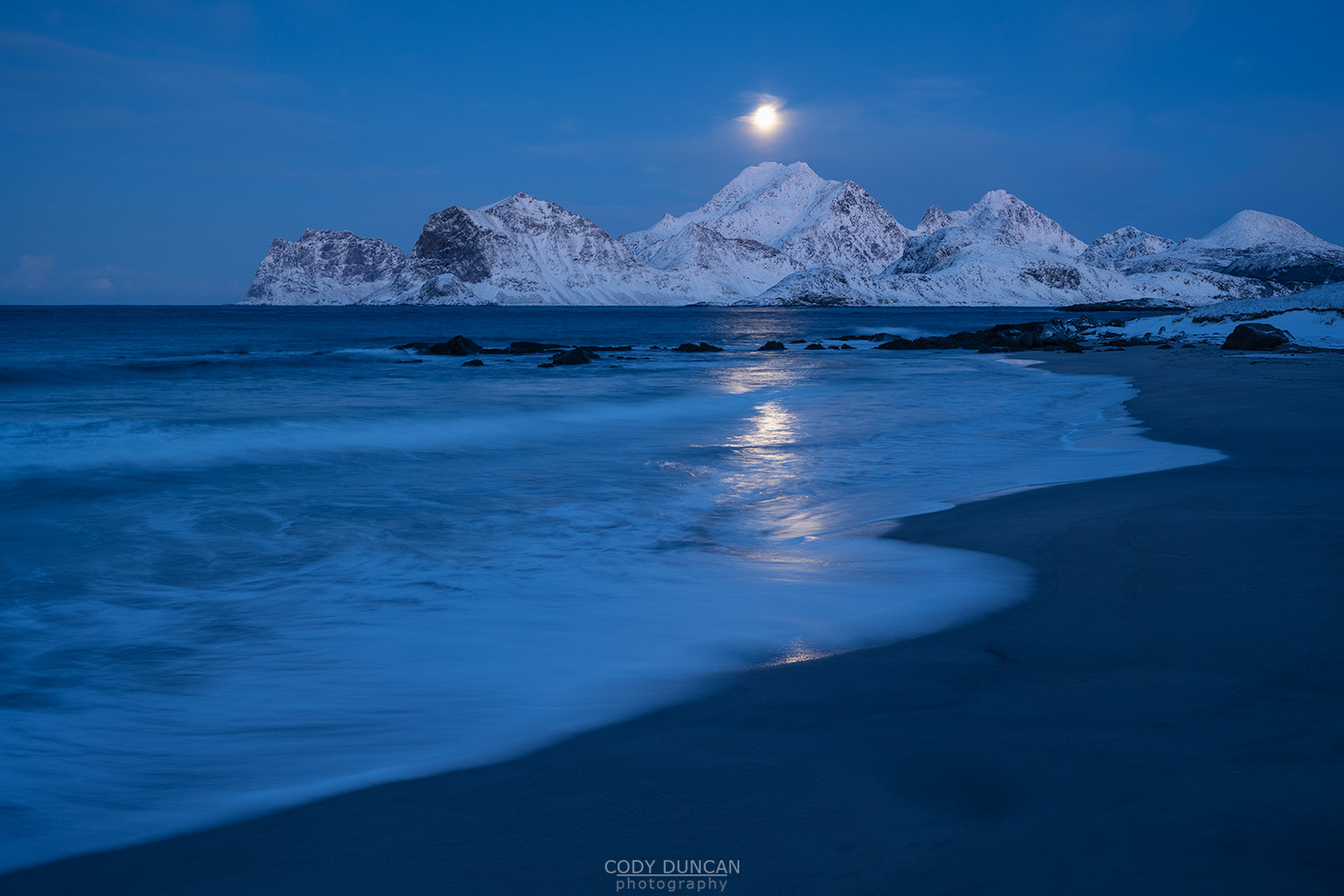
Photo: December moon shines over Storsandnes beach, Flakstadøy, Lofoten Islands, Norway. December 7, 2022. 14:26

A nice bright moon shines over Storsandnes beach at blue hour. It looks like sometime in the evening, but on the Lofoten Islands in December, the is 14:26 is the afternoon. This image is taken one hour after last week’s image (Friday Photo #570), and there is quite a difference. Looking at the images for this article, I actually thought they had been taken on different days, not merely an hour apart.

Now a week into the polar night, if I were to shoot this image on today’s date, December 15, I would need to do so about a half hour earlier, so around 14:00. The polar night will continue to deepen for another week until the winter solstice next Friday, and which point the sun will have reached its lowest point below the (midday) southern horizon. The next time the day will have this equivalent light again is January 6, just as the sun crosses the horizon again. That’s enough numbers and dates for today.

I always like this blue hour light during winter. Even without the moon, on clear and cold days, there is a period where it seems as if the mountains are glowing from within. It is hard to photograph correctly, but if you are on Lofoten, it can seem as if the mountains get brighter as the light fades. I guess this technically just has to due with relative contrast of the white mountains against the deep blue sky, but it feels like a special light when it happens.

Head over to my Instagram account for (almost) daily postings of the local conditions here on Lofoten: @distant.north

Camera Info:
Nikon z8
Nikon 14-30mm f/4
25mm
ISO 100
f 11
1/5 Second
WB Daylight

Photo: Afternoon December sunset over Stornappstind and the beginning of the polar night, Vestvågøy, Lofoten Islands, Norway. December 7, 2022. 13:20

If you were just to arrive on Lofoten today, it would feel dark! But in reality, it has already felt dark for some weeks and it is rare that I will have seen the sun in the last days, as even a small layer of clouds is enough for it to hide behind. Last year was actually the latest I have seen the sun for the year, December 11, while I was on the summit of Reinebringen (Friday Photo #519) – The elevation in mountains add a couple more days.

There still remains some twilight in the hours around midday, especially in parts of Lofoten overlooking the Vestfjorden to the south. And with the right conditions there can be some nice color as well. But by early afternoon, it will be night again.

By the time this photo was taken at 13:20 the sun will already have sunk below the horizon and the last color will begin to fade from the sky. Not usually to light and color you see in the middle of the day, but on Lofoten in winter, midday photography can be quite nice!

Head over to my Instagram account for (almost) daily postings of the local conditions here on Lofoten: @distant.north

Camera Info:
Nikon z7 II
Nikon 24-120mm f/4
59mm
ISO 100
f 7.1
1/13 Second
WB Daylight

Photo: Full moon in twilight November sky over mountains of Vestvågøy, Lofoten Islands, Norway. November 26, 2023. 14:06

After a couple days of stormy weather last week, the sky has once again cleared and Lofoten has fallen into a silent deep freeze again. And thought the days are now preciously short with the beginning of the polar night just around the corner, and bright full moon has been illumining the snow covered landscape.

The moon is full when opposite the sun. In these short days with the sun low on the southern horizon, the full moon is actually remaining above the horizon for the entire day with an orbit similar to the midnight sun would be 6 months ago. Except with the full moon, it is lowest on the horizon at Noon in the northern sky, not midnight like the sun would be. So it it the complete opposite, or the midday moon.

The opposite effect can also happen with the moon, where there are cycles where it never rises above the horizon for extended periods of time.

Luckily, the moon fits perfectly in these twilight days at the moment. I have mostly been shooting with a longer telephoto lens towards distant mountains to have a larger moon in the frame. But as I was finishing up at this location on my way home from Leknes, I decided to shoot a panoramic as well. I still shoot a fair amount of panoramics, but don’t often post them here and they don’t fit the design of the website that well.

But for this scene, rather than a more dramatic larger moon and mountains, this image better represents the mood and feeling of these clear November days of the past week. Here, the moon sits low in the over the distant mountains of Vestvågøy as I was shooting across the Nappstraumen. Truly magical!

Head over to my Instagram account for (almost) daily postings of the local conditions here on Lofoten: @distant.north

Camera Info:
Nikon z8
Nikon 24-120mm f/4
120mm
ISO 200
f 9
1/13 Second
WB Daylight
5 image panoramic

Photo: November light over Himmeltindan, Vestvågøy, Lofoten Islands, Norway. November 19, 2023. 12:35

The weather has changed since last weeks post (Friday Photo #567) and a nice layer of snow fell over Lofoten, like in this photo, followed by a rainy storm a few days later. So now everything is frozen in a solid layer of ice or hard compact snow, such as my driveway, so I now have to park at my neighbours barn.

I was a little too lazy on Sunday and the light caught me by surprise. I first headed down towards my beach, but a photo workshop was just leaving, so all the fresh snow was trampled with footprints. But the better light was on the distant mountains anyhow, so I walked back home and hopped in my van to head down the road, hoping the light would keep shining for a little while longer.

Luckily, I only have to go a few km down the road before I have this view across to the mountain peaks of Himmeltindan. It would have probably been a nice view from up there, and I can see some tracks if I zoom in on the hi-res version of the image. But for standing on the side of the road, this image isn’t too bad either. And having photographed this scene multiple times before, this might be some of the nicer light I have captured here.

Even though I drive this road daily, I always carry my camera with me, even if I’m just going to the supermarket, as I never quite know what might happen. And usually the rare time when I forget my camera is when I see a moose standing in the middle of the road at Tussan or Storeidet. The nice thing about this time of year, and Lofoten in general, is that the light can change so quickly. And its more of an issue during winter from my location on the northern side of the islands, where I can’t really see what the sun and light is doing on the southern side of the islands until I’ve driven down the road. And a scenic road it is to drive down!

The tricky thing with this image is that the first hill in the foreground, Verberget (233M), is much closer than the background mountains of Mannen and Himmeltindan. With fresh snowfall like here, they all look quite uniform and if a single set of mountains. But was is more common is nice light on the higher Himmeltan, while Verberget looks out of place and sort of blocks the background, especially when Himmeltind is covered in snow while Verberget is just brown. But in this image, everything is pretty well balanced as much as it can be.

Head over to my Instagram account for (almost) daily postings of the local conditions here on Lofoten: @distant.north

Camera Info:
Nikon z8
Nikon 100-400 f/4.5-5.6
140mm
ISO 100
f 8
1/80 Second
WB Daylight

Photo: November twilight over Himmeltindan, Lofoten Islands, Norway. November 12, 2023. 15:03

Like last year, it has been a clear cold November so far – though a big storm is coming next week. I was actually thinking of posting several of the same photos this week, as I took this nearly exact same image 3 days in a row of the afternoon twilight after a cold and crisp November day.

The sun is already low on the horizon and many areas of Lofoten no longer receive direct sunlight. In this calm weather, Leknes actually sinks into a deep freeze as the cold air settles in the valley around the town, making it colder than Svolvær. Returning home from my Isle of Skye photo workshop last Friday, I had the fun task of installing the winter tires on my new tour van in quite cold temperatures for this time of year. Though that also meant my driveway was frozen solid and not the usually muddy mess when I change tires earlier in the autumn.

Despite these clear nights, and despite the forecast of an incoming solar storm, they northern lights played tricky and generally did not arrive until well after midnight, when I myself was sleeping after long days of work catchup on the computer. With both the weather and aurora forecast, I had thought about hiking out to Kvalvika beach on this night, but I’m glad I didn’t, as I would have either frozen to death or returned home, or fallen asleep had I decided to camp, well before any northern lights occurred. Even with everything looking favourable, the northern lights can still require a bit of effort and luck! More so than I was willing to contribute this past week.

Luckily for me, I’ve yet to grow tired of this view out my window. It’s actually a bit distracting at times when I need to concentrate on work – I’m currently busy working on the next update of my Seasons on Lofoten – Winter ebook, which I hope to get out in the next couple weeks, ready for next years winter season. So in these short days, it is nice to be able just to walk into my backyard, take a couple photos, and then get back to the computer work and at least feel like I’ve also done a bit of photography without having had to climb a mountain.

Head over to my Instagram account for (almost) daily postings of the local conditions here on Lofoten: @distant.north

Camera Info:
Nikon z8
Nikon 24-120mm f/4
120mm
ISO 100
f 8
1/4 Second
WB Daylight

Photo: Deep freeze – clear, dry, and cold November weather leaving Storeidvatnet with a layer of hoarfrost, Vestvågøy, Lofoten Islands, Norway. November 21, 2022. 13:52

On average, November is a cloudy, rainy, and windy month. Some years I only see a few short hours of sunlight the whole month it what can seem like an endless cloud of rain. In general, I consider November the worst month of the year on Lofoten. However, every few years the weather seems to shift dramatically and it can turn into one of the colder and drier months of winter. 2022 was one of those years, in which there was only 60mm of precipitation compared to a normal yearly average of 187mm. Actually, looking back over the last 12 month, November 2022 was the second driest month overall, after July 2023, and just squeezing ahead of April 2023 by 0.1mm.

I first noticed the November cold when I arrived at Hardstad-Evenes airport after a few weeks in Scotland. It had been a rainy October morning when I departed and now I returned to my van completely frozen in ice and -10˚c or so. It took me several minutes just to get the doors open – having to climb in from the back and then push open the doors from the inside. In my hasty departure a few weeks earlier I had also forgotten one important item – my snow/ice scraper. Even with the van running, it took me the better part of an hour before I was able to scrape the hard layer of ice off my windshield using various cards I had in my wallet, breaking several of them in the process. And so I began my drive home on the dark and icy roads.

The weather remained the same once home, cold and clear. The Leknes area, which sits in somewhat of a low valley, was particularly cold in the still air. While there was no snow on the mountain peaks, everything in the lower elevations was frozen in a thick layer of frost. I had driven past Storeidvatnet a few times to and from Leknes and thought it would make a nice foreground. Usually I like this location with a longer focal length, as it is a nice view of Himmeltindan and Ristind mountains. I think in this image, even at 25mm, the mountains get slightly lost. But I guess the image is more about the foreground any, and the mountains are just the setting. Still, I think I could have spent a little more time and probably found a stronger composition.

Head over to my Instagram account for (almost) daily postings of the local conditions here on Lofoten: @distant.north

Camera Info:
Nikon z8
Nikon 14-30mm f/4
25mm
ISO 100
f 11
1/5 Second
WB Daylight

Photo: A November sun low on the southern horizon shine through the clouds over Nappstraumen, Vestvågøy, Lofoten Islands, Norway. November 9, 2020. 12:37

With the last sunset of the year and the polar night is still just over a month away, the midday sun is already perilously low over the southern horizon. And while the sun of early November is equivalent to late January and early February, the months almost feel like complete opposites. In November, I never know when I might have seen my last sun of the year before a month of twilight and darkness. While in January, there is only more light to come as the days quickly grow longer. The same but different.

As November arrives, my house, and many locations on the northern side of Lofoten will have already been in the shadows of the ‘Lofoten Wall’ for several weeks or more, where they will remain until mid February or later. The light along the southern horizon comes and goes, while the north remains in the cold shadows of mountains. Even on warmer days, the ice remains in the shadows, cold and bitter in northern winds. Only a warm spell of southern rain might thaw things out, until the next snows arrive. The weather is more chaotic now than in the old days, so who knows what will happen in the future, but the sun will remain the same – low on the southern sky.

Head over to my Instagram account for (almost) daily postings of the local conditions here on Lofoten: @distant.north

Camera Info:
Nikon z8
Nikon 14-30mm f/4
25mm
ISO 100
f 7.1
1/30 Second
WB Daylight

Photo: Northern lights – aurora borealis shine in sky over red cabins of Eliassen Rorbuer, Hamnøy, Moskenesøy, Lofoten Islands, Norway. February 19, 2023. 23:30

The arrival of mid April means the end of aurora season on Lofoten. By next weekend the sky will no longer be dark enough for the northern lights to be visible as the sun continues its journey towards the northern horizon.

Overall, this year has been a pretty good year for northern lights. My season started on August 27th while just outside of Kvikkjokk in Sweden before heading out to hike sections of the Padjelantaleden and Kungsleden trails (eBooks available here). Once back in Norway, the aurora continued on a fairly regular basis throughout the autumn and into early winter. Some heavy weather arrived with the beginning of photo workshop season in mid January, but every group managed to get at least one night of northern lights during their workshops, and many groups got lucky with multiple nights.

I was over on the mainland with perfectly clear skies March 23 when a G4 solar storm hit, in one of the best and most colourful northern lights displays I’ve ever seen. This was the biggest solar storm in 6 years, and was visible throughout Europe and down to the southern US. Crazy! Not sure if I’ll ever post any of the pictures here, but maybe they’ll eventually show up over on distantnorth.com.

By now, only the brightest displays are visible in the hours around midnight. Have I seen my last aurora for the season yet? I’m not sure, but probably. The chances grow lower with each passing day. And by the 20th, I’ll be pretty confident the aurora will be over.

This image was the last stop of what had been 4 hours of dancing aurora this night with a workshop group. Usually I don’t like to put too many signs of civilisation or light pollution in my images, but as it had already been a good night for the group with multiple other locations visited, we decided on one last stop just around the corner from our cabins at Eliassen rorbuer – so we were actually shooting out cabins from this location.

On a lower activity night, this would normally be a somewhat risky location, if the aurora only remained in the north. But luckily, the activity pickup up after 23:00 and the aurora moved to the southern part of the sky. The exposure was quite tricky, and I was bracketing with 0, -1 stop exposures just to be on the safe side with the bright lights of the cabins. Though this photo is from a single image. A bit of moonlight would have definitely helped with this scene to balance out the light. Overall, still a nice shot I think, and one that I’ve not previously taken, despite the amount of time I spend in the area each winter.

Head over to my Instagram account for (almost) daily postings of the local conditions here on Lofoten: @distant.north

Camera Info:
Nikon Z7 II
Nikon 20mm f/1.8
20mm
ISO 1600
f 2
3 Seconds
WB Daylight