Photo: The classic view from Hamnøy bridge, Lofoten Islands, Norway. February 20, 2024. 07:30
A moody morning at one of Lofoten’s classic views: the red rorbu cabins from Hamnøy bridge.
While the desire for many photography is for a bright and colorful sunrise, I generally tend to prefer a bit more of a moody shot these days – not like I don’t already have folders full of bright sunny sunrises as well. And while I’ll spend dozens of hours standing here this winter, only a few times will I pull out my camera for photo.
On this morning I liked the misty clouds around the summit of Festhæltinden and the stormy sea in the foreground. This is actually one location in the area that I think works better in a bit of stormy weather. You’re not going to be looking for reflections here anyhow, so a bit of wave action around the rocks is better than a calm sea in my opinion. It is also better around high tide, as otherwise the rocks become too much of a dominant part of the foreground.
Camera Info: Nikon Z8 Nikon 14-30mm f/4 18mm ISO 64 f 11 6 Seconds WB Daylight 6 stop Nisi ND filter
Photo: Photographers stand shoulder to shoulder on Hamnøy bridge during sunrise, Lofoten Islands, Norway. February 12, 2024. 08:43
With February arriving tomorrow Lofoten’s winter photography workshop season will be kicking into high gear. Over the next two months thousands of photographers will stand shoulder to shoulder on this bridge, rain or shine, sunrise or sunset, dancing aurora or full blizzard. Sometimes I think to myself that there is probably at least 1 photographer on the bridge 24/7. And no doubt with my first tour of the year having just started, I’ll spend many hours on this bridge myself over the months.
The Lofoten locals themselves will record many videos of the crowds as they pass over the bridge and a few of the more crowded days will get posted to the local facebook groups, gaining a slew of comments about all the crazy things tourists do on Lofoten’s roads. And so far this winter the roads have been a wrecking house for rental cars – worse than I have ever seen with multiple daily crashes becoming a regular occurrence, unfortunately.
And this bridge can be a dangerous location as too many people are disrespectful and ignorant of the fact that they are standing on the side of a road, the E10, Lofoten’s main highway and the route many of the winter fish take from the islands towards the ferry at Moskenes. Many times myself, I find I’m having to play traffic cop for oblivious tourists standing in the middle of the road, hood scrunched over their face as a snow plow, bus, or truck heavy with fish is heading down the icy bridge towards them. And then the honking and yelling from the drivers begin…
So, as with every year, please be respectful when visiting Lofoten this winter. It is in fact, not Disneyland. It is a place where thousands of people live and work, and would like to be able to safely drive the roads to do so.
Camera Info: Nikon Z8 Nikon 14-30mm f/4 23mm ISO 320 f 2.6 1/80 Second WB Daylight
Photo: Dark morning on Hamnøy bridge, Moskenesøy, Lofoten Islands, Norway. December 31, 2020. 09:21
The darkest day of the year has now passed and the sun once gain begins its journey north and in only 5 months the midnight sun will shine all day long over Lofoten. But before that happens there is still 4 more months of northern lights filling the evening sky and hopefully many days of good skiing in March and April – once my photo workshop season finishes.
For a short while longer though, night will remain a strong presence over Lofoten. Here at 09:21 in the morning in late December it is darker than it will ever be in May. But once that first sun arrives a week into the new year, it feels like the days accelerate at an amazing speed. It is a swift transition from lazy mornings to having to set the alarm quite early to head out for sunrise – and sunsets changing from late afternoon to dinner time. Each week I wake up 30 minutes earlier to match the pace of the northward moving sun. Which by late March the decision then becomes: Get up incredibly early, or just simply stay up until sunrise and then sleep. Needless to say, though of us working as photo guides here in the far north have terrible sleep patterns!
On this New Year’s eve morning I was actually hoping to photography the full moon between the mountains in the background. But what was forecast for clear sky over Reine – looking directly up, ended up with a cloudy horizon, and thus no moon to see on this morning. I spend dozens of hours each winter standing on this bridge, but not often when it’s empty. And even though the iconic shot is too my right, I liked the contrast of the yellow lights and street against the deep blue morning sky of the Polar Night.
Camera Info: Nikon D850 Nikon 24-70mm f/2.8 24mm ISO 100 f 9 8 Seconds WB Daylight
Photo: Summer traffic waiting for the Moskenes – Bodø ferry, Moskenes, Lofoten Islands, Norway. August 8, 2023. 13:53
Anyone who has been near Lofoten this summer will have seen how busy it was with the islands seeing substantial growth in tourism numbers over the previous year and far exceeding pre-Corona numbers. And with this growth, tension is building both among the locals but also increased dissatisfaction among tourists themselves; finding Lofoten less pristine than the advertising and social media influencers lead one to believe.
The other week I attended a tourism conference in Lekenes, with speakers from the local municipalities and some running tourism management abroad. My impression in that Lofoten is still not ready to join the big leagues of tourism, even if those numbers are here already. There simply does not seem to be enough inter-island cooperation and communication and definitely no regional planning. Moskenes is too poor to do much of anything. Flakstad wants what is best for Flakstad – Which means paid parking and many parking tickets written. Vestvågøy thinks they are using their own money to gift the rest of Lofoten popular locations, with little income in return. And Vågan wants a tourist tax as they will earn all the income, having the most hotels and accommodation. So basically, the chaos will remain on Lofoten for years to come.
During the conference, several presenters gave usage figures about Lofoten. In July, Ramberg had a daily average of 4707 vehicles passing through. I didn’t think that sounded like much, but if you break it down a little and figure most of that will be from 09:00 – 21:00 – that is roughly 390 vehicles per hour, or roughly every 10 seconds. All traveling along the outdated E10 of west Lofoten. For comparison, the E6 over Salfjellet – Norway’s main north to south highway, only averaged 3359 daily vehicle crossings in July. Lofoten is basically 25% busier than the main highway of northern Norway.
There were also some troubling ideas to hear coming from the local authorities. Their main solutions to all the chaos seems to be further regulations and restrictions. With some even questioning if Norway’s tradition of Allemannsretten – the right to roam – can survive in the era of mass tourism. This would be a tragic loss. But every time I see a motorhome camped in the entrance to the farm field outside my neighbour’s house, or along narrow roads where it is clearly not allow to park, both which were many times this summer, the voices against Allemannsretten grow stronger. Which is strange, as Allemannsretten does not apply to motor vehicles, so traffic laws already existing should be enough, but they aren’t enforced for some reason, so the business unfairly gets blamed on Allemannretten.
And so I fear we will all lose the freedom that once was here on Lofoten. And what a sad day that will be.
Photo: Rain heavy clouds fill the midnight sky over mountains of west Lofoten. June 7, 2021. 0042
Last week (Friday Photo #596) I wrote about the endless light of summer’s midnight sun. But that was only part of the story. The endless light is the dream, but not always the reality. And while yes, the sun will be above the horizon the entire month on June, it is not always present in the landscape.
This evening I was looking at a mixed forecast with an eventually passing couple hours of rain. I took a gamble with the forecast and headed up to an isolated mountain ridge to camp for the night. While I got some decent photos, the weather ended up a bit heavier than expected, so I never got much light. If I would have sat the evening in my garden, it probably would have been one of those sky on fire sunsets. The weather forecast for either event basically looks the same, but you never know what will actually happen until it does. In which case, hopefully you have chosen the mountains over a bbq.
Camera Info: Nikon Z7 II Nikon 14-30mm f/4 18mm ISO 100 f 8 1/10 Second WB Daylight
Photo: Evening sun shines over Kvalvika beach, Lofotodden national park, Moskenesøy, Lofoten Islands, Norway. May 15, 2021. 22:55
Lofoten’s midnight sun season officially begins next week on May 24th. But for the whole of May, there isn’t really darkness, and in the last days before the midnight sun, it is practically daylight all night long already. Photographically, I actually prefer the weeks pre/post midnight sun, as this is when the chances for colourful twilight nights are best, while there is actually less color during the midnight sun itself, as the sun is never below the horizon.
I often use mid May to visit some of Lofoten’s more popular locations before they become too busy for my liking once summer fully arrives. One of these may trips is usually to Kvalvika beach for one of the last sunsets before summer. Maybe I camp, and maybe I just hike back out, but usually I’ll spend about 4-5 hours out there, hopefully alone in the last calm before the chaos. Although in the coming years, even in May I will probably need significant luck on my side to ever have a night alone at Kvalkiva again.
As a side night, having just returned from a long overdue trip back to California, I found an old hand drawn map for Kvalvika/Ryten in my travel journal from the summer of 2006 – when I camped alone at Kvalvika for 2 nights. The old days of limited internet info, no smart phones with GPS guided hiking apps, no social media hotspots. Guided instead by word of mouth, shared knowledge, and hand written maps. How the times have changed. And I’m not sure if I would say for the better…
Camera Info: Nikon D850 Sigma 14mm f/1.8 14mm ISO 31 f 16 1/4 Second WB Daylight
Photo: Cold weather and fresh snow leaves mid May looking like winter, Moskenesøy, Lofoten Islands, Norway. May 8, 2022. 18:08
By early May the nights are no longer dark and the midnight sun is only a few weeks away. The light says summer! The weather however might not always agree, and winter fights to maintain its old on the islands. Summer will eventually arrive, but it can take until June or even July for that to happen.
This day was particularly dreary looking. Had I been shown the image and asked when I thought it was taken, I would have guessed anytime from November to April. I probably would not have guessed mid May. Aside from the snowy mountains, the landscape itself is still quite brown and wintry looking. I’m sure if I looked closer at the scene I would have seen the first signs of new grass growing, but from this distance, it just looks like winter brown.
This is one of the reasons why I find May a slightly frustrating month photographically. I know summer is coming soon and the landscape will be green and full of flowers. But the brown, dead grass and leafless trees of late April and early to mid May I find uninspiring. Even in the nicest light – which May often has as the days to the midnight sun approach, I wish the landscape was more vibrant and alive. But the winters are long here in the north, and so summer must wait a little while longer.
Camera Info: Nikon Z7 II Nikon 24-200mm f/4-6.3 85mm ISO 100 f 8 1/100 Second WB Daylight
https://www.68north.com/content/2024/03/friday-photo-591-still-winter.jpg10001500Codyhttps://www.68north.com/content/2016/12/68north-logo-V4.pngCody2024-05-03 03:00:002024-03-29 08:37:44Friday Photo #591 – May Or Winter
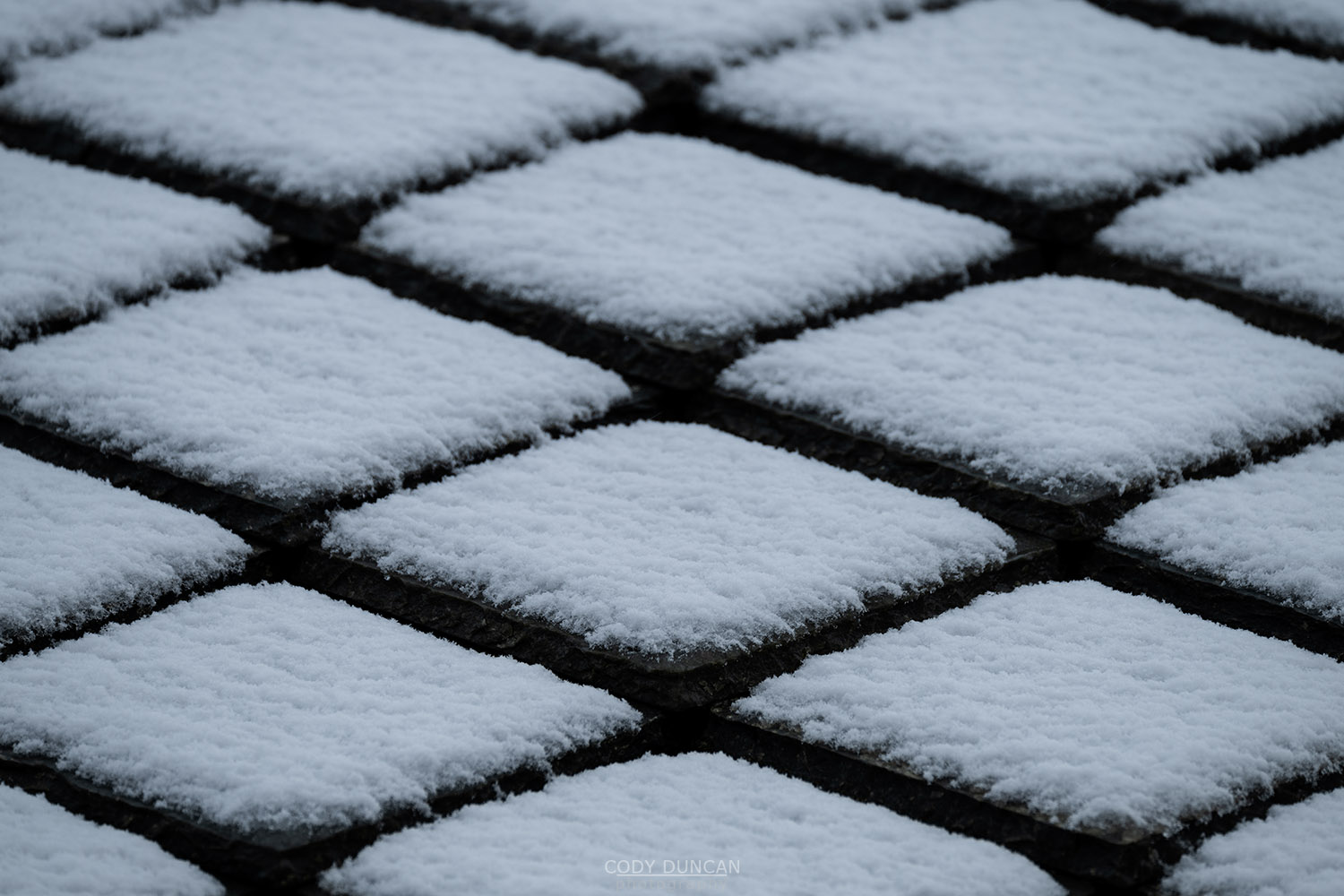
Gentle snow had been falling all morning, brining winter back to what had previously been a dry looking Lofoten. Walking out of my cabin mid-morning, I noticed the snow had created a nice abstract patter on the roof of the cabin opposite mine.
I first shot a wider angle version, but switched to a telephoto lens for a more detailed shot, which I like better – as there is too much visible in the wider shot. Its a bit more abstract than what I usually post here.
As the snow continued to fall, the gaps between the tiles became filled in and the roof was eventually entirely white, and uninteresting.
Camera Info: Nikon z8 Nikon 100-400mm f/4.5-5.6 290mm ISO 100 f 6.3 1/250 Second WB Daylight
https://www.68north.com/content/2024/03/friday-photo-588-roof-snow.jpg10001500Codyhttps://www.68north.com/content/2016/12/68north-logo-V4.pngCody2024-04-12 03:00:002024-03-29 08:31:40Friday Photo #588 – Snow On The Roof
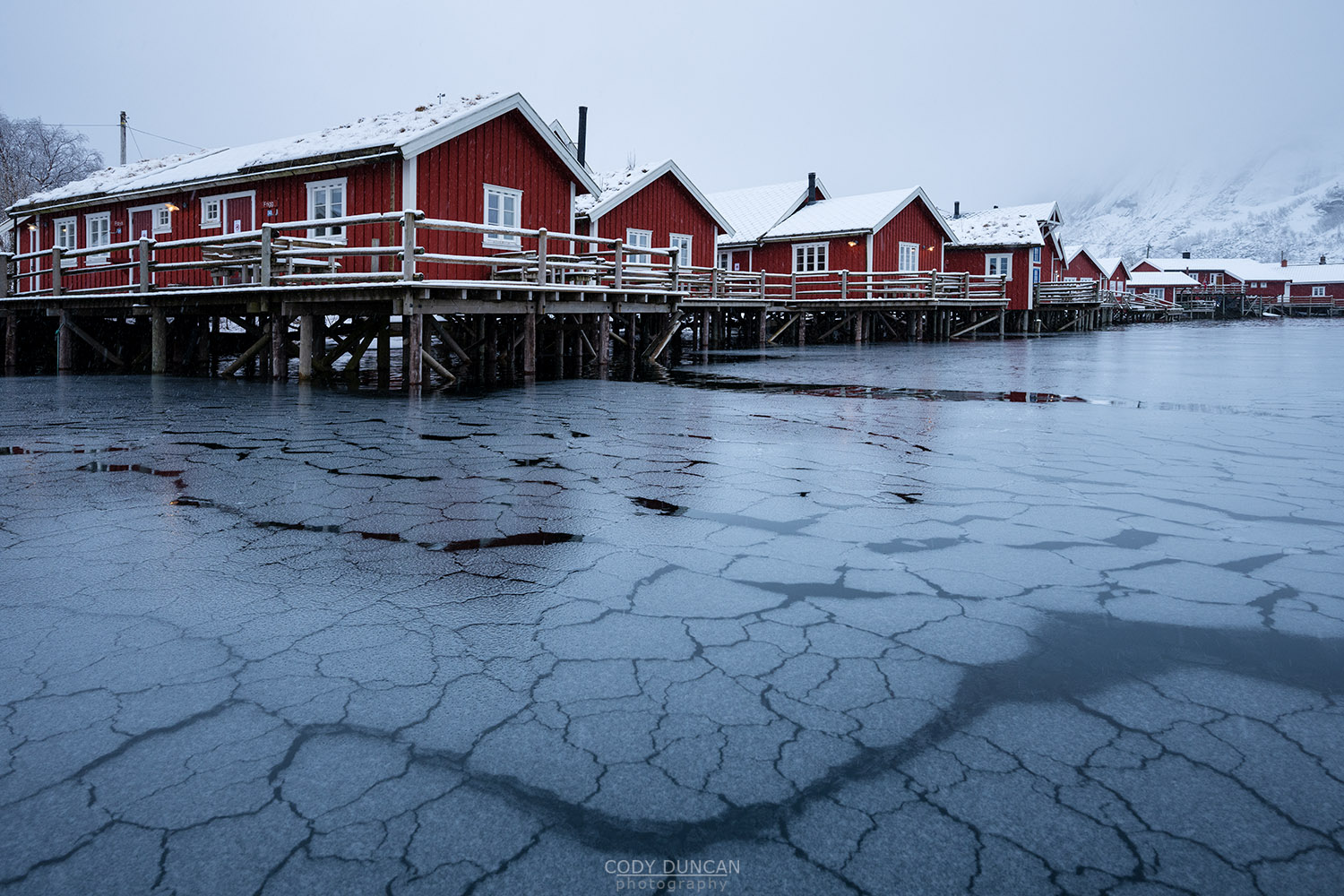
Photo: Snow patterns form on the sea outside Reine Rorbuer, Moskenesøy, Lofoten Islands, Norway. March 14, 2024. 15:05
In contrast to the deep cold of March 2023, March 2024 has been a largely mild and dry month. As of my writing, only two days this march will have had an average temperature below 0˚c, with most days a few degrees above. Compared to 2023 when March had an average temperate of -3.3˚c, these feel like two different seasons all together. And why it is so difficult to make any predictions about the weather in Lofoten.
During my second to last workshop of the winter, a spring-like looking Lofoten changed to a winter wonderland over the course of a single day of heavy snowfall and low winds. Here, later in the afternoon, the snow can been seen freezing on the top of the sea in Reine harbour, just outside our cabins at Reine Rorbuer. While earlier in the winter there were some days of the sea surface freezing itself in the low temperatures, that was not the case here, as the temperature was only around 0˚c and not enough for the sea to freeze. The patterns on the water here are from a combination of the heavy snow and still wind. More wind or less snow and this scene would not have existed.
And so while this was a bit of an indoor day for this group, the result on the following day was well worth it, as we headed out the door at 05:00 for sunrise on a summit to sea snow covered landscape, which had not existed on Lofoten for several weeks at this point. But that is how winter on Lofoten is these days, less predicable than ever, while one hopes for the best…
Camera Info: Nikon z8 Nikon 14-30mm f/4 20mm ISO 200 f 8 100 Second WB Daylight
https://www.68north.com/content/2024/03/friday-photo-585-snow-on-water.jpg10001500Codyhttps://www.68north.com/content/2016/12/68north-logo-V4.pngCody2024-03-22 02:00:002024-03-17 02:11:02Friday Photo #585 – Snow On The Water
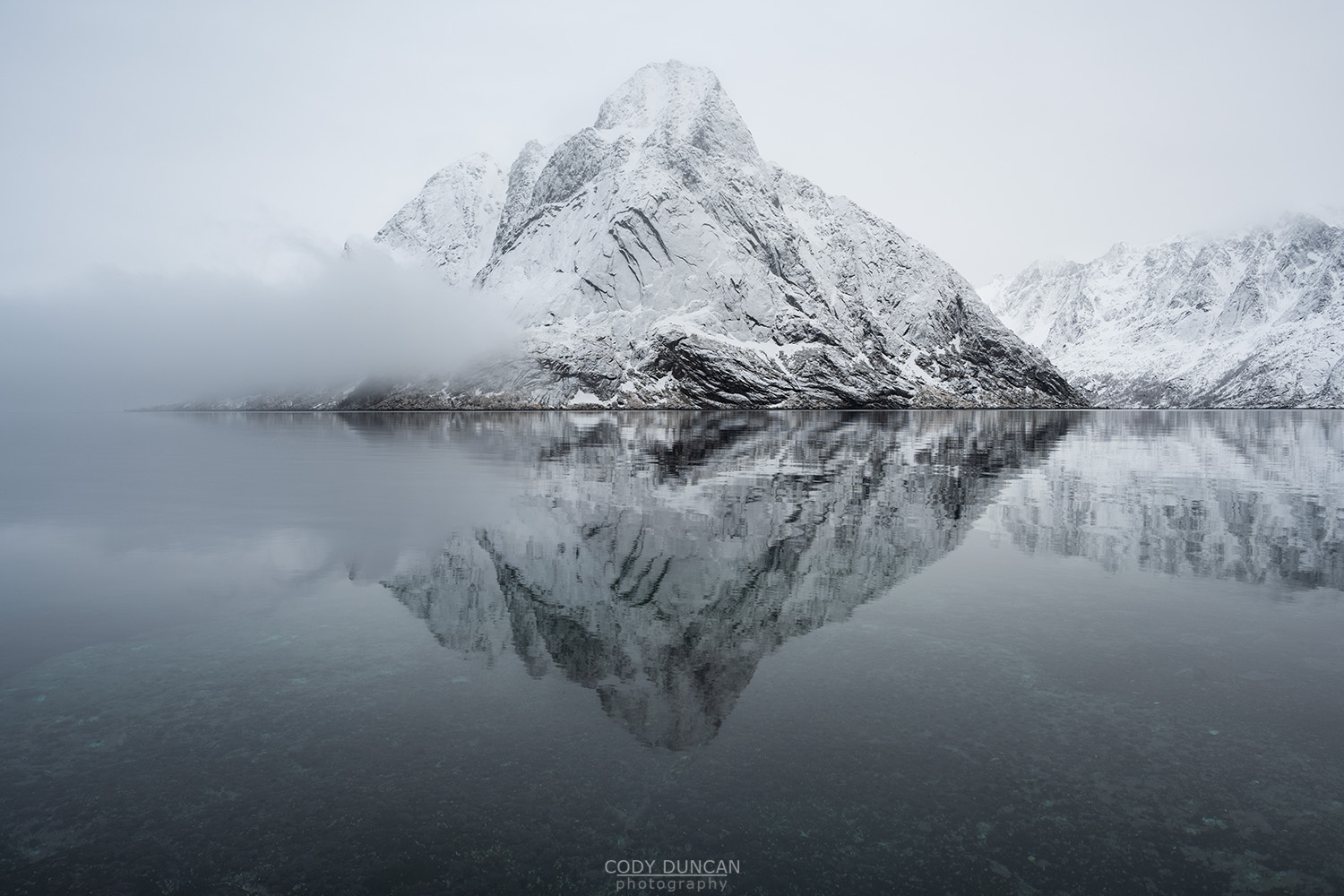
Photo: Olstind winter reflection in Reinefjord, Moskenesøy, Lofoten Islands, Norway. January 29, 2023. 12:35
I often write about how the winter landscape of Lofoten can often be almost black and white. This image of Olstind is a perfect example of that that. Even the water, which can potentially be quite colorful only has a hint of color, as it’s otherwise overly dominated by the reflection of the flat, grey sky. And I always think Olstind looks best with a fresh dusting over snow, so as the main rock face in the center of the mountain doesn’t become too dominant.
I probably should have taken more time when shooting and used a ND filter for a longer exposure of 30-60 seconds to soften up the low cloud on the left side of the image. In this photo, it feels slightly distracting to the otherwise almost perfect symmetry of the scene.
Camera Info: Nikon z7 II Nikon 24-120mm f/4 24mm ISO 100 f 8 1/30 Second WB Daylight
We may request cookies to be set on your device. We use cookies to let us know when you visit our websites, how you interact with us, to enrich your user experience, and to customize your relationship with our website.
Click on the different category headings to find out more. You can also change some of your preferences. Note that blocking some types of cookies may impact your experience on our websites and the services we are able to offer.
Essential Website Cookies
These cookies are strictly necessary to provide you with services available through our website and to use some of its features.
Because these cookies are strictly necessary to deliver the website, refusing them will have impact how our site functions. You always can block or delete cookies by changing your browser settings and force blocking all cookies on this website. But this will always prompt you to accept/refuse cookies when revisiting our site.
We fully respect if you want to refuse cookies but to avoid asking you again and again kindly allow us to store a cookie for that. You are free to opt out any time or opt in for other cookies to get a better experience. If you refuse cookies we will remove all set cookies in our domain.
We provide you with a list of stored cookies on your computer in our domain so you can check what we stored. Due to security reasons we are not able to show or modify cookies from other domains. You can check these in your browser security settings.
Google Analytics Cookies
These cookies collect information that is used either in aggregate form to help us understand how our website is being used or how effective our marketing campaigns are, or to help us customize our website and application for you in order to enhance your experience.
If you do not want that we track your visit to our site you can disable tracking in your browser here:
Other external services
We also use different external services like Google Webfonts, Google Maps, and external Video providers. Since these providers may collect personal data like your IP address we allow you to block them here. Please be aware that this might heavily reduce the functionality and appearance of our site. Changes will take effect once you reload the page.
Google Webfont Settings:
Google Map Settings:
Google reCaptcha Settings:
Vimeo and Youtube video embeds:
Other cookies
The following cookies are also needed - You can choose if you want to allow them: