Photo: Snow covered Stornappstind mountain peak rises over Nappstraumen, Lofoten Islands, Norway. November 27, 2024. 13:04

The temperature has slowly dropped over the last week in what otherwise has been a mild and wet November. In fact, every month since May this year has been above average in temperature after a hot summer and stormy autumn. Compared to November 2023 which was very cold, calm, and dry – 4.4˚c below average (-1.6˚c vs. normal 2.8˚c ), this November will follow October’s trend of above average precipitation and temperatures. It seems like the whole north Atlantic is quite grumpy this year as storm after storm sweeps over Lofoten and northern Norway. Hopefully this pattern breaks before my photo workshop season begins in January!

If you wanna checkout what the weather has been up to yourself, you can see the historic weather statistics on yr.no: Leknes Last 13 Months

I’ve written a lot about the weather lately, but that is because it’s one of the most important elements of any Lofoten trip. Sometimes you’ll get lucky and everything is nice and you don’t even need to think about the weather, but unfortunately, this is far from the majority of the time. So it’s generally a good idea to know a little bit about reading the weather up here – although this year, that might have been somewhat depressing if you’ve visited from late September until now.

I was actually going to post a different photo today, also from Wednesday, but a much more colorful image of what will likely have been my last sighting of the sun for the year. But it was really just a snapshot and nothing very interesting. That image was actually take from below the mountain you see here, looking south, towards the left side of the frame. In this image, just 20 minutes later and looking west, the landscape is dark and almost completely void of color. Colorful sunset vs. grey winter, just a few kilometres and minutes apart.

Camera Info:
Nikon Z8
Nikon 24-120mm f/4
62mm
ISO 100
f 8
1/13 Seconds
WB Daylight

Photo: November afternoon sunset from Ballstadheia, Vestvågøy, Lofoten Islands, Norway. November 25, 2022. 13:09

November is that middle ground between no longer autumn and still not winter. Although as far as the sun is concerned, the daylight hours are similar to January and early February. So if you’re heading to the mountain for a sunset hike like I was on this afternoon up on Ballstadheia – you probably need to start hiking before lunch! Quite a difference from my after dinner hikes of summer, which was not that long ago.

In the last couple Friday photo posts, I’ve showed images of 2023’s cold November, with a -1.6˚c average temperature, was the coldest month of the whole winter – 28 out of 30 days dropped below 0˚c. November 2022, when this photo was taken, was quite a bit milder, having an average of 3.8˚c and only dropping below 0˚c on 12 days.

What both 2023 and 2022 have in common is that they were both relatively dry, with less that 50% of average rainfall for the month. Now compare this with November 2021 in which there was above average rainfall and precipitation on 29 out of 30 days – I remember it as a grey and misty month when I was struggling to get some final images for my Northern Light ebook. I would have much preferred the weather of 2022 or 2023!

So where am I going with all this? Nowhere really. Just an example of how there’s no predicting much of anything outside of general trends when it comes to Lofoten’s weather.

Camera Info:
Nikon Z7 II
Nikon 14-30mm f/4
20mm
ISO 100
f 14
1/25 Second
WB Daylight

Photo: The morning’s high tide line washed into the snow covered sand of Vik beach, Vestvågøy, Lofoten Islands, Norway. November 20, 2023. 09:23

Not every year is it possible to photograph snow covered beaches already in November. If I was just shown this image and asked to guess when it was taken, my first guess would be January or February, followed by March. November wouldn’t be in my top three guesses, but here it is.

I already wrote a bit of an overview last week (Friday Photo #617) about November 2023 being colder than average, and in fact, the coldest month of the whole winter. This day, November 20th, was a particularly chilly day at -3.8˚c. Lucky for me, the cold temperature actually made this image possible, as the beach remained frozen enough that even a light dusting of snow was able to remain. Had it been closer to even 0˚c, then it is more likely the snow would have melted away before my arrival.

I would have rather photographed the scene closer to high tide, but with sunrise around 10:00 in late November, the timing wouldn’t work. And the snow was nice enough anyhow!

Camera Info:
Nikon Z8
Sigma 14mm f/1.8
14mm
ISO 2000
f 2
1.6 Seconds
WB Daylight

Photo: November deep freeze over mountains of Vestvågøy, Lofoten Islands, Norway. November 10, 2023. 08:51

It was a frozen morning with temperatures dropping to -5.8˚c in which I caught the morning light over Ristind and Himmeltindan mountains rising over the frosty landscape. I had actually camped somewhere further east on my way back from Evenes airport after a photo workshop in Scotland, arriving to my van frozen like a block of ice in the cold darkness. This time I at least remembered to put my window scraper in the van, and even then, quite of bit of effort was required before I could drive.

Usually November is a bit more mild with maybe a short cold snap or two bringing a bit of snow. November 2023 was not that! With a -1.6˚c average temperature, it the coldest month of the whole winter. 28 out of 30 days dropped below 0˚c at some point and 21 days had a below 0˚c average temperature. It was cold!

The cold also brought many clear and calm days, and only 40% of average rainfall for the month. Visually it was probably the best ‘winter’ month of the entire winter. If every November was like this, I would schedule 1/2 my photo workshops then. Unfortunately, there is no way to know and it is just as likely, if not more to end up with November 2021 weather, where it rained/snowed 29 out of 30 days.

What will this year be like? I don’t know. But coming off a windy and wet October, I suspect the stormy weather will be quite frequent. Though maybe I’ll be pleasantly surprised by clear and calm days and nice full of dancing aurora. We will see…

Camera Info:
Nikon Z8
Nikon 24-120mm f/4
98mm
ISO 100
f 6.3
1/80 Second
WB Daylight

Photo: Surfer in wave at Unstad beach, Vestvågøy, Lofoten Islands, Norway. October 4, 2022. 17:19

The autumn storms bring nice swells to Unstad each year, which combined with the still mild water temperatures and autumn holidays make it a popular time for surfing. This day with one of my autumn photo workshops a nice clean slightly overhead swell was rolling into the bay. Though I don’t surf too much these days – hard to find the time! I still enjoy shooting surfing when I get the chance. And it’s usually a unique experience for workshop clients who often don’t associate the arctic and surfing.

As the afternoon light began to fade I decided to change things up a bit. Instead of continuing to increase my ISO to keep a fast enough shutter speed for the surfers to remain sharp, I did the opposite. Putting my ISO down to 31 and stopping the lens down to f22 – which unfortunately made every dust spot on my dirty camera sensor visible – I should have put on a 3 stop ND filter instead – I was able to get an exposure around 1/2 a second.

Tracking the waves and finding the correct movement and shutter speed is relatively straightforward enough. Adding a surfer onto the wave who then moves within a 3 dimensional space makes things a little more tricky. Ideally the surfer should move as closely with the wave as possible, without too much up or down motion, which then turns them into a mushy blur.

Once finding roughly the right settings its mostly down to a bit of luck to for everything to come together, which I think it mostly did with this image.

Camera Info:
Nikon Z7 II
Nikon 100-400mm f/4.5-5.6
300mm
ISO 31
f 22
0.3 Second
WB Daylight

Photo: Autumn mountain birch trees in sunlight as rain conceals mountains, Haugheia, Vestvågøy, Lofoten Islands, Norway. October 4, 2023. 13:59

More so than another time of year, autumn is the season of light and shadow. Or maybe light and rain. Or 4-seaons in one day – well, more like 3-seaons, as summer isn’t likely to show up. Some days it can be 3-seasons every 20 minutes where once you see the light on the landscape, it will be gone by the time you arrive. Or, you arrive in the last moments of sunlight before being greeted by showers of rain, such as the above photo, taken on a blustery autumn day on Haugheia.

The small grove of twisted birch trees on Haugheia is one of my favourite local areas at this time of year. Not in the sense of classical grand landscapes, but more looking for brief moments or details in the passing of time. Often, I just stand around observing, and never take a photo, while other days I wander around in circles with my camera as the light changes on the small hilltop. It is a place of subtleness and thought, which for me, is needed more and more in this busy world, or, perhaps I’m just getting old.

Camera Info:
Nikon Z8
Nikon 24-120mm f/4
120mm
ISO 100
f 8
1/250 Second
WB Daylight

Photo: Mountains of Vestvågøy rise from a shimmering night sea, Lofoten Islands, Norway. June 4, 2021. 01:57

Two weeks into the midnight sun season and Lofoten is bathed in 24 hour sunlight. And the days only get bright over the following two weeks until the summer solstice on June 20th. By now I will be almost completely ‘nocturnal’ as I stay up late into the morning hours with the sun drifting over the sea to the north. This view is from my house on one of those late mornings. How can I ever sleep?

I like the northern lights well enough, but rarely will I stay up past midnight exclusively for them. And the same goes for any other light on Lofoten – except for the midnight sun season. For me, the midnight sun is the highlight of the year living on Lofoten. Without it, I couldn’t live here.

Photographically, the midnight sun is rarely the best light. But it is the best time simply to be here and experience the slowness, if not stopping, of time for a few short, but precious weeks.

Camera Info:
Nikon Z7 II
Nikon 24-200mm f/4-6.3
200mm
ISO 320
f 6.3
1/640 Second
WB Daylight

Photo: May sunset over Skrådalstinden, Vestvågøy, Lofoten Islands, Norway. May 20, 2021. 23:33

With June and the summer hiking season just around the corner, the early season can still present significant amounts of snow in the inland mountain areas. So if you are looking for snow free routes, it is important to choose more coastal facing mountains early in the season.

Also note: Late spring and early summer is a time of increased rockfall. It is best to avoid hikes below steep terrain and stick to ridges and other open areas.

In this photo, on what turned out to be a fantastic sunset which I kind of wasted up on a mountain without any ability to change location, you can see the snowfields on the southeast face of Skrådalsdinen (770m), taken from Eltoftuva (361m). Most of the other inland mountains across Lofoten will look similar as well, especially the further east you go.

While there are still dozens and dozens of mountains accessible for snow-free hiking across Lofoten in the early season, you should be prepared for snow and ice across any inland or higher terrain. Which, if you are not planning or equipped for snow, will likely make many of Lofoten’s higher elevation peaks inaccessible until later in the year.

And watch out for falling rocks!

Camera Info:
Nikon D850
Nikon 70-200mm f/4
200mm
ISO 100
f 6.3
1/80 Second
WB Daylight

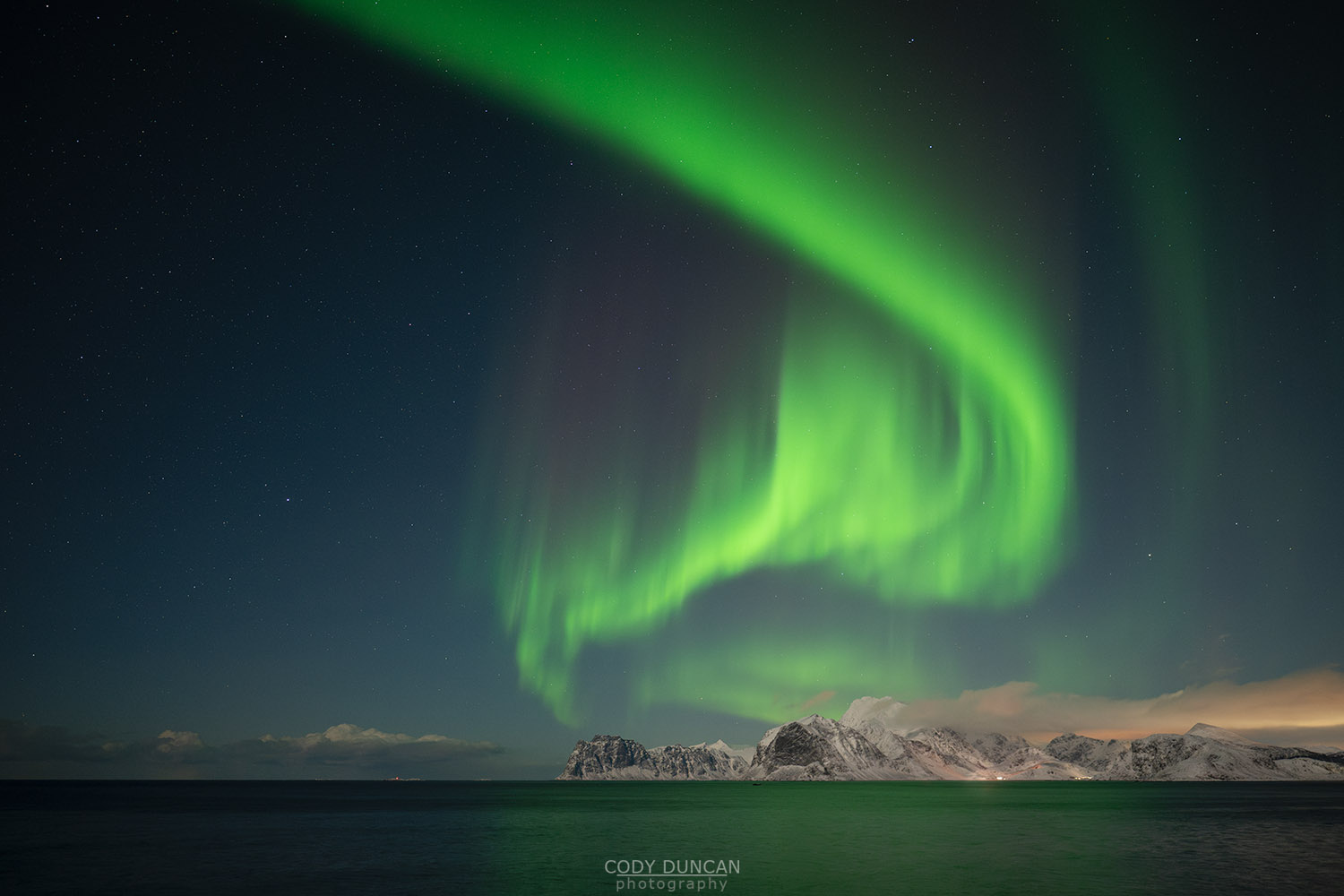
Photo: Northern Lights swirl in the sky over Himmeltindan, Vestvågøy, Lofoten Islands, Norway. January 19, 2024. 23:38

The nights are now no longer fully dark on Lofoten, and that means the northern lights season has come to an end. But don’t worry, it will be back soon as the next season begins already in late August, only 4 months away.

For Lofoten, the northern lights season is roughly: August 20 – April 20

Last year, the season started early for me and my first aurora sighting was in the early morning hours of August 19 while on Værøy. This was the earliest in the year I’ve seen northern lights on Lofoten.

Overall, I spent much of the autumn and winter traveling down south in Germany, Scotland, and Spain. So I was gone for most of the first half of aurora season here on Lofoten, and I know I missed some good nights! Luckily I was also around for some good nights, the best two being December 1 and March 3 while guiding on Senja.

It was also a difficult winter at times, with lots of cloudy weather over Lofoten, and, despite all the media hype about the approaching solar maximum, a largely quiet sun for much of January and February. So even when the clouds parted, there was not always something to see.

This image, from January 19, was one of three nights of clear sky and moderately active northern lights. I was mostly focused on getting the 5th edition of Seasons on Lofoten – Winter eBook out before the start of the winter photography season, so I didn’t travel from home. But luckily I don’t have to go too far for a decent image light this one.

Camera Info:
Nikon Z8
Nikon 20mm f/1.8
20mm
ISO 200
f 2
2.5 Seconds
WB Daylight

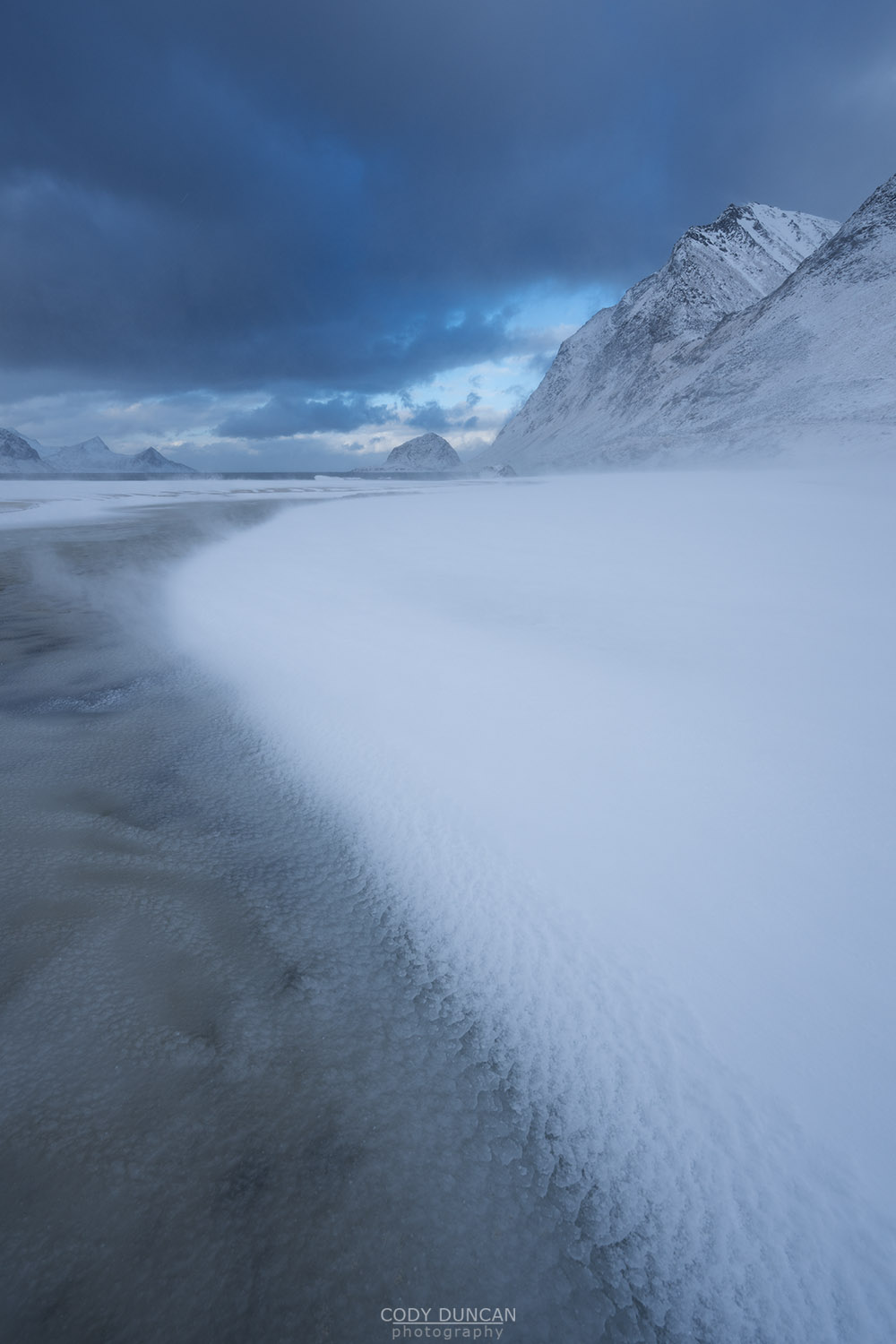
Photo: Snow blows across Haukland beach, Vestvågøy, Lofoten Islands, Norway. March 24, 2024. 08:59

There is somewhat of a joke about Lofoten actually having 12 seasons during the year, instead of 4. And you can probably guess already, that most of the additional seasons are due to the long winters, and our optimistic hope that a nice and calm sunny day might mean winter is finally over. But nope, it isn’t over…

The 12 seasons of Lofoten are:
Winter
Fool’s Spring
Second Winter
Spring of Deception
Third Winter
Allergy Season
Real Spring
Summer-ish
Actual Summer
False Autumn
Second Summer
Actual Autumn

Today’s photo of a snowy Haukland beach at the end of March is when Second winter made a return. Just a few days earlier the landscape of Lofoten looked hopeless and dry, and largely barren of snow. On the calmer, sunny days it was even enough to walk around in a sweatshirt most of the time. Fool’s spring.

Now the temperatures have dropped and the coldest day of the last month was -9.5˚c on March 28. Good news for all the ski tourists here for the long Easter holiday week. Bad news for everyone else that is waiting for the first signs of green and the long days of summer.

Now with the long days of April, Winter is long from over here on Lofoten, and the snow will likely continue to fall for the next weeks and into May. Eventually the snow will stop falling and we’ll have Spring here in the north, yet never quite sure if another Winter is waiting around the corner.

Camera Info:
Nikon z8
Nikon 14-30mm f/4
16mm
ISO 200
f 8
1/200 Second
WB Daylight