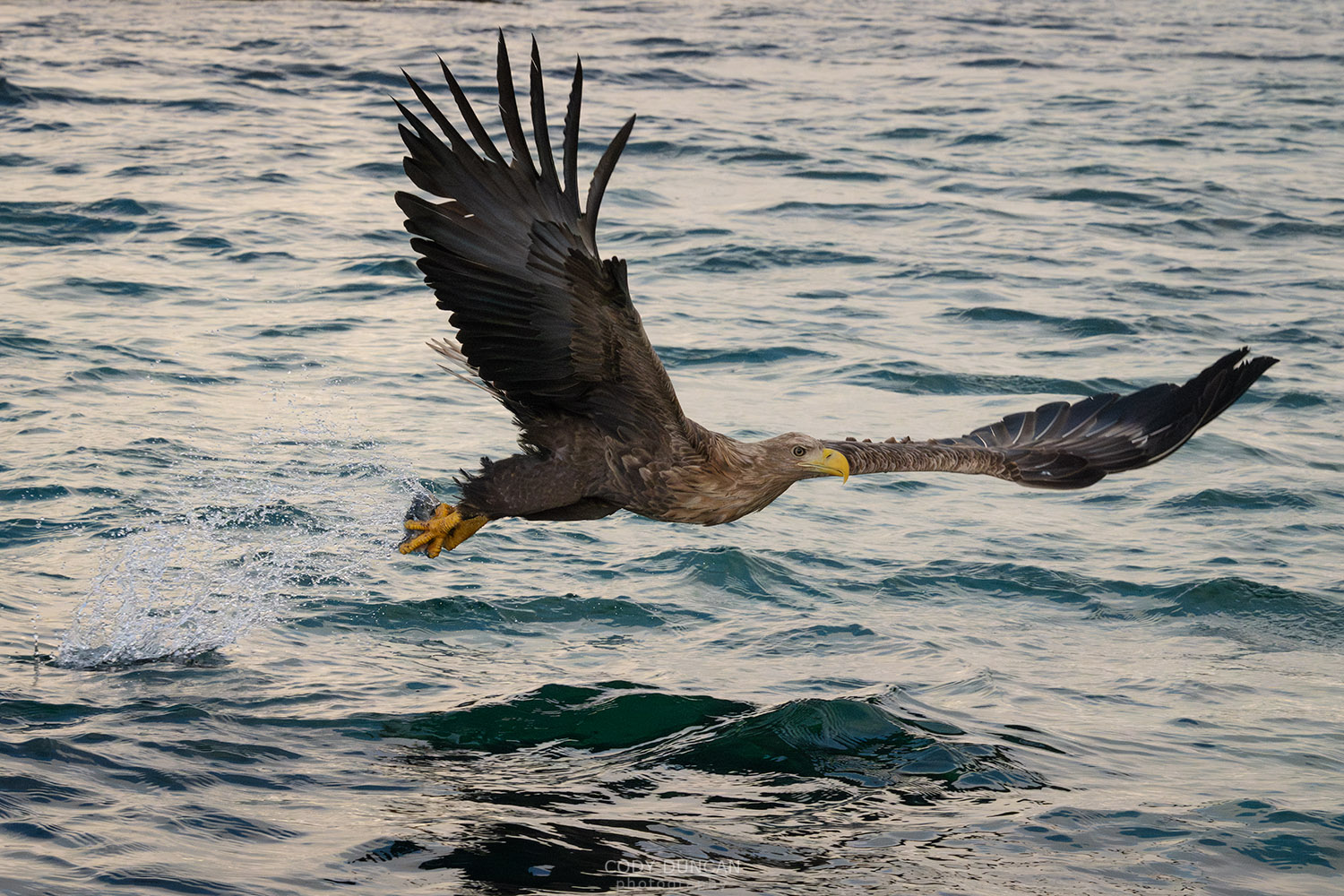
Photo: White-Tail Sea Eagle picks up fish from fjord, Lofoten Islands, Norway. February 5, 2025. 13:33

In some of my recent photo workshops we are beginning to introduce more activities than just landscape and northern lights photography. The sea eagle safaris out of Svolvær are one of those activities. And as I still consider myself a beginner wildlife photographer, this is probably as much fun for me as for the clients. And much better than standing around on the Hamnøy bridge at sunrise for the XXth time over the previous two months.

And when I say I’m a beginner, look below at my camera info to see that I made some big mistakes with this image. f/18, ouch!!! I could actually see over the sequence of images where my operate got stopped down. The combination of a small rib boat with relatively tight quarters, stormy weather, thick gloves, etc, probably all lead me to accidentally moving the aperture wheel. And in the excitement, it was sometime until I finally noticed and opened the aperature back up to where it should be for a dark winter day on Lofoten. But I used up the best light while still at f/18. Lesson learned for next year.

Luckily though, the denoise option with Adobe camera raw works wonders these days. So even this ISO 12,800 image turned out pretty decent in the end. Leaving me not too depressed with my mistake…

*For transparency, the boat drivers throw fish to the eagles, so this is not a fully wild image.

Camera Info:
Nikon Z8
Nikon 100-400 f/4.5-5.6
165mm
ISO 12800
f18
1/2000 Second
WB Daylight
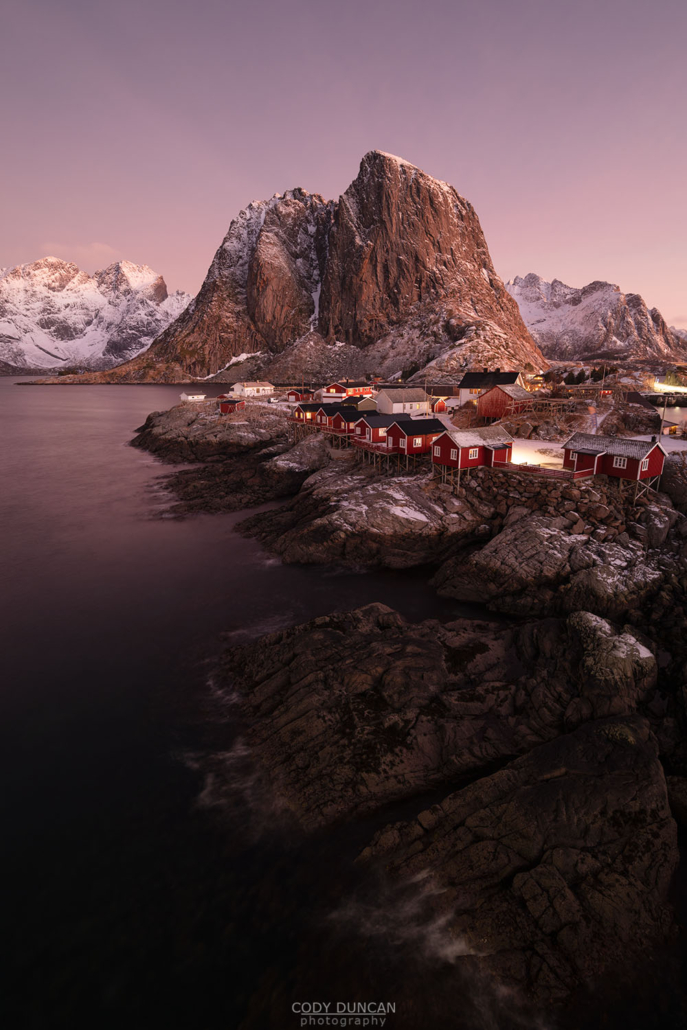
Photo: Glowing winter dawn over Hamnøy, Lofoten Islands, Norway. February 2, 2025. 07:54

This was one of those winter mornings on Lofoten where it feels like the sky is glowing from within itself. Even a photo doesn’t do justice to the light as you really need to be there, surrounded by it all – the same way no photo can ever show the experience of a dancing northern lights. I rarely photograph from the Hamnøy bridge these days, but on this morning I wanted to remember a bit of the atmosphere from the light.

Otherwise… While there are many places across Lofoten in which calm conditions are usually preferred, such as the other nearby location of Reinehalsen. For Hamnøy, I actually prefer a little more stormy and wild conditions, particularly for the sea and the rocks in the foreground. And even more so when it is low tide, such as this image.

The light on this morning was fantastic, and if you only have the option to visit Lofoten for a week, I would consider this a pretty decent image from Hamnøy. But for myself, I know the foreground, with that just overly large rock, not contributing much to the composition, could have been much better. I’m sure I’ll stand in this exact same spot for many hours over the coming months, so I won’t have lack of opportunities for this Lofoten classic…

Camera Info:
Nikon Z8
Nikon 14-30mm f/4
16mm
ISO 100
f6.3
15 Seconds
WB Daylight

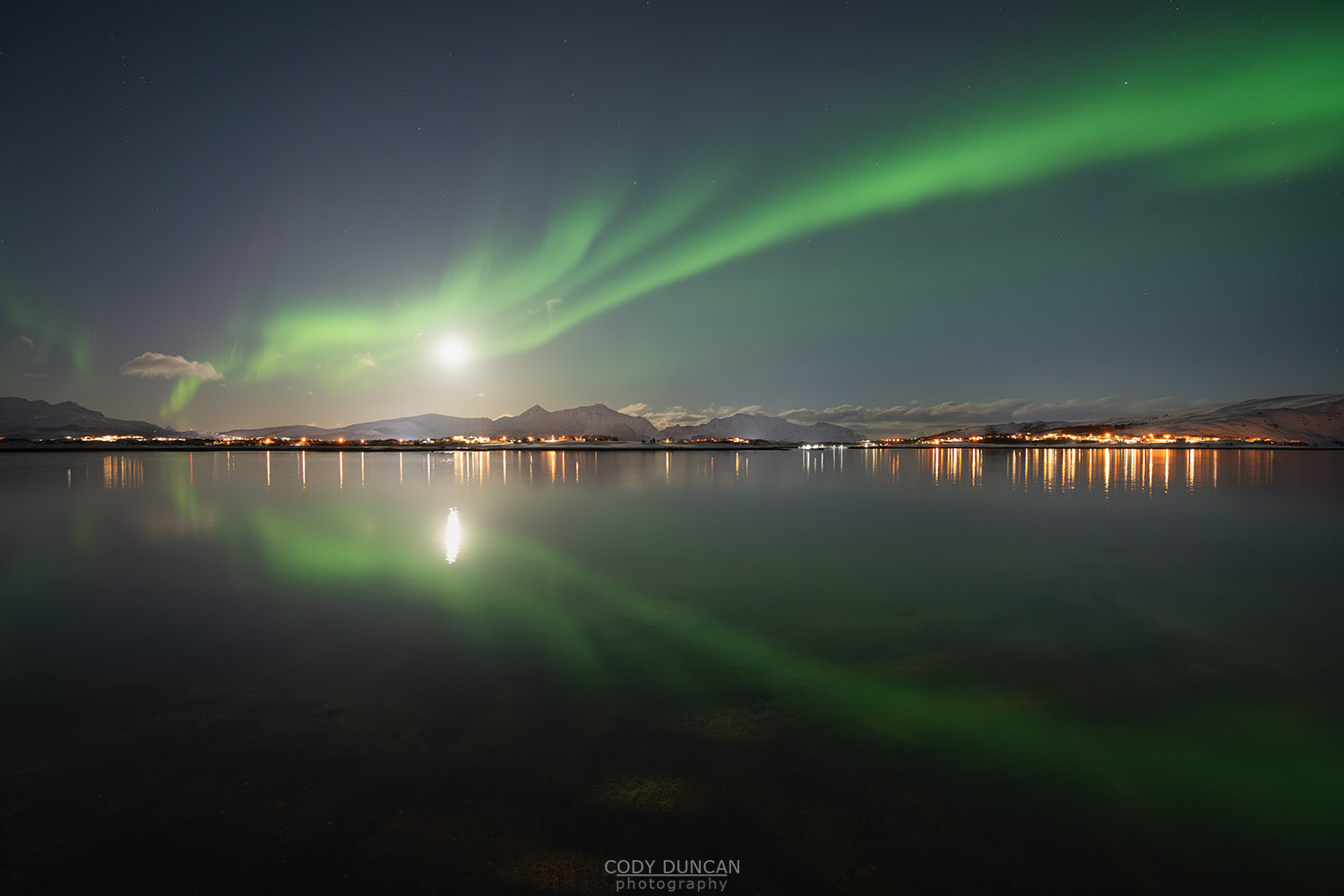
Photo: Northern lights – Aurora Borealis illuminate the sky before a full moon, Skreda, Vestvågøy, Lofoten Islands, Norway. February 14, 2025. 21:04

By now Lofoten’s northern lights season is almost half way over for the year: roughly August 20 – April 20. The bulk of my images will be be shot during my winter photo workshop season from late January to late March. On this evening, my group and already had a few hours of somewhat faint, but colourful aurora at Vik beach, just over the hill from our accommodation at Skreda. It was a cold night afternoon an already long day, so it was an early evening to be back to the cabins by 21:00.

Walking out onto the balcony of my cabin, there was still a nice green arch of aurora shining across the southern sky. The sea was calm and I actually liked the addition of the lights shining on the distant shore. And the nearly full moon added a little depth to the scene. Not the usual snowy mountains or beaches of my typical northern lights photos from Lofoten, but I like this image in a bit more of an abstract way – even more so as I was only 10 meter from my bed.

I still read online quite often the misinformation about not being able to see the northern lights with a full moon. This is absolutely false, as you can see here in this image. Yes, a full moon will reduce the visibility of a very faint aurora that you can already barely see with your eyes. But for any aurora worth photographing at least, the moon doesn’t make too much of a difference, and in fact, often aids in the overall image quality by illuminating the landscape and allowing for lower ISO and shutter speeds.

My main dislike of a full moon comes not from its direct interference with the visibility of the northern lights themselves, but more of what to do with it as a compositional element. In this image, I think the mood adds to the overall scene. But sometimes, the moon just doesn’t fit with where the aurora are in the sky and it’s in some awkward part of your preferred composition. Or, with the moon high overhead, it can cast your own shadow onto the foreground of the scene, leaving you struggling to find a foreground to the image. These are mostly critiques about composition, and not the full moon interfering with the visibility of the northern lights themselves.

Camera Info:
Nikon Z8
Nikon 14-30mm f/4
16mm
ISO 2000
f4
3 Seconds
WB Daylight

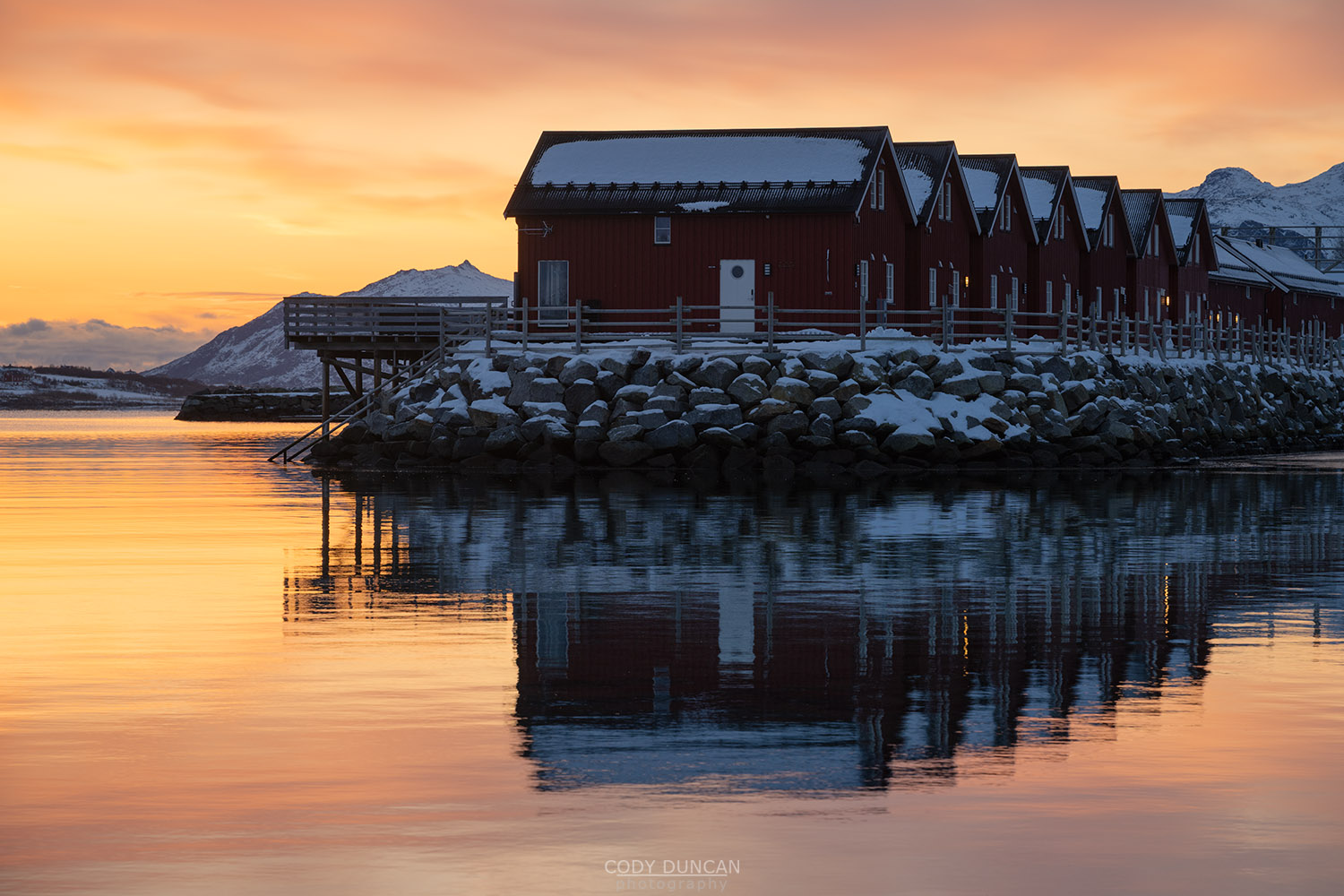
Photo: December Rorbu sunset, Vestvågøy, Lofoten Islands, Norway. December 1, 2023. 13:08

As Lofoten waits for the arrival of winter’s polar night, the little remaining sunlight may often glow bright on the southern horizon. But what looks like a nice colourful sunset in the above image, was only a small portion of the overall scene.

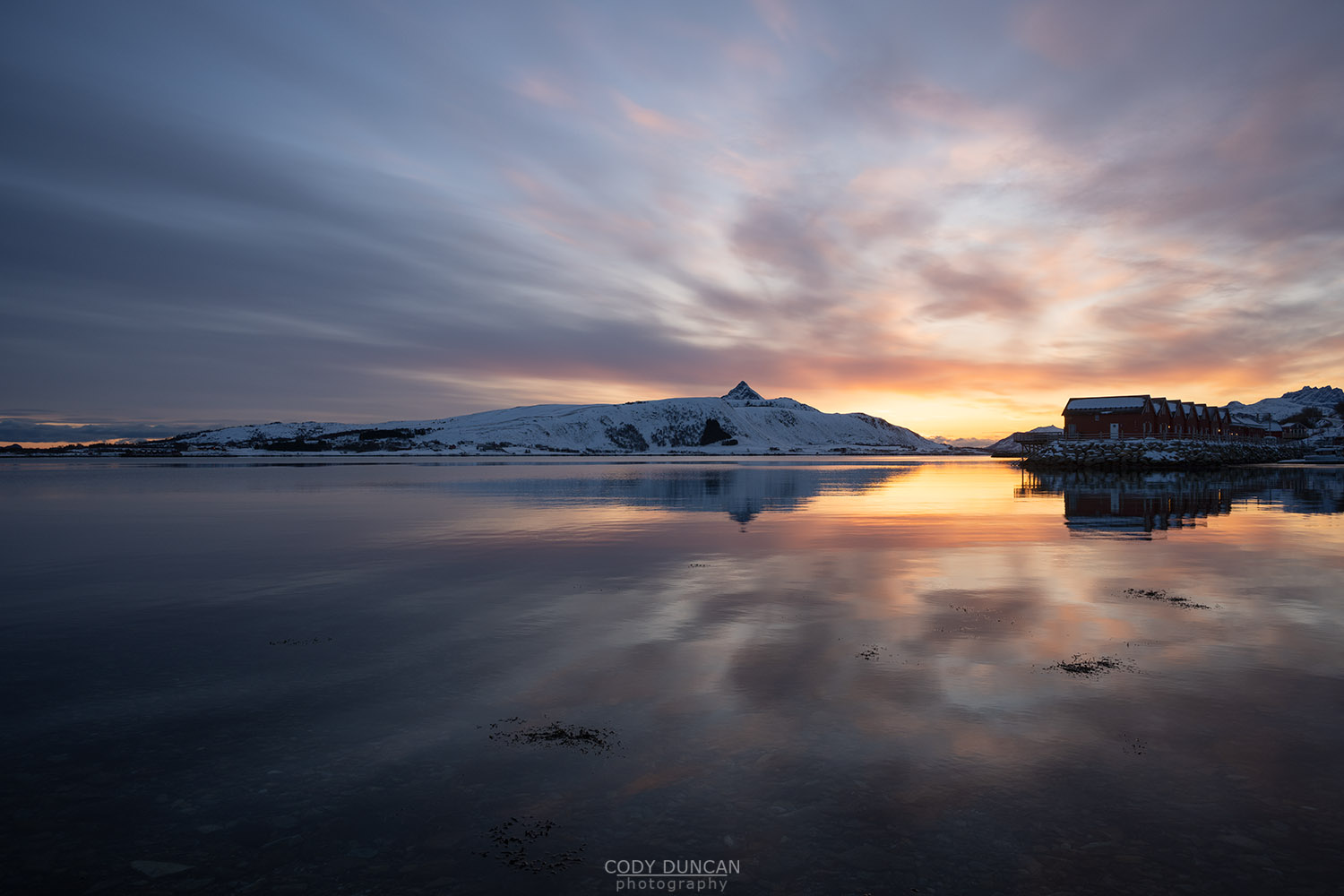
The following image is the overall scene I was presented with the moment I took the above image. It was a nice and calm December afternoon, but already by 13:00 the light of the day was beginning to fade. Standing in the same position and simply zooming in to 120mm provided an entirely different appearance and atmosphere to the moment.

So is one image more realistic than the other, both taken from the same location only 30 seconds apart. Was it a bright colourful sunset over snow covered cabins? Or was it just a glowing horizon surrounded by a world of blues and greys? Or perhaps both at the same time?

Camera Info:
Nikon Z8
Nikon 24-120mm f/4
120mm
ISO 100
f10
1/30 Second
WB Daylight

Camera Info:
Nikon Z8
Nikon 24-120mm f/4
24mm
ISO 100
f10
1/30 Second
WB Daylight

Photo: Car quickly breaks as moose crosses E10 at Storeide west of Leknes, Vestvågøy, Lofoten Islands, Norway. February 17, 2025. 9:21

With the whole of Lofoten covered in a nice layer of winter snow, while I myself am stuck at home fighting off a cold instead of perhaps my first ski trip of the season, its time for my annual winter driving post.

Winter Driving on Lofoten

Already, the local newspaper, Lofotposten, has been full of ‘bil i grofta,’ ‘car in a ditch’ articles since the roads got icy last week. And with moderate to heavy snowfall over the last days, the pace of the articles has increased to multiple incidents per day. Yesterday, there was even a headline out of a Tromsø newspaper: (tow truck driver) Pulled the same Chinese couple out of the ditch 7 times in one week. If you are renting a car on Lofoten this winter, I highly suggest getting the full insurance packages, as it is getting very dangerous on the roads these days with drivers who should be nowhere near a car in winter.

The main winter driving hazards on Lofoten these days will be:

Your own driving abilities – Especially if you are new to driving in snow.

Other tourists – Anything from inexperienced drivers driving in the middle/left side of the road (very common), turning the completely wrong way on roads/roundabouts, randomly stopping in the middle of the road, driving on sidewalks, and basically anything else you can imagine. Learn how to recognise other rental cars, as they will be one of your biggest hazards while driving on Lofoten.

Weather – There will be days where you NEED to stay in your rorbu or hotel. Do not put yourself or others at risk, not to see anything but blowing snow anyhow.

Wildlife – Moose are common in the mid and eastern areas of Lofoten, and even more so into Vesterålen and Ofoten. numerous moose vs. car crashes happen every winter. Avoid driving at night when possible.

In this week’s photo I was on my way to drop-off clients at the airport in Leknes when I spotted a family of moose on the side of the road up ahead. Luckily I was right next to the large pullout at Storeide and so I had a safe place to stop – Never stop in the middle of the road! I rushed to put on my telephoto lens as fast as I could before hopefully trying to walk somewhere for a better angle. But before I even got the door to my van shut I could see the large bull moose heading up towards the road, right into traffic. And so I shot a series of images the best I could from my distance. The best composition was unfortunately blocked by a passing car heading towards me. At least this was a decent image to talk about winter driving on Lofoten in this week’s article.

Camera Info:
Nikon Z8
Nikon 100-400 f/4.5-5.6
400mm
ISO 1250
f5.6
1/1600 Second
WB Daylight

Photo: Mountains of the ‘Lofoten Wall’ rise from the sea while traveling on the Bodø – Moskenes ferry, April 24, 2025. 19:52

20 hours after I should have originally been home from a short trip to Scotland, Lofoten’s mountain wall was finally growing larger as the ferry approached Moskenes harbor. The pervious day I had not planned to be on the ferry as I flew into Evenes airport where my van was parked. Unfortunately though, I large rockfall across the E10 just west of the intersection to Henningsvær meant I could not make the 4 hour drive from the airport and would instead need to make a long detour via Bodø.

I generally don’t like to fly from Evenes during winter and the weather is too unreliable and the driving conditions often difficult. Last year after dropping off clients I made it past a stuck semi-truck only minutes before what resulted in an 6 hour road closure in blizzard like conditions. Long winter journeys in northern Norway always bring a bit of uncertainty if they will go as planned. And this week, despite the weather almost being spring-like, things did not go to plan.

Rock slides of such, while rare, do happen every couple years here on Lofoten. As I was sitting in Oslo I still wasn’t sure what my plan would be. Normally I would have had some camping gear in my van and could just wait things out for a day or two by making a short road trip to Vesterålen or somewhere else. But unfortunately for me, I had been lazy after a long winter guiding season, and had not converted my van back to road-trip mode. Stupid mistake.

As they were uncertain with the actual opening dates for the road, but said it would likely be today at the earliest, I decided the best plan of action would be to stay at the airport hotel in Evenes and then make the 6 hour journey to Bodø in the morning. Snow showers were in the weather forecast, though the roads remained mostly snow free for the long and winding drive and so I made pretty good time to Bodø – with enough spare time for a quick stop at Bilthema. Once on the ferry I could tell I was not the only one making the long detour around the road closure – and the waiting line in Moskenes at arrival also looked overly full for a random day in late April.

Once on the ferry it was announced that the road would open at 21:30 that evening, so I could have driven back directly and just sat some hours in Svolvær had I know this. But I didn’t. And for people leaving Lofoten, there is only one ferry per day while on the winter schedule, so you had to commit to the ferry already before the info got out about the opening of the road.

And my 4 hour drive turned into a 21 hour detour through northern Nordland and a calm sailing across the Vestfjorden – which I seem to be doing a lot in recent years as I spend more time down along the Helgeland coast and Islands.

Snow showers were passing intermittently and I was hoping that the ferry’s arrival on Lofoten would be timed with some backlit snow from the evening sun. But the snow showers were too far to the east or had already passed before arrival, so I was presented with the south faces of the mountains in shadows and the sun shining from overhead. I should have switched to longer telephoto lens and focused in a bit more on the backlit blowing snow on the ridges. And even this image is somewhat cropped to remove the sun out of the top of the frame, but I still feel there is too much water in the foreground which doesn’t add much to the scene.

Camera Info:
Nikon Z8
Nikon 24-120mm f/4
120mm
ISO 100
f 8
1/3200 Second
WB Daylight

Photo: Bluehour reflection of Stornappstind with dusting of snow, Vestvågøy, Lofoten Islands, Norway. February 28, 2025. 06:37

For many weeks this winter even just a dusting of snow mid-way down the mountains like this morning was a welcoming sight. The temperatures for the entire week prior to this morning had been averaging over 6˚C and this was the first time in 8 days to fall below 0˚C again.

It takes close inspection of the image to know it was taken in winter, as it looks more like a typical autumn dusting of snow or maybe something from late spring. If you look closely, you can see some small patches of snow here and there on the mountain as well as some remaining snow in the gullies on the right of the image. These are small signs that more snow had previously been present but that almost everything else had melted away at some point. It has not been a good year for us skiers who live in the western half of Lofoten.

And while the image doesn’t look very wintry to me, I actually do like the look of the image overall and think the snow line helps add a little depth to the scene. Luckily, this was also a rare morning of still wind, so the reflections in these small tidal pools near Gravdal worked out quite nice in my opinion. Perhaps some areas are a bit dark and heavy – it was low tide – but I think it works as a nice framing of the mountain as it rises into the deep blue of the early morning sky.

Camera Info:
Nikon Z8
Nikon 24-120mm f/4
48mm
ISO 100
f 7.1
6 Seconds
WB Daylight

Photo: Setting winter sun behind misty waves at Unstad beach, Vestvågøy, Lofoten Islands, Norway. February 25, 2025. 16:47

One benefit to this year’s windy and stormy winter is that the sea is anything but boring! Unstad in particular is always better photographically when large swells are rolling into the bay and I always try to take my groups there in such conditions.

This day was quite a stormy one, with the strong offshore wind blowing mist off the tops of the waves as they broke across the bay. At first I was just shooting the waves themselves with a telephoto lens from up near the parking lot. But as the setting sun emerged from behind the mountain Helligberget (the Holy Mountain), I headed down the the shoreline to see if I could come up with something different.

And while I love this conditions, it is also quite hard to capture the sense of being there amongst all the chaos into a single, still image. The wind, the mist and spay, the rumble of the waves, the smell of the ocean, the approaching storm, the surrounding mountains – there is a lot so see! For me, I was manly looking at the atmosphere of the mist blowing into the air and the atmosphere this created with the sun setting in the background.

Unfortunately though, the angle needed to get the mist blowing into the sky meant getting down by the beach where visibility of the larger waves breaking further out in the bay was lost. Overall I like the feeling of this image, but it does fail to capture much of the drama and the size of the waves on this day.

Camera Info:
Nikon Z8
Nikon 24-120mm f/4
97mm
ISO 100
f 8
1/50 Second
WB Daylight

Photo: Northern lights dance over Storsandnes beach, Flakstadøy, Lofoten Islands, Norway. March 6, 2025. 20:46

Like every year, the ever shortening nights of April mean Lofoten’s northern lights season is quickly coming to an end. This season has been a good one. Especially so for my photo workshop clients, which, despite some challenging weather, each group had at least 2 nights of aurora, and some 3-4 nights. And not just nights of a bit of green between some clouds, but nights of dancing light across the sky.

This image was taken on the last night with my fourth group of the winter. It was raining and heavily clouded as we showed up to the beach after dinner. But as the forecast said, the clouds began clearing after 20:00 and soon enough the sky was dancing with light! This particular moment was so bright that I only needed a 1 second exposure.

Not a bad way to finish an otherwise stormy week on Lofoten.

Camera Info:
Nikon Z8
Viltrox 16mm f/1.8
16mm
ISO 2500
f 2.2
1 Second
WB Daylight

Photo: Snow and no snow at Haukland, Vestvågøy, Lofoten Islands, Norway. March 17, 2025. 09:55. And March 6, 2025. 12:40

In the last days of March it finally feels like spring is in the air and that winter is coming to an end. However, much of the winter so far has already felt this way already. For many visitors to Lofoten this winter season, snow has been a rare element on the islands, and many weeks looked more like May or October than January, February, or March.

That is not to say there hasn’t been a lot of snow this winter as well, as there has been. But more often than not, a nice snowfall has been followed by warm rain and then an extended period of mild weather. Particularly so in February, which ended up being 2.8˚c warmer than normal. For Lofoten’s already fine balance between snow and rain, this tipped the scales heavily in the rain direction this year.

Lofoten was not alone in the mild weather this year. Much of northern Norway experienced the same and rain was no stranger in Tromsø or Senja either. So the difference of winter wonderland or brown dead grass was just a bit of luck this year – more so than most years. Hopefully a little more snow falls in the following weeks, as after two months of back to back photo workshops, now that I have some free time, I’d at least like to be able to pull out my skis for a mountain or two!

Camera Info:
Nikon Z8
Nikon 24-120mm f/4
40mm
ISO 100
f 6.3
1/400 Second
WB Daylight

Camera Info:
Nikon Z8
Nikon 24-120mm f/4
41mm
ISO 200
f 8
1/500 Second
WB Daylight