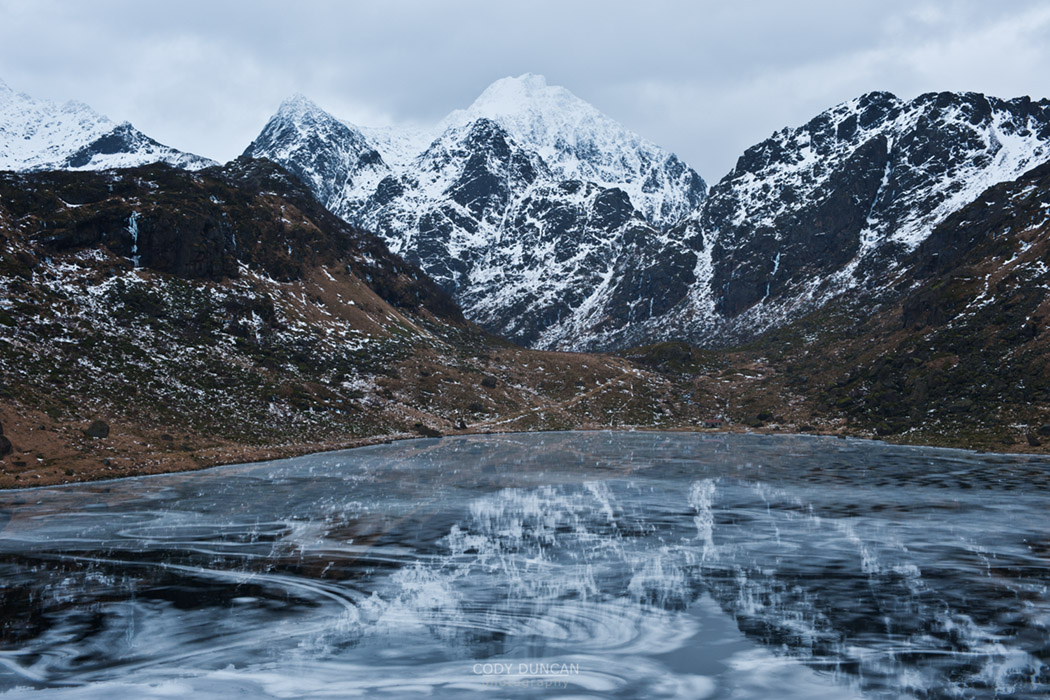
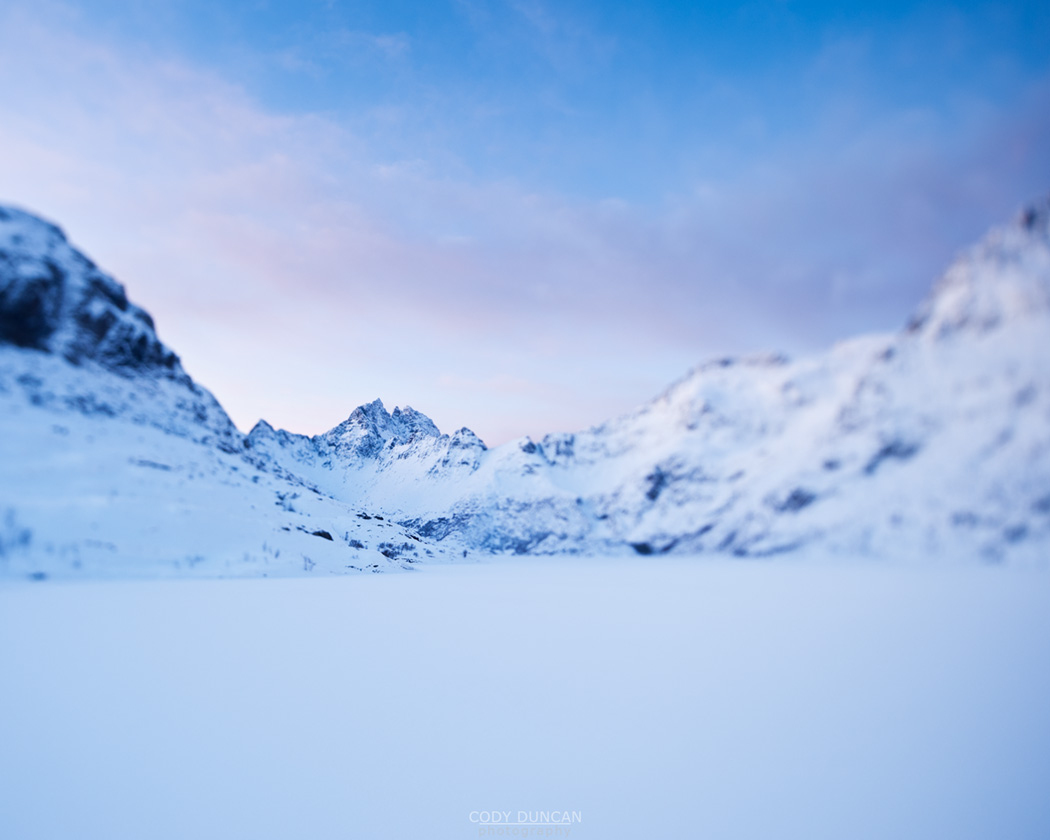
Lake Ågvatnet and snow covered mountain landscape, Å I Lofoten, Lofoten islands, Norway

Photo: Lake Ågvatnet in Winter, Å I Lofoten, Moskenesøy, Lofoten Islands, Norway.  Jan 6, 2010.  14:22

Having followed the light from Vestvågøy to the end of the road at Å on this short January day, and the only day I saw the sun on this trip, I was eager to get as much variety as possible.  While waiting for the light to fade a bit more before heading out to the coast for sunset, I wandered over to lake Ågvatnet, sublimely covered in a fresh layer of snow.

I took a few ‘normal’ images, ie. no tilt, but for some reason, the scene wasn’t doing much for me.  I’m not quite sure why, but I think it just felt a little out of balance and with no clear focal point.  Finally, I just decided to throw a full tilt on the lens, open up the f-stop for a shallow depth of field and focus on the pointy mountain in the distance.

This did the trick for me.  Combined with the soft light and fresh snow, this image has a bit more of an etherial feel that I typically shoot.  But I like it for some reason.  And the subtly of the image works well as a desktop background, which I currently use.

Camera Info:
Nikon D700
Nikon 24mm f/3.5 tilt-shift
24mm
ISO 200
f 4.8
1/60 sec
WB Daylight
2 images – top, bottom
Full lens tilt

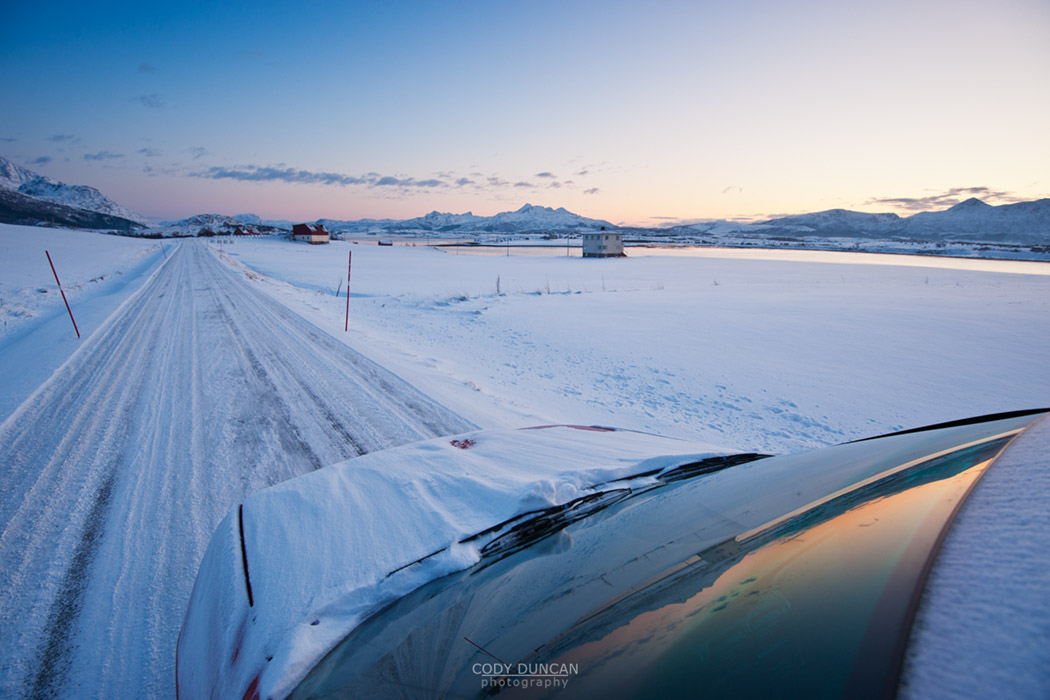
driving on winter road with snow, Lofoten Islands, Norway

Photo: Heading to Haukland beach on winter roads, Vestvågøy, Lofoten Islands, Norway.  Feb 6, 2012.  8:57

This week’s photo is more for illustrative purposes than of something scenic.  With more and more people planning on visiting the islands in winter, it can be a bit of a shock to drive on the roads for the first time, especially if you are like me, and grew up in a temperate climate.

While my experience on the European continent is that they tend to keep roads snow free in winter, either by plow or grit, in Lofoten, this is not overly practical.  In big storms, the roads are cleared of deep snow and snow drifts, but overall, there always remains a layer of snow and ice covering any asphalt.   To deal with these conditions, the Norwegians (and Swedes) utilize studded tires from November to April.

While not like driving on dry asphalt, the studded tires work amazingly well.  In my estimate, I would say they retain about 70% the traction level of normal tires on dry conditions.  For road conditions like in this photo, you can more or less drive normally (but be weary on sharp turns).

Where driving conditions become dangerous is when the temperatures warm to 2-6 degrees above freezing and it begins to rain.  This turns all the hard, compacted snow of the roads into a layer of wet ice.  Scary and slippery!  The road plows are good at dealing with this and will have the main roads gritted and ice free within a few hours.  But I would suggest minimizing your driving during this period if possible.  I have gotten stuck a few times where I pulled down into an icy parking area and was unable to drive back out without considerable effort on my part to clear away enough ice to get a bit of momentum built up.

Camera Info:
Nikon D700
Nikon 16-35mm f/4
16mm
ISO 200
f 57.1
1/30 sec
WB Daylight

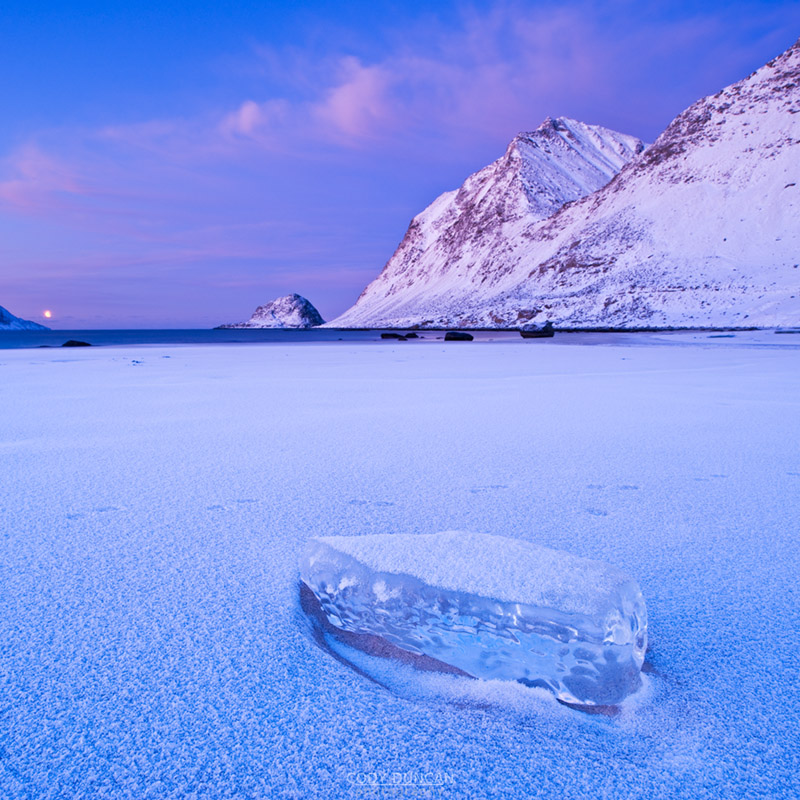
Block of ice on frozen Haukland beach in winter, Vestvagøy, Lofoten islands, Norway

Photo: January dawn on Haukland beach, Vestvågøy, Lofoten Islands, Norway.  January 6, 2010.  09:49

Some time ago I posted a photo from this morning at Haukland beach, but as I’m now less than one month away from returning to the islands, it’s time for more winter images to inspire me.  Even now, looking back four years later, it still remains one of my most memorable days on the islands and is partly what saw me start this website in the first place and begin to look at Lofoten with a different set of eyes.

After having spent a stormy night at Utakleiv attempting the sleep in the cramped back seat of my all-too-small rental car, Haukland beach was the first scene I came across for the day.  I was not in a rush to get anywhere in particular, but I was in a rush to get as much variety out of the 4 hour day as possible.  I was also still cold from the night, only having a 0˚ sleeping bag with me, as the temperature dropped to -10˚ or so, and the car had yet to properly warm me up in the short drive from Utakleiv.  With already cold feet, I crunched my way across the snow covered sand and down towards the beach.

When I caught sight of this small chunk of ice on the frozen beach, I knew I had found something special.  While Lofoten is cold, there is not often ice on the beaches such as this.  But thanks to the cold temperatures and the small creek that runs into the sea at Haukland, a frozen piece of creek ice must have washed back onto the beach at high tide, and then a light layer of snow fell overnight to complete the scene.  I have attempted to find a scene like this in my last several winter visits, but have never been so lucky again.

The only thing that distracts me is the otter tracks across the middle of the image, I guess he was up before me.  But overall, this is still one of my favorite images from the islands.

Camera Info:
Nikon D700
Nikon 24mm f/3.5
24mm
ISO 200
f 16
8 seconds
WB Daylight
2 images – top/bottom

________________________

Well, I’ve reached image number 52, a whole year of weekly Lofoten Images.  Good thing I still have about 900 images left in my archive to keep things going.  But at the moment, I’m not too sure if I’m going to continue posting weekly photos.  I initially started when there wasn’t all that much content here on the site, so I was just hoping to fill things in a bit.  And in all honesty, I haven’t received much feedback for my efforts during the last year, so I’m kind of questioning whether it’s worth my time to continue.

So now your chance to chime in.  If you find the information or stories useful on this Friday Photo series, maybe make a comment letting me know.  If it’s just been a waste of time, you can let me know that as well. 🙂

Happy 2014!  For those of us heading north in the next months, lets hope the mountains are full of snow and the skies full of Auroras.  And if you see some guy in a ugly blue jacket wandering around, come say hello. (I also accept invitations to hot tea and use of an oven to cook a frozen pizza for dinner in.)



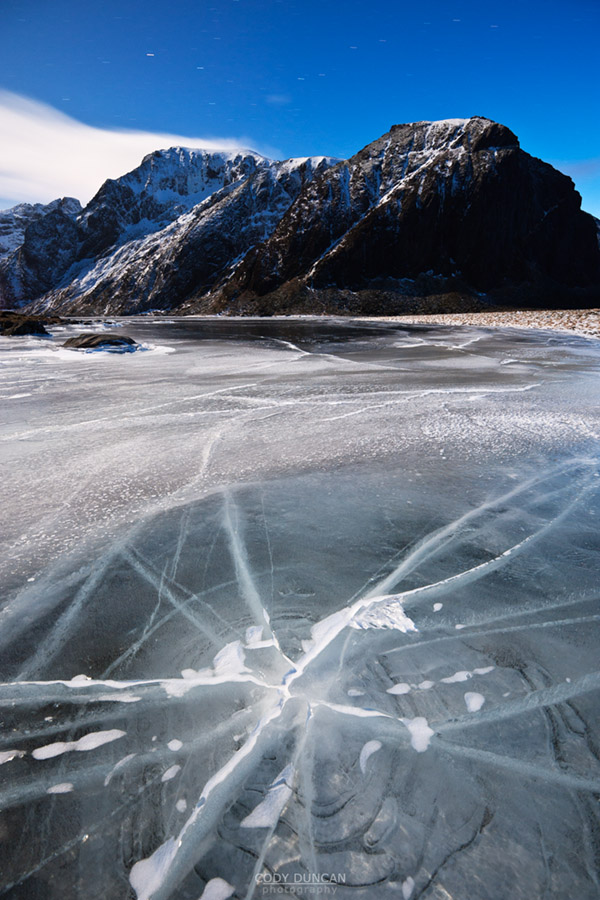
Night image of crack in frozen lake Nedre Heimdalsvatnet, Eggum, Lofoten Islands, Norway

Photo: Winter night on Nedre Heimredalsvatnet, Eggum, Vestvågøya, Lofoten Islands, Norway.  Feb 2, 2012.  17:38

With a near full moon and calm winds, five-o-clock is too early to go to be, even in February on Lofoten.  Parked at Eggum for the night, I wandered off for a bit of exploring.

Growing up in California, I’m not sure I even stood upon a frozen lake until my time in Germany five years ago.  But with the low snow levels upon my arrival at the beginning of February, frozen lakes were about the only thing of interest.  I wandered out into a shallow section of the frozen lake, making sure I could always see the bottom in case I happened to fall though; I figured as long as I could still stand up, it wasn’t too likely that I would die.

Several cracks formed interesting features on the surface of the lake, and so I used these as a foreground subject, lit by moonlight.  It was a bit eerie, to stand there alone in the darkness, the ice creaking and cracking as the temperatures dropped, occasionally echoing a loud ‘boom’ through the mountains.  I did my best to remain still and not fall over, often having to use my extended tripod as a bit of walking stick.  A few days later, while on a different part of the lake, as I was putting my camera away, winds blew my tripod towards the center of the lake.  It was a scary few minutes trying to get it back!

Camera Info:
Nikon D700
Nikon 16-35mm f/4
16mm
ISO 320
f 7.1
152 seconds
WB Daylight

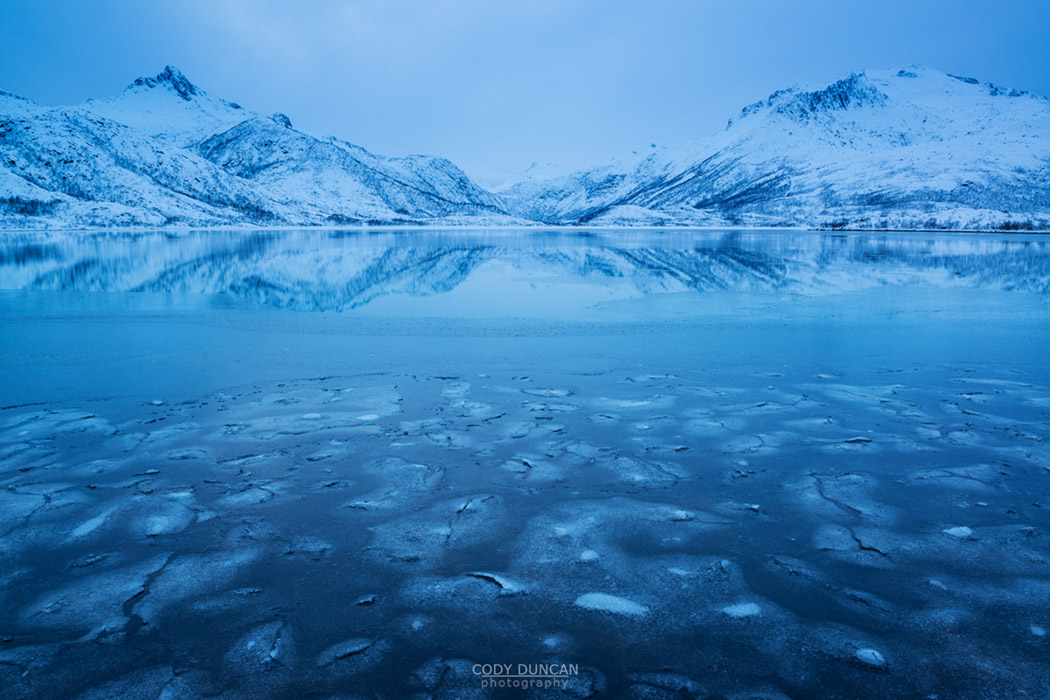
Ice forms on Vatterfjordpollen, Austvågøy, Lofoten Islands, Norway

Photo: Ice forms on Vatterfjordpollen, Austvågøya, Lofoten Islands, Norway.  Feb 15, 2013.  16:12

As the last light faded from the short February day I found myself passing Vatterfjordpollen on the way back towards Svolvær and in search for a car-bivy spot for the night.  I was actually thinking of maybe checking out the Lofoten meeting of the Norwegian Alpine Club, but the hotel looked a bit to posh for me, as so I passed on by.

When the temperature is sufficiently cold, some of the tidal fjords will begin to freeze.  Sometimes this creates something interesting and sometimes not.  The days thus far in the heavy overcast sky had mostly been a waste.  Another ‘weather’ day for Lofoten.  But in the darkening sky I wandered down to the fjord’s edge.

By far from my best image from the trip, in those first days on the islands I’m always anxious to take a picture of something, anything.  And as I drive in circles and see the needle on the gas tank fall, knowing next time I pull up to the gas station I’m going to blow through $100+, that desperation grows even further.  Sometimes I don’t have the patience to park in one place and read the day away, even though I know I should.

Camera Info:
Nikon D800
Nikon 24-70mm f/2.8
24mm
ISO 100
f 134
.5 seconds
WB Daylight

Mountain reflection of frozen lake Vikvatnet, Vestvagoy, Lofoten Islands, Norway

Photo: Vikvatnet, Vestvågøya, Lofoten Islands, Norway.  Feb 10, 2012.  10:42

This weeks Friday Photo is more illustrative rather than scenic in purpose.  This photo shows that Lofoten is not always a winter wonderland of white snow from sand beach to highest peak.  There is actually a fragile balance between snow and rain that has a rather dramatic effect on the appearance of the landscape, and in turn, what photographic opportunities you will find.  With a fresh layer of snow, most anything is photogenic.  When the snow line retreats up the mountains, the low areas can often look bland and lifeless.

Despite the northern latitude of Lofoten, the winter temperatures remain quite mild.  For several days previous to this photo a southwest wind brought the temperatures above the freezing level, while rain melted away the snow.  Finally reaching a high of 6.2˚C, which might not sound like much, but it was February in the Arctic Circle.  And for another reference, the high temp on June 1st, 2012 was 6.5˚C, while June 1st, 2013 reached a high of 26.3˚C.  What an amazing variation!  Lofoten weather is unpredictable at best, and years seldom seem to repeat themselves.  In fact, the weather almost makes a point of being completely bi-polar year upon year.

When I passed by this scene a few days earlier, the lake had been covered in a nice coating of snow.  On this morning, I passed by once again on my way out to Haukland beach to see if I could find something interesting.  Now, a layer of rain water covered the ice, allowing for a reflection of the mountains.  And in combination with the freeze patterns in the ice, created some interesting texture. The light was a bit flat, but what can you do.  I was glad it had actually stopped raining for a few minutes.

Camera Info:
Nikon D700
Nikon 24-70mm f/2.8
44mm
ISO 200
f 11
1/20 sec
WB Daylight

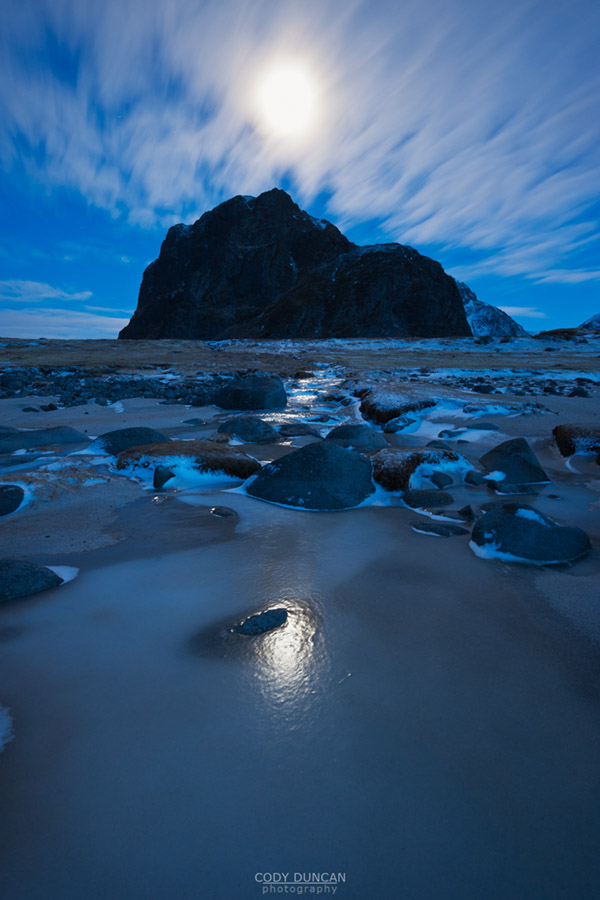
Full moon shines in night sky above mountain peak, Eggum, Lofoten Islands, Norway

Photo: Moonlight over Mustaren, Eggum, Vestvågøya, Lofoten Islands, Norway.  Feb 3, 2012.  17:13

To my dismay, barely any snow covered to lower elevations of the islands upon my arrival at the beginning of February 2012.  This was in quite a contrast to my first real winter experience on the islands in January 2010, where it snowed so much that I got my car stuck several times and had to be pulled out.  I had traveled to the islands imagining what scenes I would find and how I would photograph them, and yet I arrived to something totally different.

The lack of snow left much of the landscape somewhat drab looking, especially in the flat light of my first days on the islands.  And so I found myself looking for new perspectives that I hadn’t though of.  At this point in my previous winter experience, I’d never really seen ice, as it had always been covered in snow before.  And so on my second night while camping out at Eggum I took a little wander.

By evening the the weather had calmed by what had thus far been some pretty blustery weather.  Though Eggum is often one of those places, depending on wind direction, is totally blown out (usually), or sometimes eerily calm, such as this night.  I tried some seascapes, but they weren’t working out particularly well, so I turned around and pointed my camera towards the near full moon just as some clouds began appearing from behind the mountain.

I stood there for a while in the cold and silence, the crashing of waves a few meters behind me the only sound to be heard.  Some minutes later, a pair of otters began wandering around the rock near me, oblivious to my presence; perhaps it was so cold they couldn’t smell me, or I’d only been on the islands for a couple days so I wasn’t too ripe yet.  I’ve seen otters many times on the islands, but this night, in the darkness, was the closest I’ve ever been to them.

Camera Info:
Nikon D700
Nikon 16-35mm f/4
16mm
ISO 200
f 11
121 seconds
WB Daylight

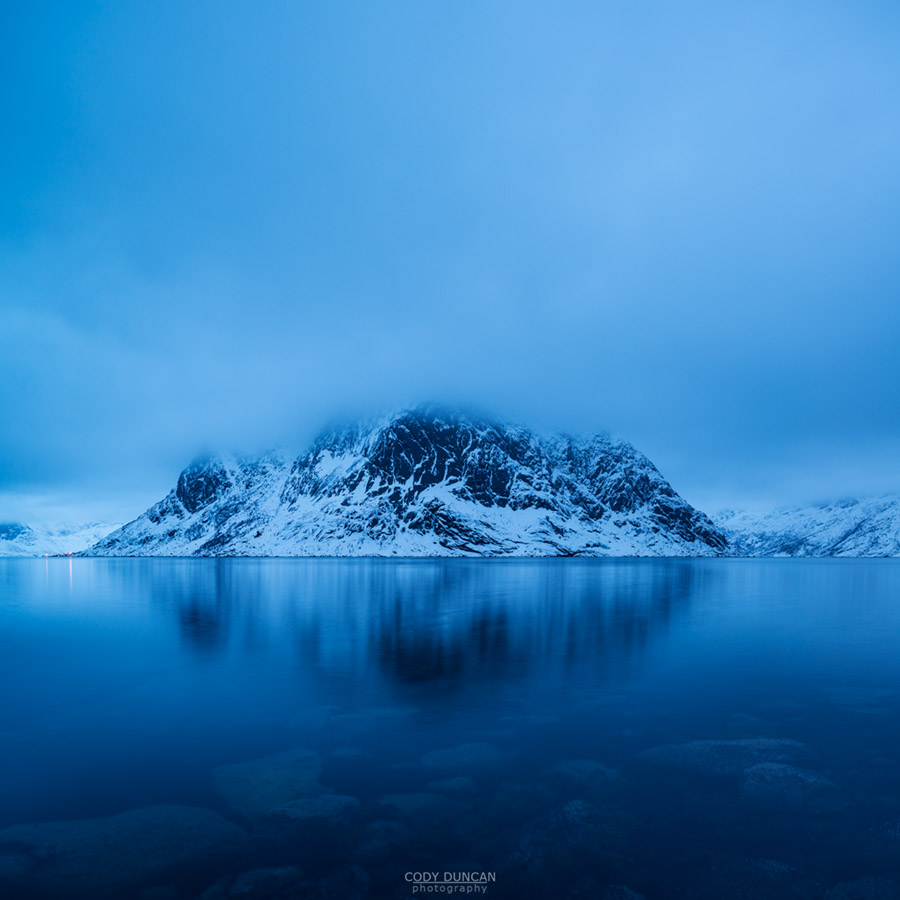
Heavy clouds conceal summit of Olstind mountain peak rising from fjord, Reine, Moskenesøy, Lofoten Islands, Norway

Photo:  Olstind hidden in Winter Clouds, Moskenesøya, Lofoten Islands, Norway.  Feb 17, 2013.  17:11

Olstind, probably the most iconic peak of the Lofoten Islands, when you can see it.  Taken at the same time an location as last weeks Friday Photo, another gloomy image during the fading light of a short February winter day.

For some reason I don’t imagine I’ll ever have enough images of Osltind.  While often times I pass the mountain by if it’s a scene and lighting conditions I’ve previously photographed, when something new is to be found I’ll usually make the effort to hop out of the car, or walk, and see what I can come up with.

I think the calmness of the evening drew me out here on this particular day.  I’ve seen the mountain hidden in clouds enough times before, but for some reason, there was something a bit more interesting this time.  The sky was heavy, as indeed, rain started falling only a few minutes after this image.  But at the moment, the islands were calm.  The waters of the fjord sat flat and silent, hardly making a sound on the barnacle covered rocks I was standing on.  And so yet another photo of Olstind was taken.

Camera Info:
Nikon D800
Nikon 24mm f/3.5 tilt-shift
24mm
ISO 100
f 8
8 seconds
WB Daylight
2 Images – Top/Bottom

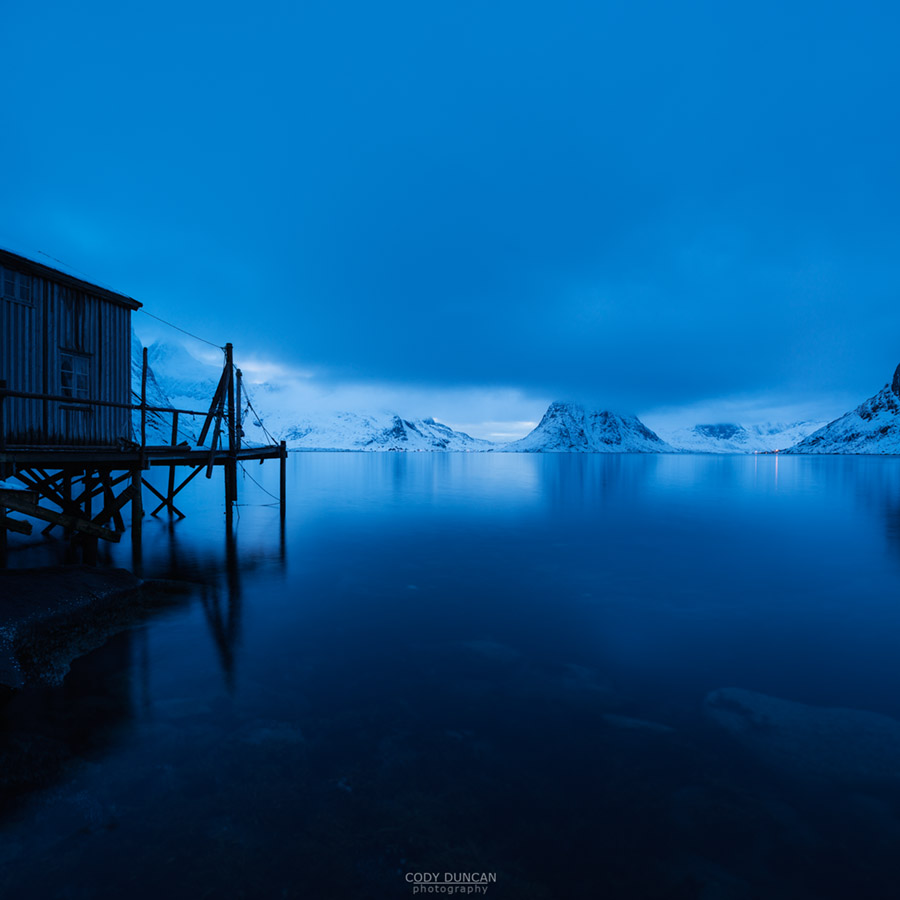
Derelict Rorbu sits on edge of fjord, Vestvalen, Reine, Moskenesøy, Lofoten Islands, Norway

Photo: Abandoned Rorbu, Vestvalen, Moskenesøya, Lofoten Islands, Norway.  Feb 17, 2013.  17:12

Like last weeks Friday Photo, this is a location I’m so familiar with that I’ve never thought of taking a photo of it before.  I’ve stood in front of this building a dozen times or more, with my camera pointed at Olstind – one of my favorite locations to shoot Olstind from as you can get away from all the power lines – yet I’ve never turned around and given much though to the building itself.  Perhaps I just needed the right conditions.

I find something haunting about this image.  It is dark and subtle, far from the typical ‘hero’ type Lofoten photos I and others normally take.  It feels lonely and forlorn, yet with a glimmer of something. A future.

Perhaps on most occasions I would not have even been here as the last traces of light faded from a February day while a gentle rain began to fall just as I put my camera in my backpack and wandered back to the car.  I was merely killing a bit of time before being graciously invited by another photographer I had met for a cup of tea in his Rorbu just down the road – an invitation not to be passed up while sleeping in a car in winter.  And so, I ended up with what is probably one of my favorite images of the trip.

Camera Info:
Nikon D800
Nikon 24mm f/3.5 tilt-shift
24mm
ISO 100
f 8
8 seconds
WB Daylight
2 Images – Top/Bottom

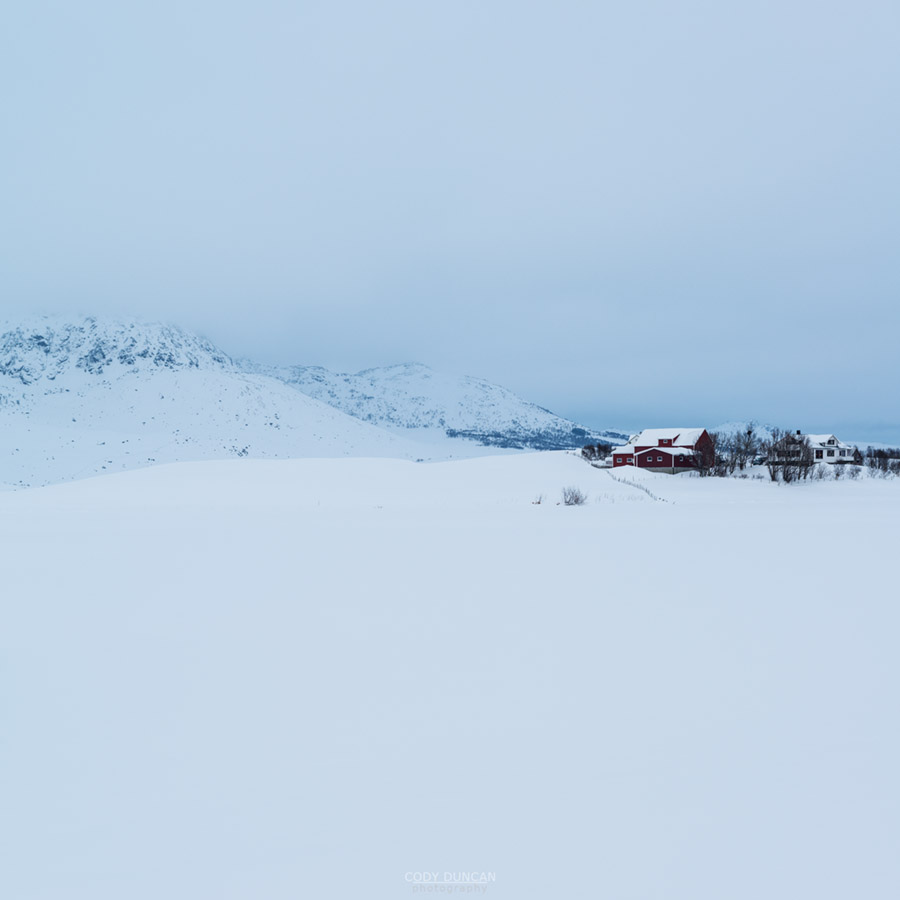
Farm building in snowy winter landscape, Farstad, Vestvågøy, Lofoten Islands, Norway

Photo: Winter farm, Vestvågøya, Lofoten Islands, Norway.  Feb 16, 2013.  14:21

It had now been several days of heavy, mountain concealing clouds covering the islands.  Exactly the opposite of what I want, but often what is there.  At least it was still cold, and the snow remained, so there is that to be thankful for.  But it was one of those days where the needle on the gas tank drops lower and lower, yet the camera rarely makes it out of the bag.

I’ve driven by this lake and farm a hundred times or more, and never taken a photo, likely since I was headed towards something better.  But for some reason on this particular day, a day of otherwise almost nothing photographically, the emptiness of this scene caught my eye.  There is almost nothing but white and gray, save for a single farmstead.  Somehow I can almost feel the cold and the bleakness of the Lofoten winter in this image.  I’ll probably drive by a hundred more times and never take another photo.

Camera Info:
Nikon D800
Nikon 24-70mm f/2.8
70mm
ISO 200
f 11
1/100 sec
WB Daylight
2 Images – Top/Bottom