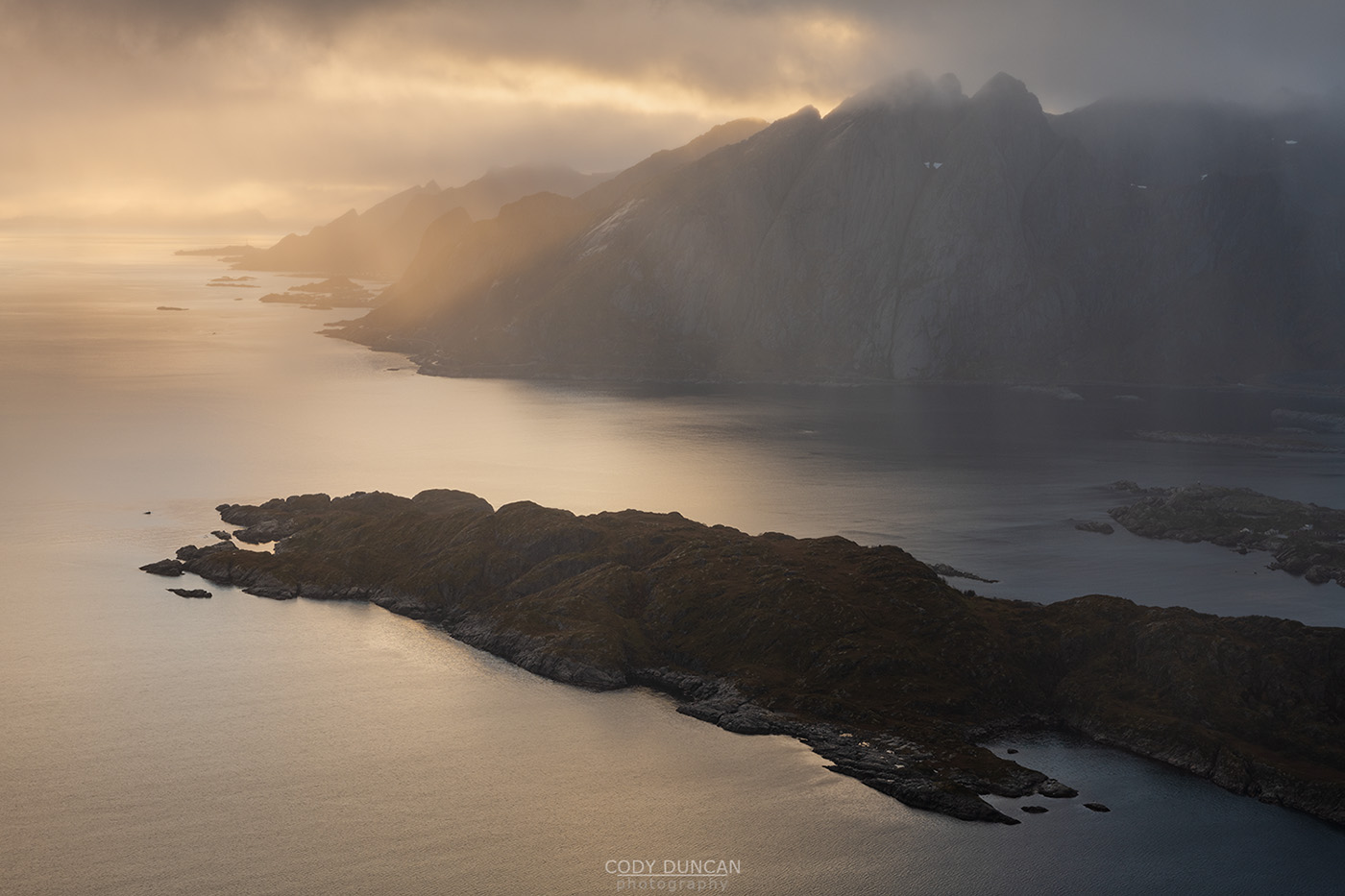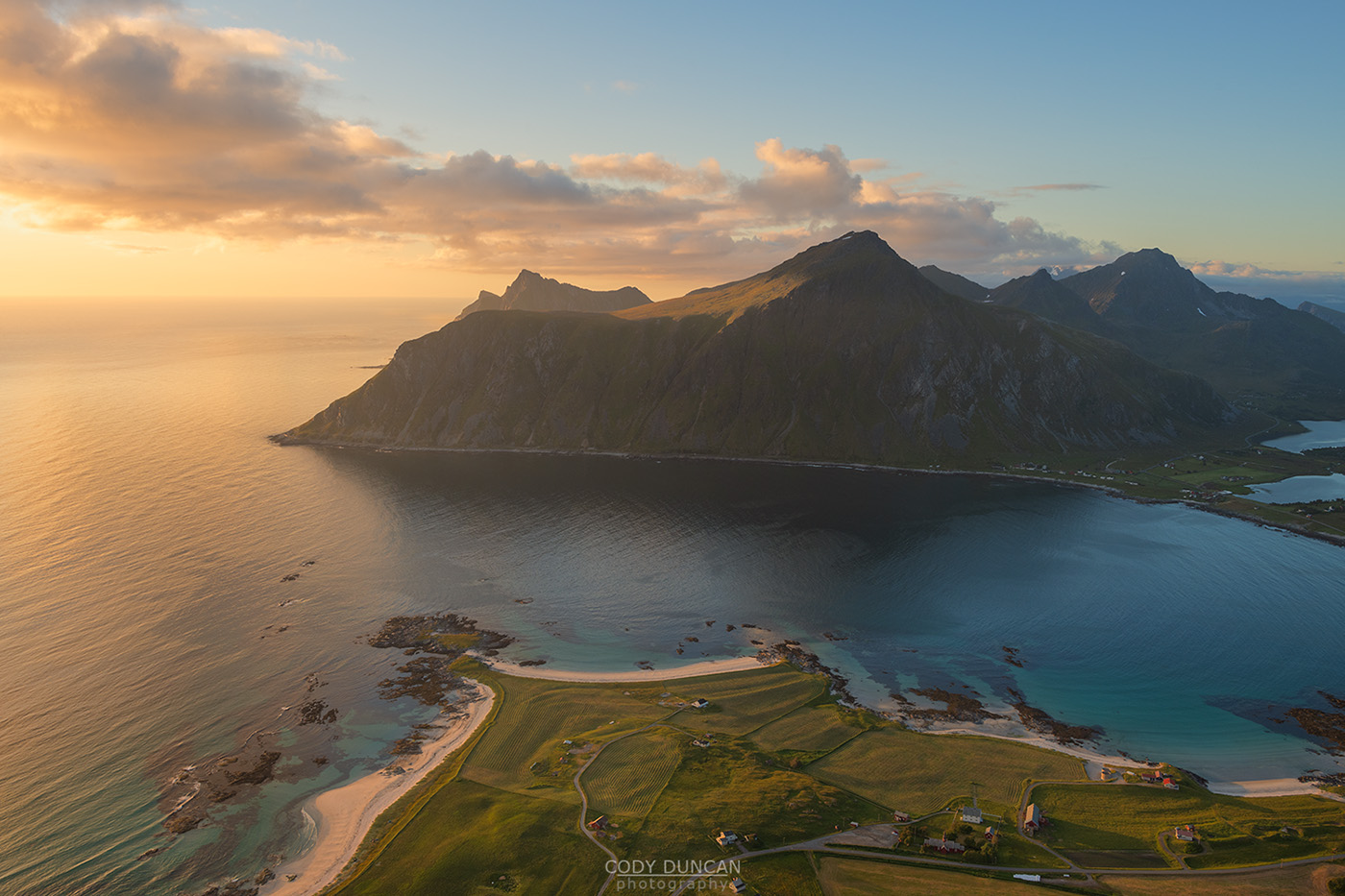
Photo: Golden summer light over Flakstadøy from Flakstadtind, Lofoten Islands, Norway. July 9, 2020. 22:34

It has been a good summer this year. Actually for photography it has almost been too good! After the long and almostly constantly cloudy winter it seems we have switched to the opposite and now have endless days of blue sky. It’s seems like more of less every photo I’ve taken since the start of the midnight sun season has just been of the sun low on the horizon in a perfectly clear blue sky. I’ve been slowly working away, photographing new mountains for future hiking guides. But I must say it’s all starting to look the same by now and its hard to maintain motivation to go hiking vs. sit in my yard and have a bbq.

While there have been some cool cloudy days, by the evenings when I typically go out, it seems to sky is always clear again. But the other week finally it seemed like there could be something interesting and so I headed up Flakstadtind, which I haven’t hiked in a couple years anyhow. Conditions were looking good as I neared the summer, planning to wait a few more hours and hopefully get lucky.

But then I got a phone call. Orcas were in the area and my friends were going out with their boat… (Friday Photo #392)

Camera Info:
Nikon D850
Nikon 24-70 f/2.8
28mm
ISO 100
f 10
1/80 second
WB Daylight

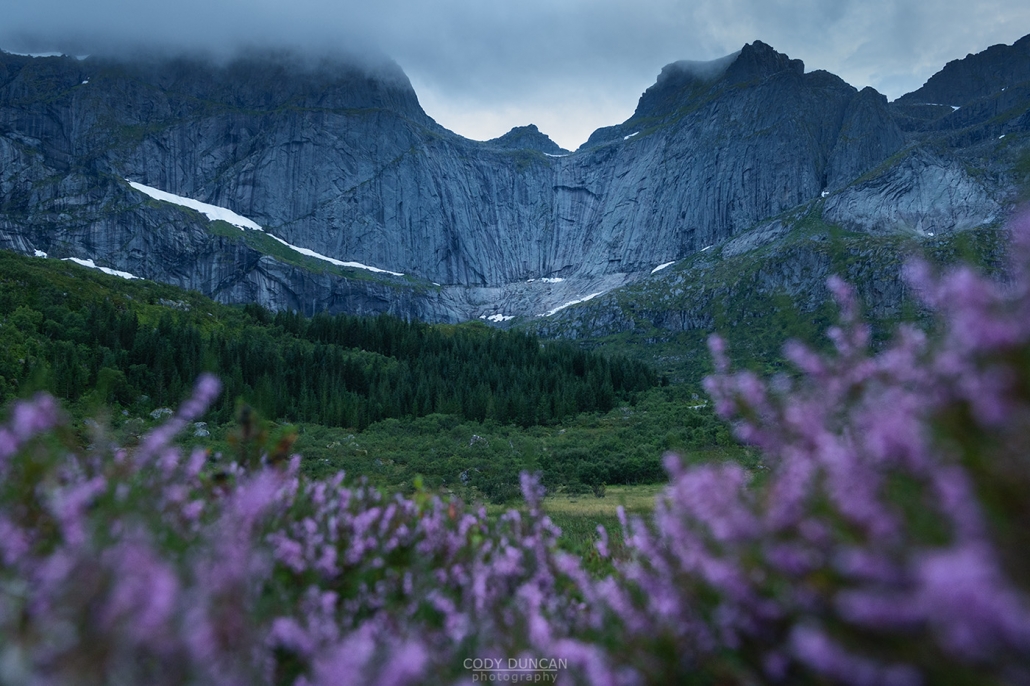
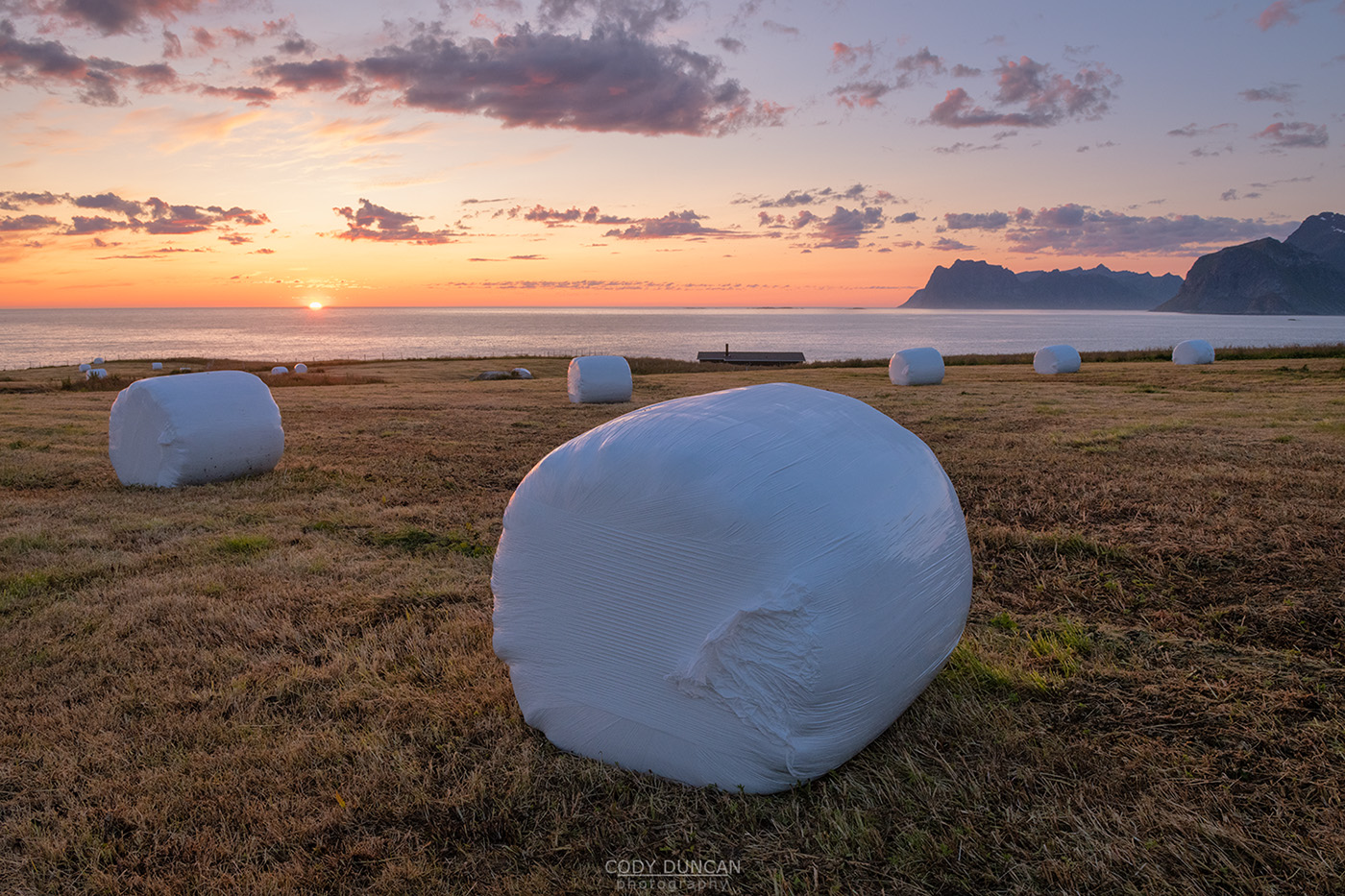
Photo: Norwegian marshmallows under the last of summer’s midnight sun, Flakstadøy, Lofoten Islands, Norway. July 19, 2019. 01:03

Every year in mid July comes the crass cutting season. Having spent six weeks of so under the midnight sun, what appears like flower filled meadows are actually the winter feed for the local sheep and cows. In most places across Lofoten, anytime you see a field of grass, it is cultivated land that was turned that way from generations of farming and also likely some efforts at draining the land to keep it from becoming bog. Otherwise, most of the ‘wild’ land of Lofoten will be heath and heather moorlands, too boggy for much to grow.

This does mean that you only have a few weeks to photograph the flowery fields in some areas, especially on Gimsøy and around Flakstadøy. Otherwise, you might drive by one day and find its all gone as every farmer seems to be out with their tractor on the same day in mid July.

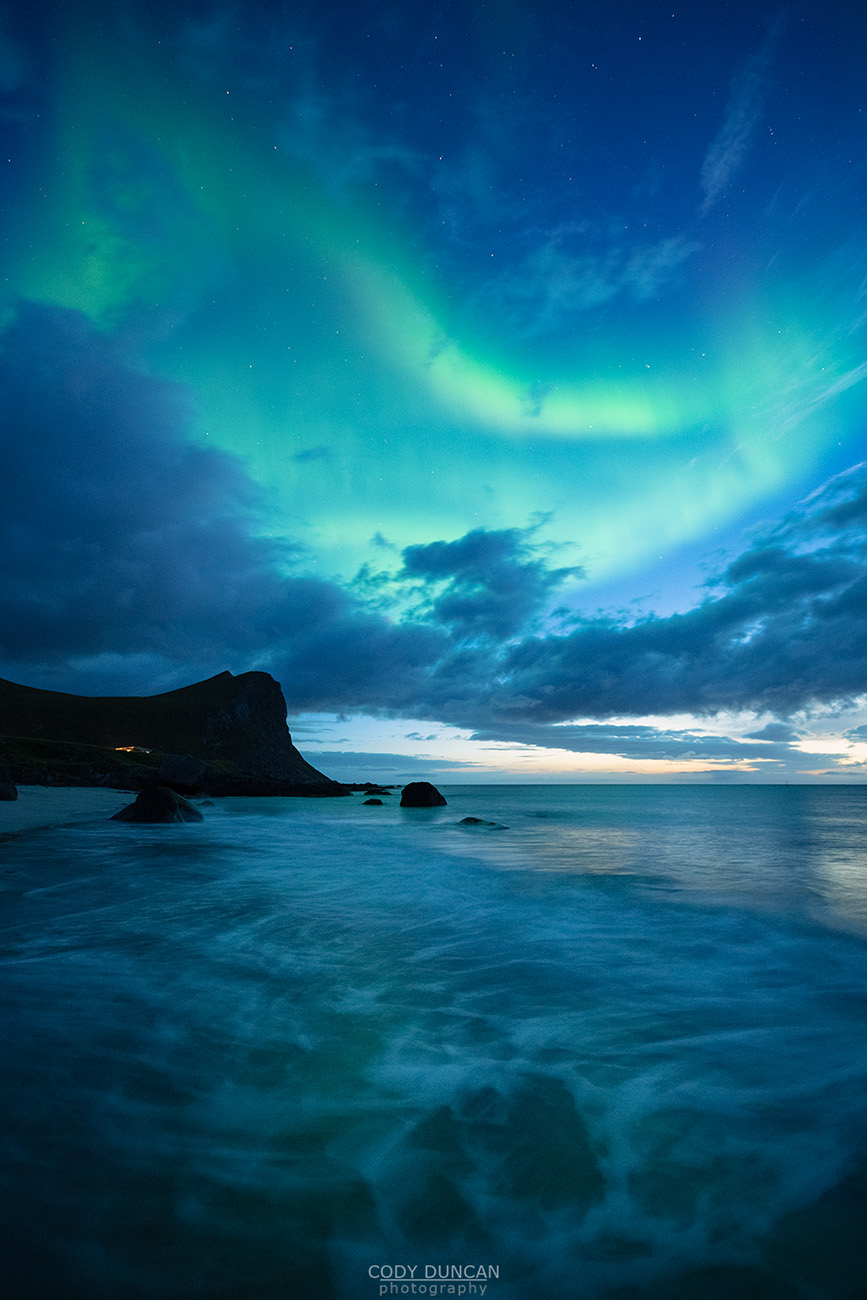
Like so much else of Lofoten, it is one of the signs of how quickly the seasons pass here. With the fields cut and the midnight sun ending, it is really only one month until the northern lights return to the late August sky.

Camera Info:
Nikon D850
Nikon 24-70 f/2.8
24mm
ISO 800
f 13
1/50 second
WB Daylight

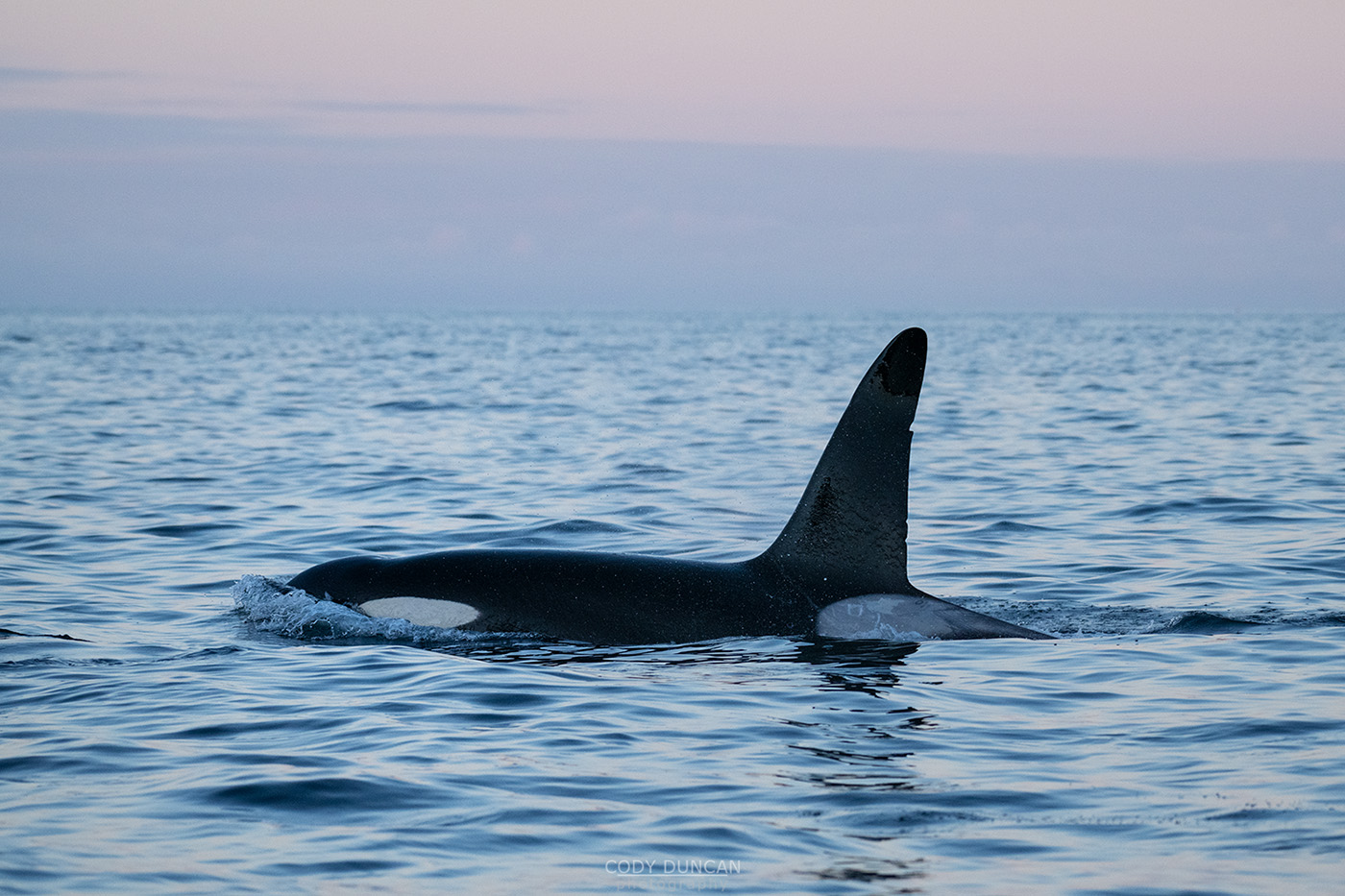
Photo: Midnight orca in Vestfjord off the coast of Nesland, Flakstadøy, Lofoten Islands, Norway. July 10, 2020. 00:20

Over the years I’ve noticed a pattern on Lofoten: Nothing happens, and then everything happens. It can be with events, where there’s nothing going on for weeks and weeks, then suddenly 3-4 things to choose from on a single weekend, before going back to weeks and weeks of nothing again. Last night as I was hiking the final few meters to the summit of Flakstadtind with nice golden light shining over the landscape my phone rang. A friend called to say the orcas had been spotted and they were going out with their boat. I wouldn’t be writing this if it was only the first time it has happened – I’ve missed some good orca sightings while up on a mountain somewhere.

This time though, I decided the orca were more important. And luckily, I was just down the road from where they were anyhow, off the coast of Nesland. So after a few photos of the nice light and clouds, I headed down the mountain as quickly and safely as possible – it’s steep and loose up there!

Getting back to my van I headed to the coast, where my friends were watching them from the boat. I shot from shore for a bit, they were almost just on the rocks, feeding on a large school of hearing. But once they headed out to sea a bit, I found an impromptu harbor and got on the boat. While I’ve see the orca multiple times on Lofoten, and photographed them from boats up on Vesterålen, I’ve never had the chance to be on a boat here in Lofoten.

When I left my house at 21:00, kinda bored and just going hiking because I had nothing better to do, I never thought I’d have nice mountain light and orca from the water on the same evening!

Camera Info:
Nikon D850
Nikon 200-500 f/5.6
200mm
ISO 1600
f 5.6
1/1000 second
WB Daylight

Photo: Desert-like mountain highlands over Nappstraumen, Flakstadøy, Lofoten Islands, Norway. June 6, 2020. 23:55

Summer seems to have fully arrived here on Lofoten during the last week, and despite a couple cold misty days we’ve mostly experienced blue sky and endless sunlight. Tomorrow we might even hit 20˚c for the first time this year! I guess its time to work on my summer sunburn.

With such good weather, I actually haven’t been camping and have been saving most of my hiking for the evening hours. While the days are nice to be outside, a solid blue sky isn’t the most productive photographically, so it’s better I put my energy towards the most productive time of day, which is the night. And there’s not really any point in spending the night in 24 hour sunlight for a hike that is only 3-4 hours in length anyhow.

But with the full summer ahead, it is time to begin exploring some new mountains, and revisiting places I haven’t been to for some years. The main work for summer will be to cover Vestvågøy and Austvågøy in the east. But there’s still some new places in the west that I’ve never been to for whatever reason. This photo from Nesheia being one of them.

I’ve driven by and looked at the rocky mountain landscape hundreds if not thousands of times, but for sum reason until last weekend I never ventured up there. It is kind of a unique landscape which feels more like the deserts of California than anything found on Lofoten. I think this will be a cool place to visit again in autumn with a fresh dusting of light snow, so I’ll provably be back again before the year is over.

Camera Info:
Nikon D850
Nikon 24-70 f/2.8
27mm
ISO 100
f 13
1/15 second
WB Daylight

Photo: Rockfall over Myrlandsveien which hit mail man and closed road for 24 hours, Flakstadøy, Lofoten Islands, Norway. June 3, 2020. 11:38

Summer seems to have arrived with June this year as the temperatures have warmed up over the last week to 15 degree and sunny t-shirt weather. May was much colder than average here and so the spring greening of the islands feels a couple weeks late this year. But as always with the melting of the snow comes rockfall.

All across Lofoten you can see dark brown streaks of rockfall across sections of remaining snow. And when out and about in mountain area photographing, even at midnight after the day has cooled, you can hear numerous rockslides and snow/ice avalanches falling from the peaks. I posted video of a bigger one on my instagram story the other day that lasted long enough for me to hear it, see where it was, pull my phone out of my pocket and start recording.

Yesterday, Thursday, a large rock/snow fall occurred on Reinebringen in the late afternoon, covering a section of the steps in a layer of debris. Numerous people have already been hiking the mountain in the nice weather of the last days, but luckily tourism is off to a slow start this year and no one was present when the rockfall occurred.

I myself had even been planning on hiking Reinebringen yesterday, and likely would have been in the area near the time when the rockfall occurred. Luckily as I was driving there in the early evening I could see the evening sun would go into a layer of clouds, so I decided to go elsewhere last night.

But that is two reminders in two days for me that this is always a dangerous time of year in the mountains of Lofoten – though that’s not saying you can just relax the rest of the year – but the melting of the mountains in spring and early summer is always a period of elevated rockfall.

So, when you’re planning your hikes in the next weeks, be sure to know what your route is like and try to avoid areas traveling below steep cliffs.

Camera Info:
Nikon D850
Nikon 24-70 f/2.8
44mm
ISO 200
f 9
1/500 second
WB Daylight

Photo: Stortind rising into the midnight sky above flowing waters of the spring snowmelt, Flakstadøy, Lofoten Islands, Norway. May 25, 2020. 23:29

Finally, after a seemingly never ending winter the thermometer broke into double digits again last weekend and gave us the hottest day of the year so far – 16˚C! Well, I’m sure for most of you reading this, that doesn’t sound like much, but for us here on Lofoten, this was only the 2nd time above 10˚C this year, the previous time being on January 2nd during a strange warm period. Otherwise, we’d have to go back to late October to find 2 more days above 10˚C.

Though unfortunately this was just a quick teaser of what’s hopefully to come. As the rest of the week since Tuesday has fallen back to a pattern of heavy grey skies and cool rain. But At least we had a few days to sit outside while not in a down jacket and remember what the warmth of the sun felt like – I don’t think my arms have seen sunlight since September…

Thus far in May, most of the precipitation arrived as snow. And while it has mostly since melted away from the coastal areas, the inland mountains still have significant snow coverage, even here in west Lofoten. Last year I was already hiking up snow free trails on moderately hight peaks by now. I might have to wait a little longer this year.

The mountain snow combined with the sun and warm temperatures quickly set the spring thaw into motion. All over Lofoten the often quiet little streams were flowing high and fast. Driving by this location on my way to somewhere else I noticed the river flowing across a section of rocks that for whatever reason I’ve never photographed before – I usually only visit the lower waterfalls here.

I first made a stop in the late afternoon and hiked a little ways up the valley to where the river was flowing across the flat, slabby rocks. But the sun was in the wrong part of the sky, so after a little while exploring and observing the conditions, I made the plan to come back later in the evening.

As the hours passed the winds picked up into quite some gusts out on the exposed coastal areas. Luckily, this valley was mostly sheltered, though at times the wind gusted strong enough to blow water across my lens. The sky was nearly completely cloudy, yet luckily enough there was a hole somewhere in the northern sky to allow a ray of light to shine across the upper half of Stordind – without that, I don’t think the image would have worked as well.

Camera Info:
Nikon D885
Sigma 14mm f/1.8
14mm
ISO 31
f 16
1 second
WB Daylight

Photo: Midnight Hjell, Flakstadøy, Lofoten Islands, Norway. May 8, 2020. 00:05

Winter on Lofoten. Well, no, this is mid May 2020. After several nice days of sunshine last weekend, the thermostat has dropped and snow showers have been falling across the Islands over the last days. And the long term forecast seems to show that we’ll have the same cold conditions for the next week or more. In the one year where’d I’d just want even 10˚ on a calm afternoon. Nope!

It is not that snow is unusual in May. It’s actually to be expected here in the north, which is why we can keep our winter tires on a little longer than the Oslo city people in the south – who have already been sitting in the sunshine for weeks. It just seems this year the weather has remained extra stormy, with few days of sunshine and even cooler temperatures overall. A day or two of snow is no problem in May when you have some sunny 10˚ degrees in between. But this year, the thermostat has been struggling even to reach 5˚ over the last month.

I could have pretended this was a winter photo. And by the look of it, I could have said it was taken any time between November and March and for most people it would seem out of place. But there are some clues which show it’s not a winter image. The first, and easiest to pick up is the time the photo was taken: 00:05, five minutes after midnight. Though the sky is mostly overcast, you can see the warm light glowing on the horizon. This would not happen in winter. The second clue, and really only for those who know the area, is that the glowing horizon is in the north. Definitely not something which happens in winter. In December, this image could have been taken facing south at noon for a similar result.

But I’m tired of snow. It’s been a long winter this year. Hopefully I can start posting some sunny images soon! I need to for myself…

Camera Info:
Nikon D850
Nikon 24mm f/3.5 tilt-shift
24mm
ISO 31
f 16
30 seconds
WB Daylight

Photo: Evening twilight glow over northern coast of Lofoten Islands from Flakstadøy. April 29, 2020. 22:32

For the first time in a month there was a cloudless sky over Lofoten on Wednesday. While there have been some moments of sun here and there at times, never in the whole of April have we had a clear and calm day. So I decided to head up to the mountains for sunset.

Normally I love this time of year, with the ever lightening horizons each night. But this year, the night sky has been almost entirely cloudy, especially lower on the horizon. So I haven’t really been able to observe the change, since it all looks the same when cloudy. So with a clear sky it felt like a jump in time, suddenly it was so light!

The snow was too icy – and I brought my light crampons – for the mountain I wanted to climb, so I headed over to a section of ridge overlooking the coast above Vikten. The clear sky didn’t provide the most dramatic sunset, but it was nice to just sit and watch the sun sink into the calm sea, even if it was a little on the cold side. Normally I would have had the setting sun visible from my house for about two weeks now, but last night from the mountain was the first time I saw it happen this year.

I headed down a little before 23:00, making my journey through a mostly snow filled valley until a short steep descent to the lake and the muddy trail home. I brought my headlamp, it it remained in my backpack, probably the last time I will carry it until late August. Only a few more weeks until the sun is here for the summer and the sleepless nights begin…

Camera Info:
Nikon D850
Sigma 14mm f/1.8
14mm
ISO 100
f 9
1/5 second
WB Daylight

Photo: Grey skies over Myrlandsfjellet, Flakstadøy, Lofoten Islands, Norway. April 23, 2020. 18:23

I saw an article yesterday on NRK that Bodø has had the cloudiest April since 1977. And it has been no different out here on Lofoten. In fact, it seems like it’s been continuously cloudy over Lofoten since last year. I can only remember a few clear days or nights – one reason it was also a difficult aurora season this year for my photo workshops – although every tour still managed at least one night of northern lights, it was hard work and quite a lot of stress for me this year.

While the winter winds seem to have calmed themselves a bit, the last week Lofoten has been covered in low, misty grey clouds and 4-6 degree temperatures. And there has been some amount of precipitation on 26 of the last 30 days. All while watching the stories about summer sun and temperatures down in Oslo and the southern coast. They are promising us several days of sunshine after the weekend, but I won’t believe it until I see it – as should always be the case with weather forecasting here.

Even with the uncooperative weather, the seasons still move forward. Sunset is now after 21:30 and sunrise earlier than I want to think about. The next time the sky is clear, the sun will have moved far enough north now that I’ll see it setting over the sea from my house, no longer blocked by the mountains to the west. And while a cold spell can return anytime, the spring thaw in well under way and the first signs of green are begging to appear. Whatever new snow which may fall now won’t last long on any sun exposed terrain.

Eventually summer will arrive…

Speaking of summer. I have made the decision to cancel all summer photo workshops. I also had several private tours for early June which I was holding out hope for, but it is not looking likely. Hopefully the autumn can continue as normal, but I am unsure on that as well. If the borders do open before then, then I will only take bookings for private tours during summer.

Camera Info:
Nikon D850
Nikon 24mm f/3.5 tilt-shift
24mm
ISO 100
f 11
1/30 second
WB Daylight


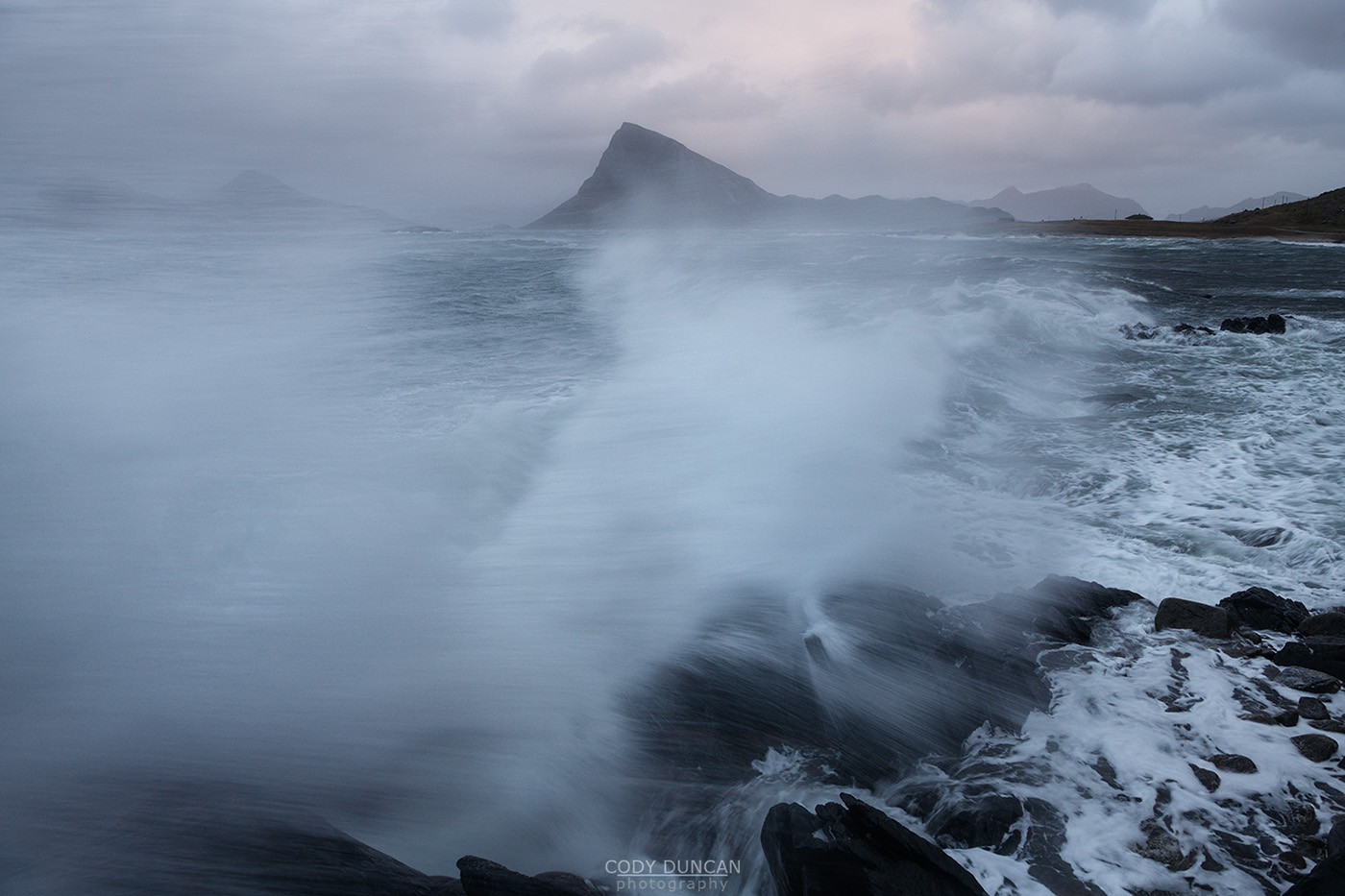
Photo: Storm over coast of Flakstadøy, Lofoten Islands, Norway. March 8, 2020. 13:06

Last week during one of the big storms I waited for a pause in the rain before walking down to the coast to checkout some of the action. The wind was blowing strongly – and actually blew me over/made me slip in the mud on my way back home. Out at the coast all I could do was sit, as it wasn’t safe to stand – especially for my camera!

This past weekend another big storm arrived, though it was a north wind, blowing the waves onshore, so not really possible to photograph from my area. And even the last days, which now feel almost calm, the wind has been blowing at near gale force. The wind seems endless this year.

I always find it difficult to photograph a stormy sea. When the big wind gusts arrive, everything turns into chaos and any composition I thought I might have had either disappears or just doesn’t look nearly as dramatic as the moment was. Especially shooting from sea level into a mostly grey sky, the scene looses all the contrast of the sea spray blowing off the waves.

In this scene I tried to put the distant mountain (Veggen) into the background for a little contrast to the flat grey sky. But even then, it is mostly just waiting and hoping that the wind gust arrives at the right time with the wave in the right location, etc. Just luck mostly. But even then, it’s also hard to give a sense of scale to such a scene.

Camera Info:
Nikon D850
Nikon 70-200 f/4
78mm
ISO 250
f 5.6
1/1000 seconds
WB Daylight