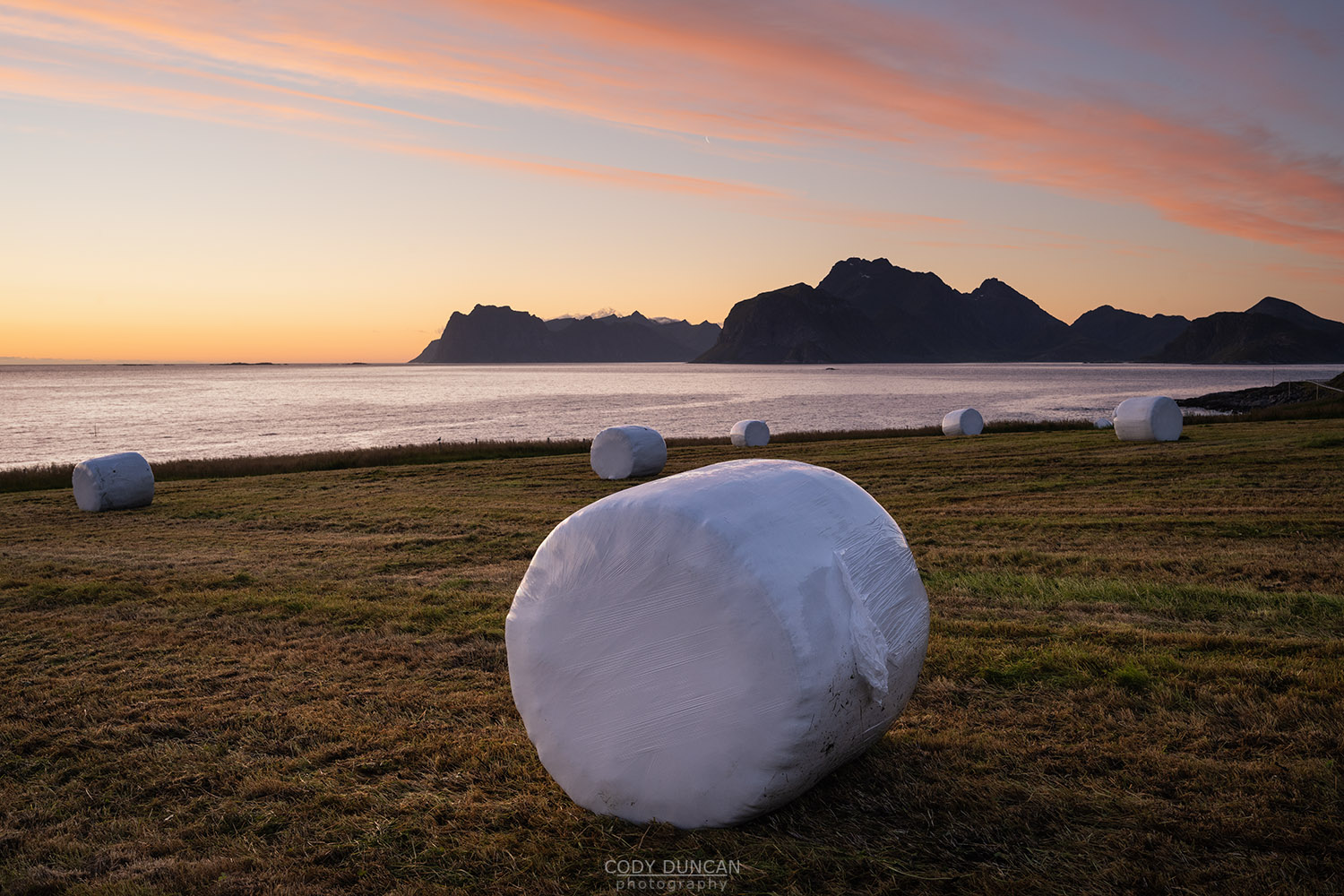
Photo: Norwegian Marshmallows – AKA tractor eggs – in freshly cut field in late July, Flakstadøy, Lofoten Islands, Norway. July 25, 2022. 01:42

Every year beginning sometime in mid July the summer harvest of the fields begin to provide winter feed for the few sheep still remaining on Lofoten. Until two years ago my neighbor used to farm this field, but he has since retired, leaving only one sheep farmer left in my small village. Even without local sheep, the grazing land remains quite important and other nearby farmers have taken over the cutting and harvesting of the fields.

A few weeks ago – Friday Photo #496 – I posted an image of the field on a stormy summer evening, still full of flowers but already becoming quite overgrown. It felt a little later of a harvest this year, even though the summer has been a good one and the overall feel of the landscape to me is that things are a few weeks ahead of ‘normal.’ Perhaps it was the fairly cold and wet weather in the second half of July this year that has seen them waiting.

And indeed they seemed to be in a hurry once the tractors did arrive; working until after midnight on both Saturday and Sunday nights. This picture was taken at near 02:00 early Monday morning just after they had finished wrapping the bailing the loose grass. And still later they returned to collect everything!

So for the farm meadows, the flowers are now gone for this year and harvested fields remain. In a while, once the grasses grow a little taller again, the sheep and lambs will be moved into the fields during the autumn after they’ve been collected from the mountains. And then they will also be gone, along with the migratory birds and one day I’ll stand out in my yard and notice that its eerily silent; all the life and noise of summer has gone. From then on, winter is not far away.

Head over to my Instagram account for (almost) daily postings of the local conditions here on Lofoten: @distant.north

Camera Info:
Nikon Z7 II
Nikon 14-30mm f/4
28mm
ISO 100
f 10
1/13 second
WB Daylight

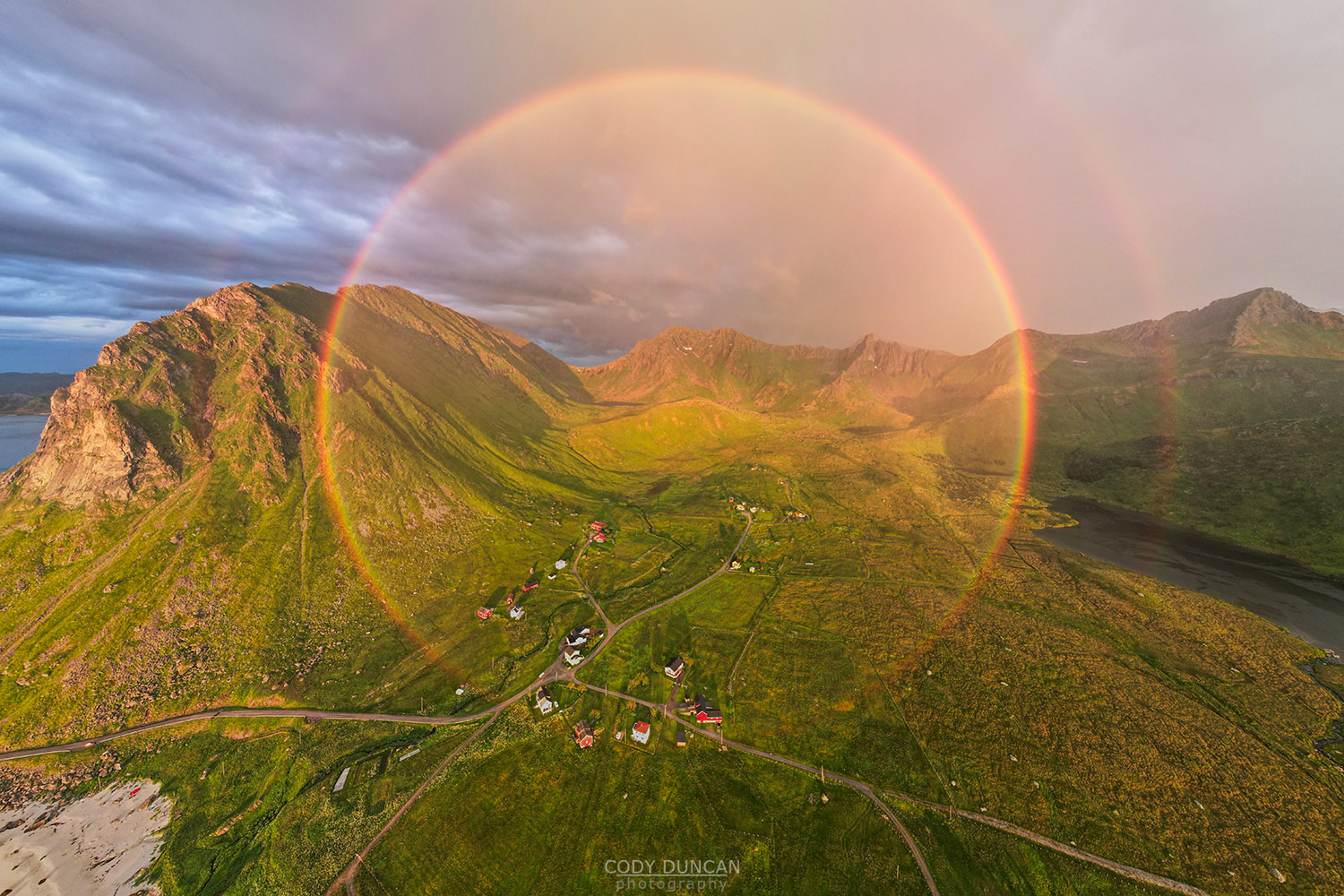
Photo: Full rainbow under light of the midnight sun, Flakstadøy, Lofoten Islands, Norway. July 4, 2022. 23:57

This was one of those stormy Lofoten days where the weather is quite boring and rainy during daytime, but as the sun gets lower on the horizon interesting light can happen. I had been out hiking Storknubben on GImsøy the day before in boring cloudless blue sky, but unfortunately had a meeting scheduled for this evening so I couldn’t get too far away from the house.

As midnight approached there was some nice light out in the distant mountains across the Nappstraumen so I wandered out to the field next to my house for a few shots. Soon I felt some drops of rain begin to fall while the sun was still shining bright. Behind me, I could already see the faint beginnings or a rainbow forming as the rain began to fall heavier and heavier from a seemingly invisible cloud.

With the sun low on the horizon and almost due north at midnight – the rainbow occurring almost directly south – I knew I wasn’t in the best location and it would take some time to get to a better composition for the location of the rainbow. So instead, I sent up my drone, which hasn’t seen much use this year as I understand their utility, I still have a fair dislike of them in general, just looking at the world through a tiny screen while a bunch of advanced technology does more or less all the work; that is not really photography for me. But alas, in the situation, my drone seemed like the best option, so I sent it up.

For what I generally consider the low quality image of a drone photo, I think it captured the moment pretty well, and was the only way I could do so without having already been on maybe Stornappstind, Middagstind or Møntind as the rain approached.

Head over to my Instagram account for (almost) daily postings of the local conditions here on Lofoten: @distant.north

Camera Info:
DJI Air 2s
ISO 100
f 2.8
1/100 second
WB Daylight

Photo: Cow parsley flowers blow in the midnight summer breeze, Nordlandshagen, Værøy, Norway. June 27, 2022. 01:10

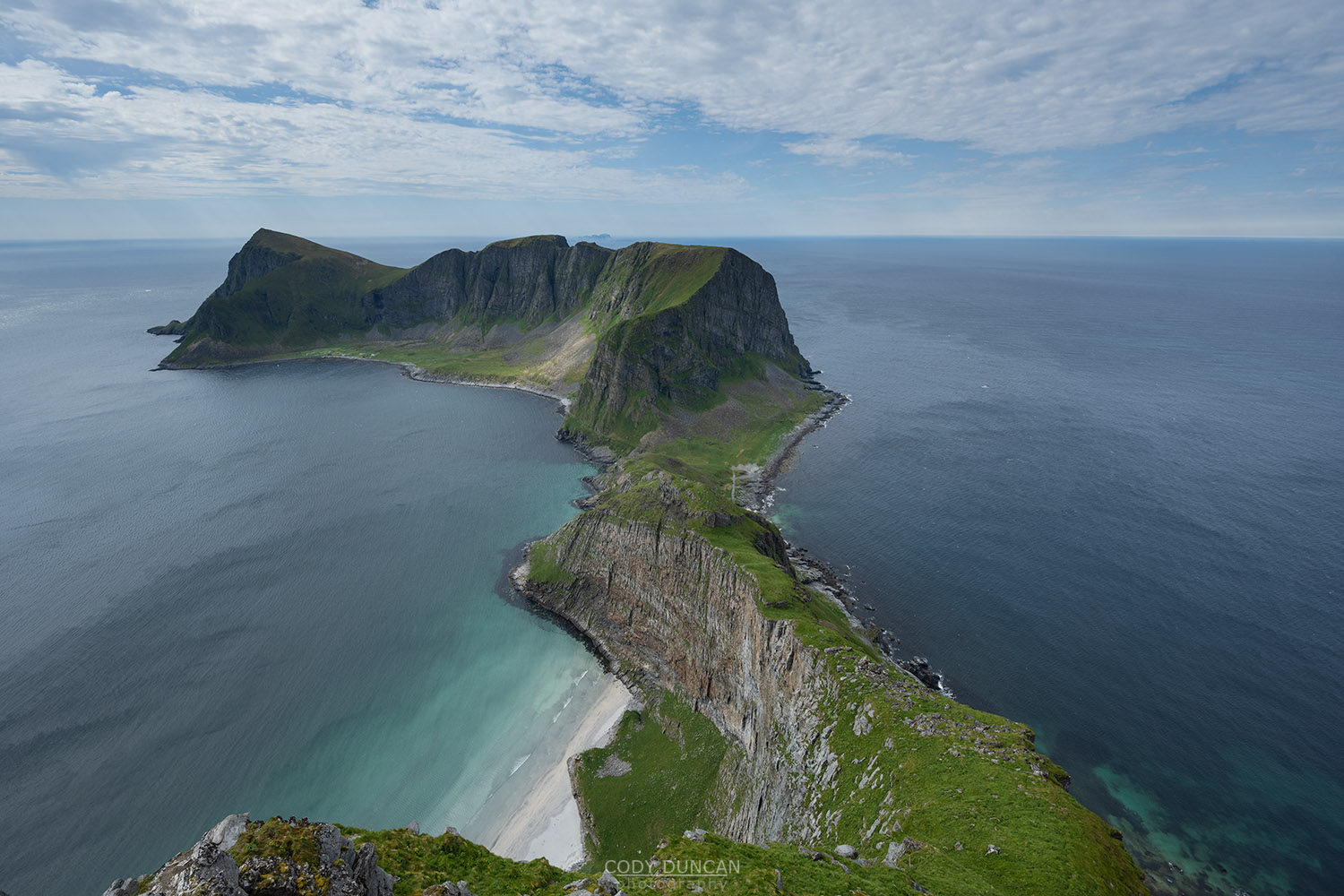
It feels strange to admit, but before the end of June, I had never stepped foot on Værøy before. I’ve passed by several times on the ferry – more so because I could get a little more sleep during winter during the longer journey from Bodø and not have such a long wait for the bus in Moskenes. And I’ve stared across the Moskensstraumen and the island rising in the distance. But it always just seemed some place that I could always go to, and thus never did…

And that was a mistake! I should have headed out there years ago. It is a wonder place that feels a little like ‘old Lofoten,’ before things got a little on the busy side and every single roadside parking spot is filled with motorhomes and camper vans. Værøy was peaceful and quiet. And there actually seemed to be much better tourism infrastructure than Lofoten, with signs, maps, and parking for the numerous hikes around the island, and a nice clean (and free) toilet at Nordlandshagen, where the hike to Måstad and Måhornet/Måstadheia begins. It kinda feels like a little island that time and tourism has overlooked.

Over the long weekend I headed up Håheia/Håen – probably the most famous hike on the island, Hornet, and Måstad/Måhornet, the westernmost peak on the island after a scenic coastal hike. Overall, there is a surprisingly good selection of hiking routes for such a small place, so I look forward to going back again soon. And even better, having started on July 1st, the ferry between Moskenes – Værøy is now free, even for cars. So it is now cheaper and faster for me to go to Værøy than even just to get to Bunes or Horseid beaches! Especially with the new expensive parking fees in Reine which make it a slightly unfriendly place to visit now for someone living just down the road…

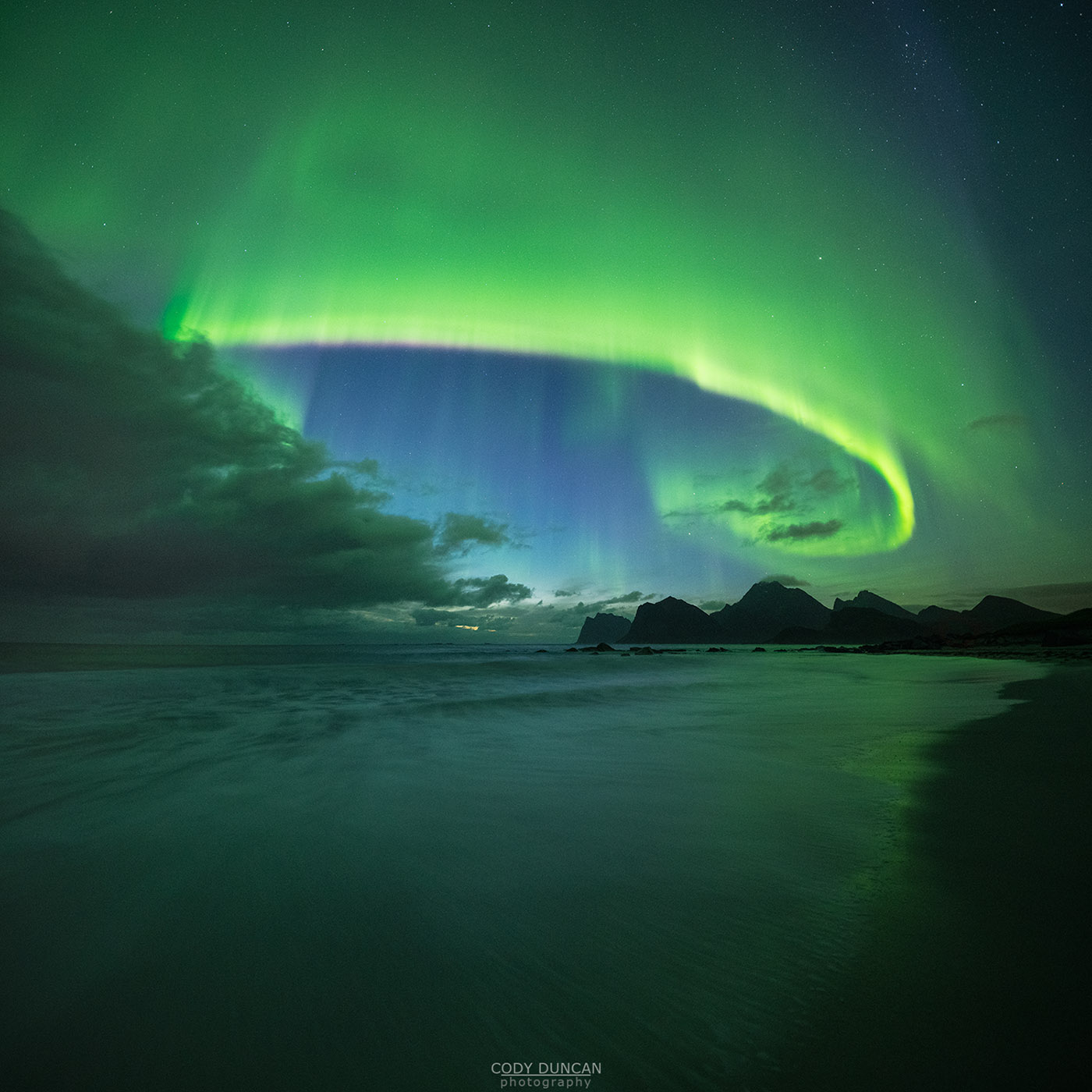
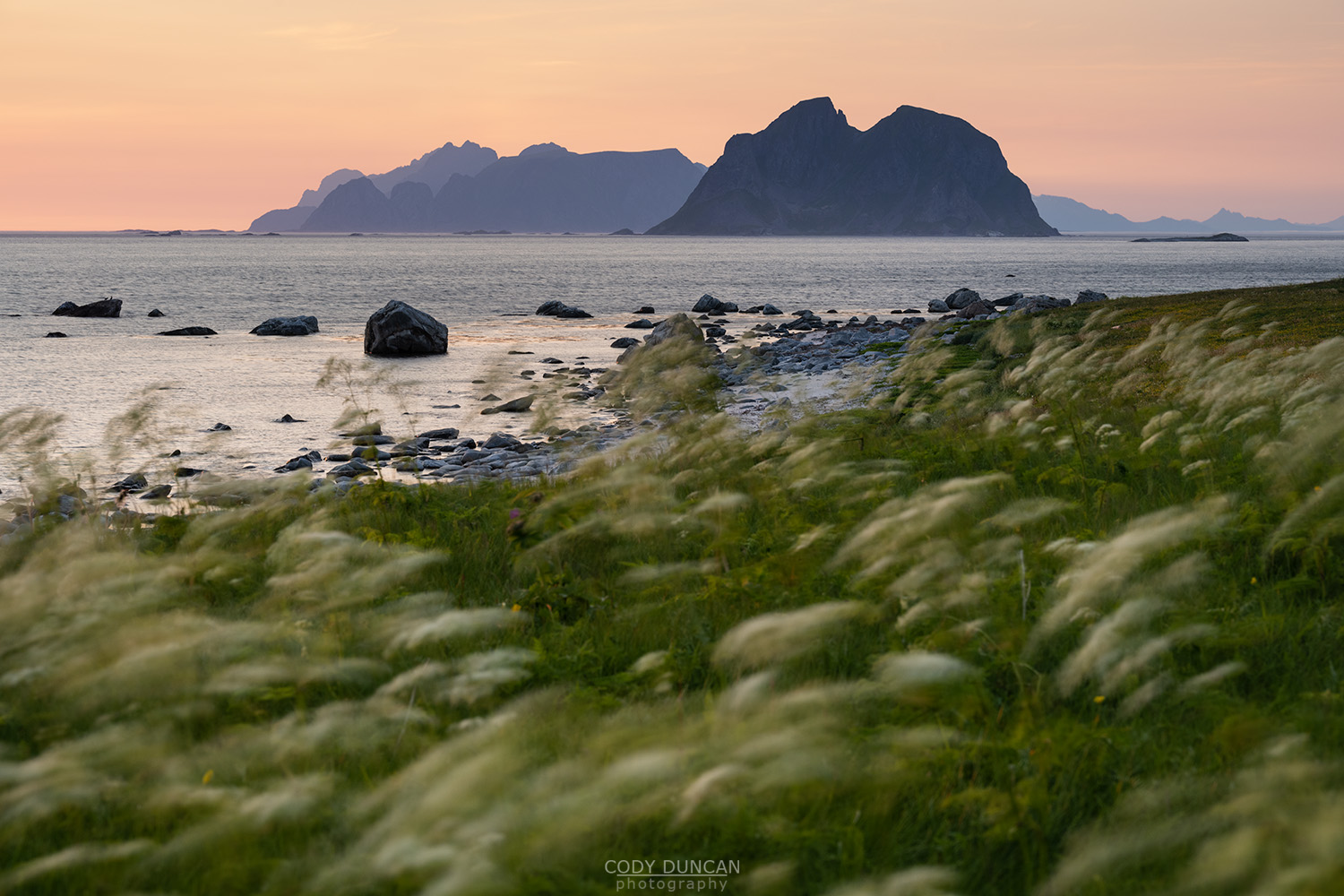
On this evening I had gotten back to my van early after hiking out to Måhornet. It was a hot day (by Værøy standards), but a breeze picked up near midnight – Its kinda always windy on Værøy it seems. Parked on the runway at the old airport for the night, the flowers were blowing in the soft and hazy evening light. Looking back north, first is the island of Mosken, then the distant silhouette of Lofoten proper. In autumn, this might be a nice view for northern lights dancing over the distant mountains.

Head over to my Instagram account for (almost) daily postings of the local conditions here on Lofoten: @distant.north

Camera Info:
Nikon Z7 II
Nikon 24-200 f/4-6.3
66mm
ISO 100
f 10
0.4 second
WB Daylight
3 Stop ND filter

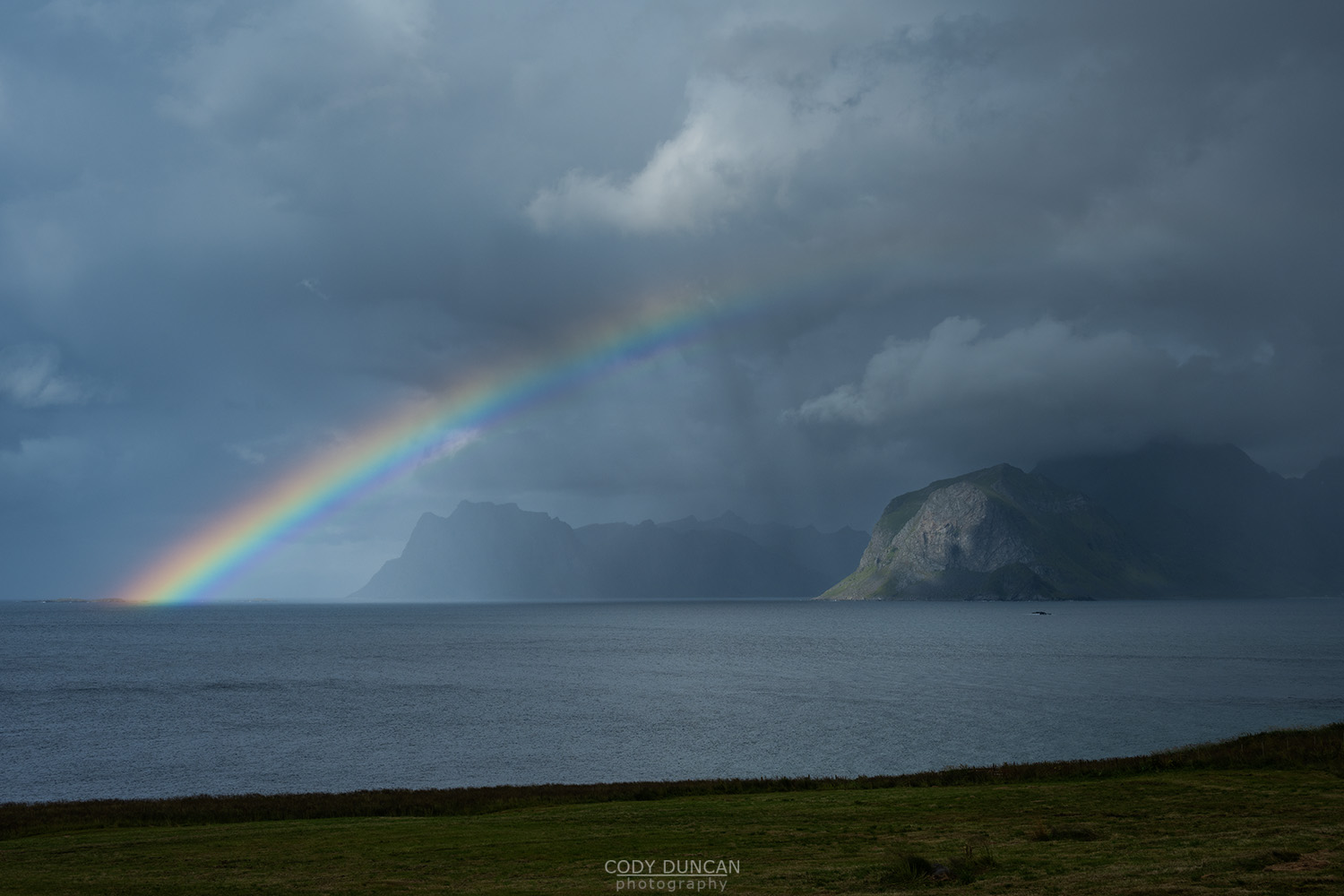
Photo: Midnight summer rain over mountains of Vestvågøy, Lofoten Islands, Norway. July 4, 2022. 00:07

So far this summer it has been one of those years with either completely clear weather or completely grey weather. And while sunset doesn’t occur during the midnight sun season from late May to mid July, so nice color can occur with the right cloud conditions. But often this year, even in the late night hours, the light has just been a bit, ‘ehhh…’ With the sun just hanging over the horizon in a semi-hazy blue sky. But finally this week there was a little bit of nice drama in the sky and the weather turned blustery and rain showers swept across the islands.

Luckily the fields by my house have escaped their summer cutting so far, by this late in the summer the grasses are already growing much higher than the flowers, giving the late a bit more of a wild and unkempt look than a few weeks previous. On my daily route to Leknes I can see the farmers have cut most of the fields already, so it won’t be long until this one is harvested as well and then the flowers will be gone for the year.

Head over to my Instagram account for (almost) daily postings of the local conditions here on Lofoten: @distant.north

Camera Info:
Nikon Z7 II
Nikon 24-200mm f/4-6.3
35mm
ISO 400
f 6.3
1/80 second
WB Daylight

Photo: Three seagull hatchlings in evening light, Flakstadøy, Lofoten Islands, Norway. July 1, 2022, 03:59

With summer will underway it is the beginning of hatching season for the local seabirds. What are usually already loud nights have become even louder as the various bird species squabble and fight to defend their chicks which are now free from the nests and generally just walk around. While there are (supposedly) no foxes on Flakstadøy, these three have a risky few months ahead of them, with predation from other birds the largest threat.

Beyond the wild lands of Lofoten, these little fuzzballs can be seen walking around literally everywhere during the next months: from parking lots in Leknes, sidewalks in Reine, piers in Henningsvær, and basically everyplace else. On my drive home from the Moskenes ferry late Monday night, there were multiple times I had to slow down on the E10 as there were various hatchlings just standing in the middle of the road.

These three have spend the last couple days on a rock just outside my house while the mother keeps watch the telephone pole in my backyard. Usually they take a bit more shelter in the grasses during the day and come out more in the evening hours. Though it does seem awfully exposed for them to just stand on top of a rock for several hours and I’m surprised I haven’t seen or heard any major attacks on them yet. Although perhaps the rock is safer, as the field will likely be cut within the week for winter feed for the local sheep, so probably best they stay out of the way of the tractor and mower.

Head over to my Instagram account for (almost) daily postings of the local conditions here on Lofoten: @distant.north

Camera Info:
Nikon Z7 II
Nikon 200-500mm f/5.6
500mm
ISO 400
f 6.3
1/640 second
WB Daylight

Photo: Arctic Skuas under the midnight sun, Flakstadøy, Lofoten Islands, Norway. June 18, 2022. 01:02

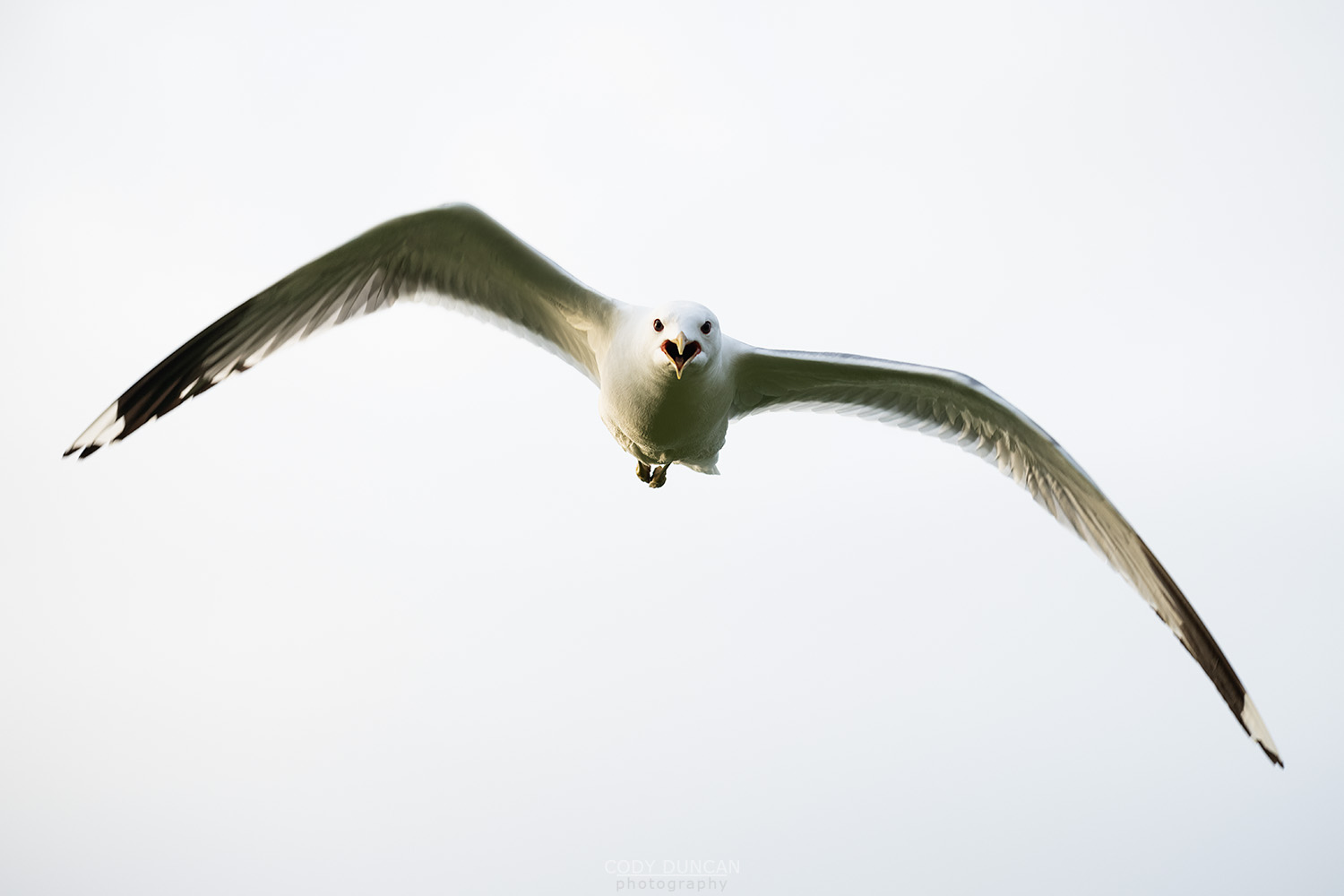
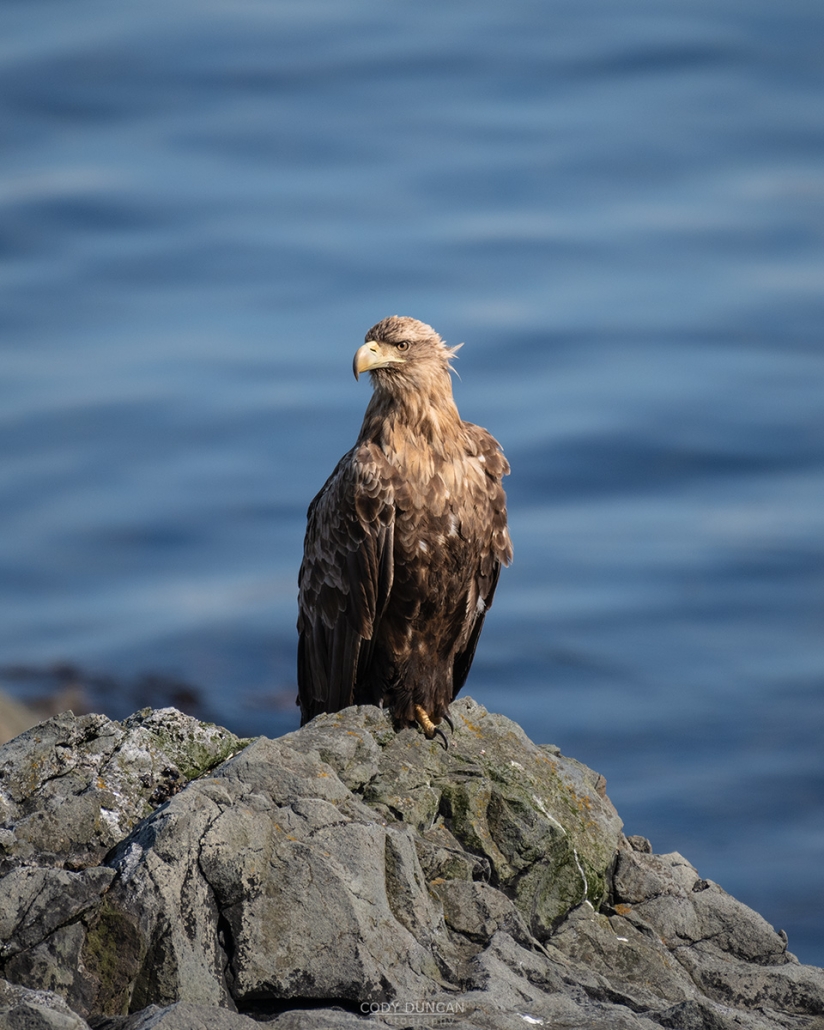
I am admittedly a terrible wildlife photographer and even worse when it comes to birds – probably because I don’t really have much interest in birds anyhow. But there is one coolish bird in my neighborhood – Arctic Skua.

I first encountered Great Skuas on Orkney in 2003 and then over several following trips. Last summer on Svalbard was my first encounter in Arctic Skuas. Much small than Great Skuas, they are equally aggressive when approaching too close to their nesting area and will repeatedly attack any trespassers. Given my mostly non-interest in birds, I never really noticed that they were also here on Lofoten, and a breeding pair is in my neighbourhood.

I’ve made a few attempts to photograph them, but have yet to return with anything very good. My 200-500mm lens seems too slow to focus while they are in flight – they are fast!. So I generally return with a whole card full of soft images. The surrounding mountains also make it difficult, mostly limiting my shooting direction north towards the open sea.

I’m not sure if I have to patience required for wildlife photography, but I’ll make a few more attempts over the summer months.

Head over to my Instagram account for (almost) daily postings of the local conditions here on Lofoten: @distant.north

Camera Info:
Nikon Z7 II
Nikon 200-500mm f/5.6
500mm
ISO 500
f 6.3
1/800 second
WB Daylight

Photo: Summer house by the sea, Flakstadøy, Lofoten Islands, Norway. June 17, 2022. 17:28

With midsummer less than a week away Lofoten is now reaching its peak summer lushness. The landscape is bright green and the fields filled with the endless colors of wildflowers (though mostly yellow). While the temperatures have been a little on the cooler side still, hovering around 10˚C, the sun provides plenty of warmth for an evening bbq.

I was out in the ‘myr’ – or boggy marshland of my valley this afternoon attempting to photograph the local pair or arctic Skuas. They are fast, and hard to photograph, and more so because the valley is surrounded on 3 sides by high mountains. So I can only really get clean shots while looking north towards the sea, but they never seem to be in that direction! And, they are fast. It was much easier to photograph them on Svalbard last summer, where the surrounding landscape was much more open.

Walking back, my neighbour’s house was looking quite ‘summery’ set against the distant mountains of Vestvågøy and surrounded by wildflowers. I would have like to go a little wider, but there is an old barn just off to the left which I didn’t want to include in the frame. It’s only a quick snapshot, but I think it sums up quite well a nice summer afternoon on Lofoten.

This look will only last a few more weeks at most after which any areas which are actually farm fields will be mowed for winter feed for Lofoten’s sheep and cows. While the wild areas still remain, quite a lot of the meadows are actually farm fields, especially on Vestvågøy and Flakstadøy.

Head over to my Instagram account for (almost) daily postings of the local conditions here on Lofoten: @distant.north

Camera Info:
Nikon Z7 II
Nikon 24-200 f/4-6.3
67mm
ISO 100
f 8
1/400 second
WB Daylight

Photo: Summer evening rainbow circles the sky over Haugheia, Vestvågøy, Lofoten Islands, Norway. June 8, 2022. 21:51

After last weeks brief visit of summer – hitting 20˚c on June 1st, the temperature took a significant drop over the weekend for several days of wind and rain, and a fresh dusting of snow down to about 700m. With the sun emerging again on Wednesday, I headed out to Haugheia for an evening walk and just to get the legs moving a bit after several days stuck here in front of the computer. The evening sun was shining in the mostly blue sky as I left home for the 10 minute drive to Haugheia.

As soon as I crossed the tunnel to Vestvågøy I noticed a bit of rain begin to hit my windshield. Hmm, that wasn’t supposed to be there. Soon, I noticed a fain rainbow being to appear over the leknes area, brighting over time as I neared the trailhead. As I got out of my van and put on my backpack a heavy summer rain was falling and a bright rainbow was circling the sky.

Haugheia wasn’t really the best location for such an occurrence, especially since it was nearly 20:00, the rainbow was in the southern part of the sky over the ugly industrial parts of Gravdal and Leknes harbor. So I just continued up the trail, trying to ignore the rainbow as I didn’t think I could get much of a shot anyhow. But as the minutes passed by, now probably 10 minutes since the rainbow first formed, it just stayed there. After a few minutes of hiking I got to a higher area where I finally thought it might at least be worth a quick snapshot.

There still wasn’t much, if any, of a foreground, but standing on a bit of a higher rock, I could at least take a semi-interesting shadow-selfie. Nothing special, but it would have been a shame to let such a nice rainbow pass without a single photo. So this was probably the best I could have managed in the situation. Had I known how long the rainbow was going to last, I probably would have driven to some other nearby location. Maybe next time.

Head over to my Instagram account for (almost) daily postings of the local conditions here on Lofoten: @distant.north

Camera Info:
Nikon Z7 II
Nikon 14-30mm f/4
17.5mm
ISO 10
f 7.1
1/125 second
WB Daylight

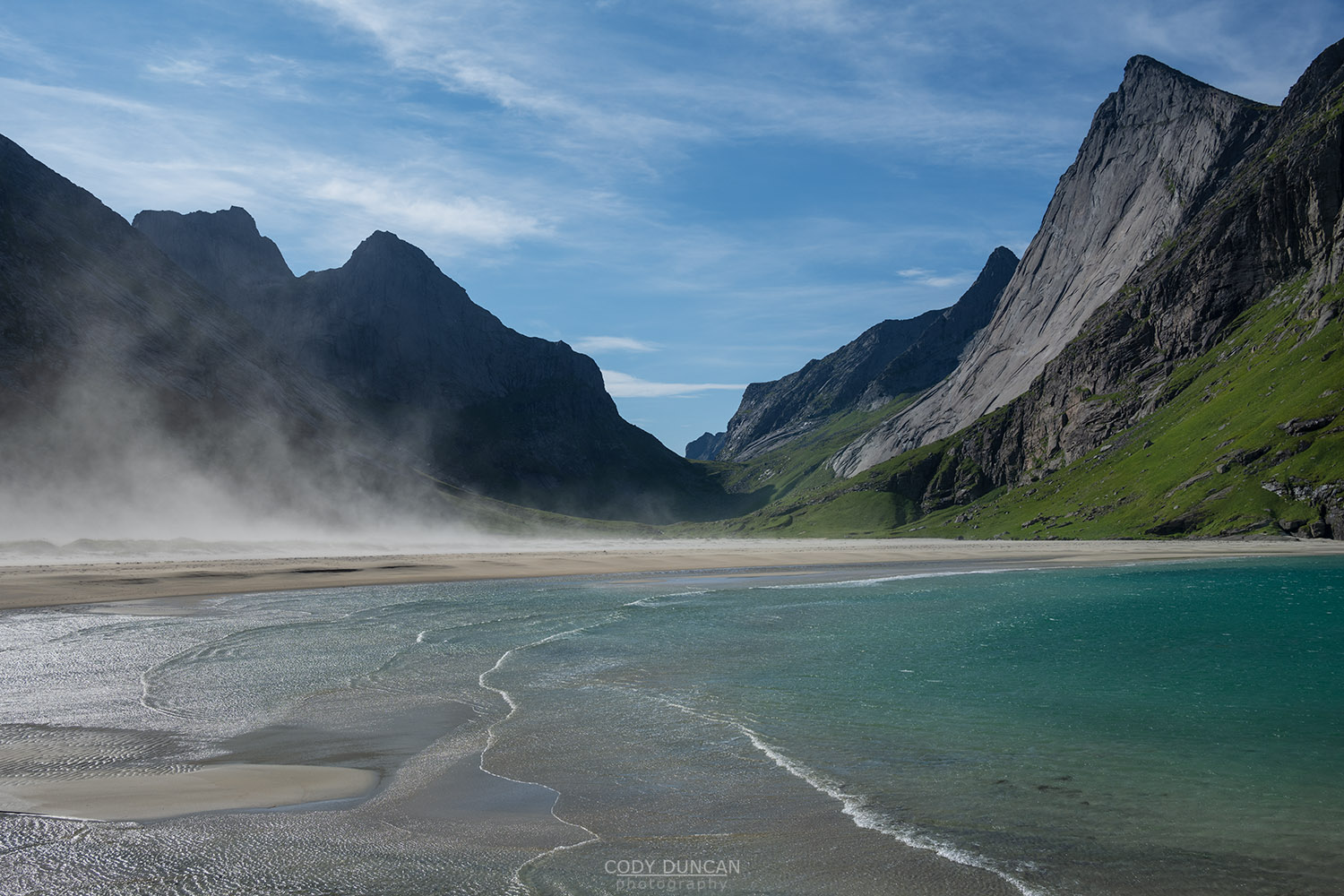
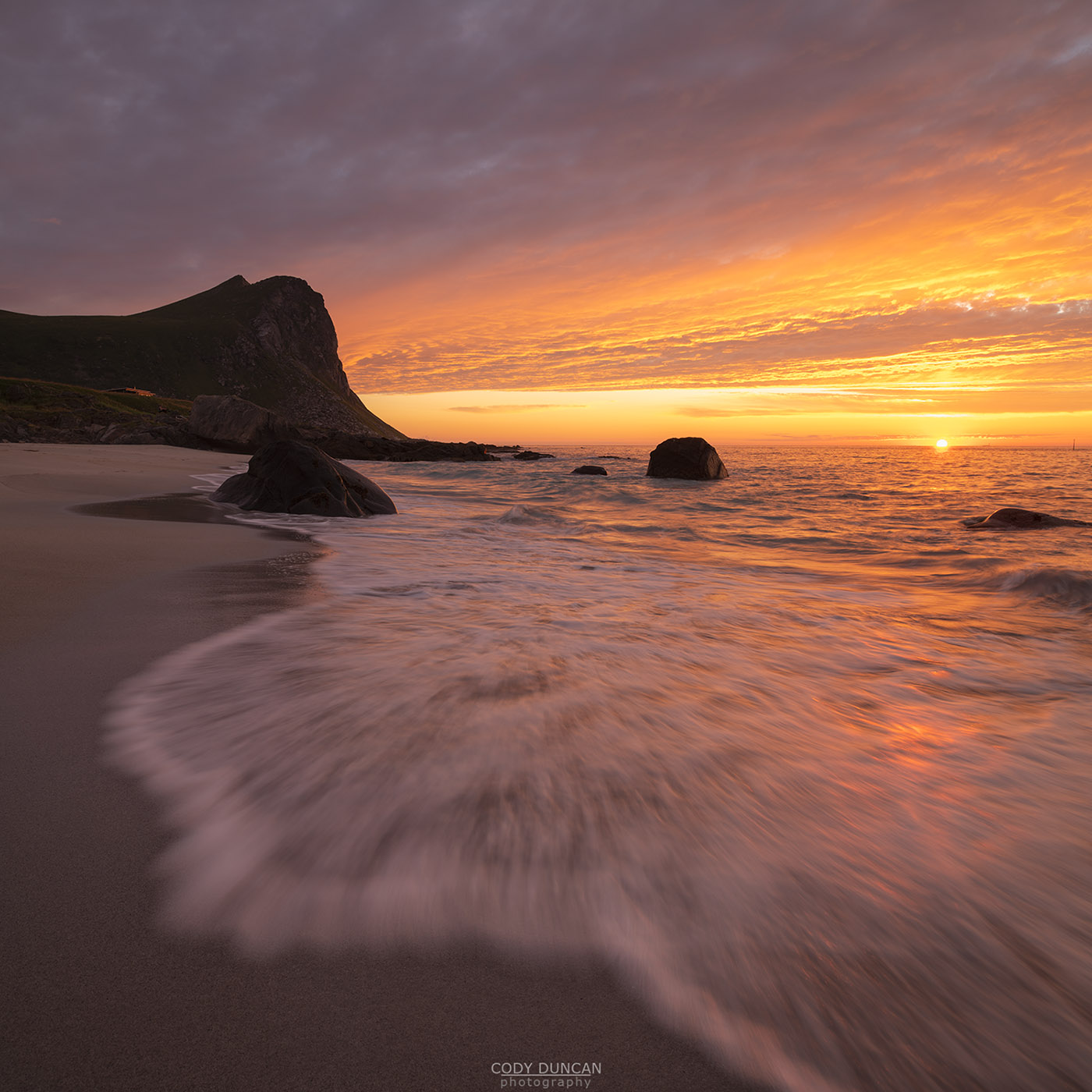
Photo: Midnight sun over Kvalvika beach, Lofotodden national park, Moskenesøy, Lofoten Islands, Norway. May 31, 2022. 00:02

After what has been a cold and wet spring this year, the last week has brought the arrival of the midnight sun and full summer weather! The weather here can often be just like switching on a light, it changes that fast. And luckily, once it changed for the better, it has lasted the better part of a week with t-shirt weather – even while sitting on mountain tops at midnight.

The good weather of the last week has seen me exploring some new mountain areas, as well as visiting some familiar one, such as this image of Kvalvika beach, before the summer season kicks into full gear and the popular places become a bit to busy for my liking. So it is good when I can visit them in summer like conditions still in May. And this year is feeling like it will be a busy one after two years of covid as the roads are already filled with continental camper vans and motorhomes.

The weather forecast on this evening was for clear sky, which is actually not that good for photography during the midnight sun season. And as you can see, the light is kinda ‘boring.’ With a fully clear sky there is often enough sea haze to block much of the sunlight, causing a weak and soft light to shine over the landscape, while the sky overhead remains bright blue. In winter, with snow covered mountains, this would be perfect light, but in summer, it doesn’t work as well.

As you can also see in the photo, the mountains area already backlit by the sun, so I’m only looking at the shadow side of them. If I was looking for dramatic sunset light on the mountains themselves, I would have to have been here earlier or later in the year, when the sun would be setting to the west and shining onto the mountains. Although then, the sun would not be in the image either.

On this evening, with a forecast for little to no wind, I was actually out at Kvalvika to photograph a different scene – these mountains reflecting in a small lake which is on the edge of the beach. But as I arrived out there at about 20:00 and 4 km of hiking, the beach side of the valley I hiked up and a bit of a breeze blowing in off the mountains and disturbing the lake too much for a reflection. I waited around for a while – until after midnight – hoping the wind would subside, but it never did.

Hiking back after midnight, once I got to the other side of the small mountain pass I could feel the conditions immediately calm. The (somewhat large) lakes I had to pass on my hike back to my van were perfectly still, with mirror like reflections of the surrounding landscape. So I was just a bit unlikely with the particular wind direction only affecting the Kvalvika beach area.

Head over to my Instagram account for (almost) daily postings of the local conditions here on Lofoten: @distant.north

Camera Info:
Nikon Z7 II
Nikon 14-30mm f/4
24mm
ISO 80
f 14
2 seconds
WB Daylight
6 stop ND filter

Photo: Ground nest in coastal moorland of common gull, Flakstadøy, Lofoten Islands, Norway. May 26, 2022. 16:07

With the midnight sun having arrived in the north and the landscape turning greener by the day – though the trees are still not fully green yet – it is breeding and nesting season for many of Lofoten’s migratory birds. 

Most of the birds are ground nesting, often choosing to hide their eggs in the thick and boggy heather of the coastal moorlands. But as the islands are full of birdlife, the nests are everywhere in reality. I’ve even seen young gull chicks walking around the parking lots in Leknes and Svolvær in the middle of the day. 

Most of the birds are semi-aggressive when you approach too close. The gulls and kittiwakes will scream as they fly towards you, but never get too close. The rarer, but highly aggressive arctic skua (dark brown in color) will come into near contact with your head in repeated attacks until you leave the nesting area. While others like the oystercatchers will try to distract you to get you away from their nesting site. 

If you are just walking through an area and suddenly notice aggressive bird activity, then take a little more caution to where you are walking, as you can see in the photo, the eggs are pretty well camouflaged, and easy to accidentally step on.

If you are camping, then you need to take a little more care to investigate the area and perhaps move away from a planned camping location. Continued proximity to a nesting area, such as setting up a tent for a night, may force the parents to abandon their nest for too long, and thus the chicks never hatch. So be careful to keep a great enough distance should you happen to enter into a nesting area.

Head over to my Instagram account for (almost) daily postings of the local conditions here on Lofoten: @distant.north

Camera Info:

Nikon Z7 II

Nikon 200-500mm f/5.6

450mm

ISO 500

f 5.6

1/1000 seconds

WB Daylight