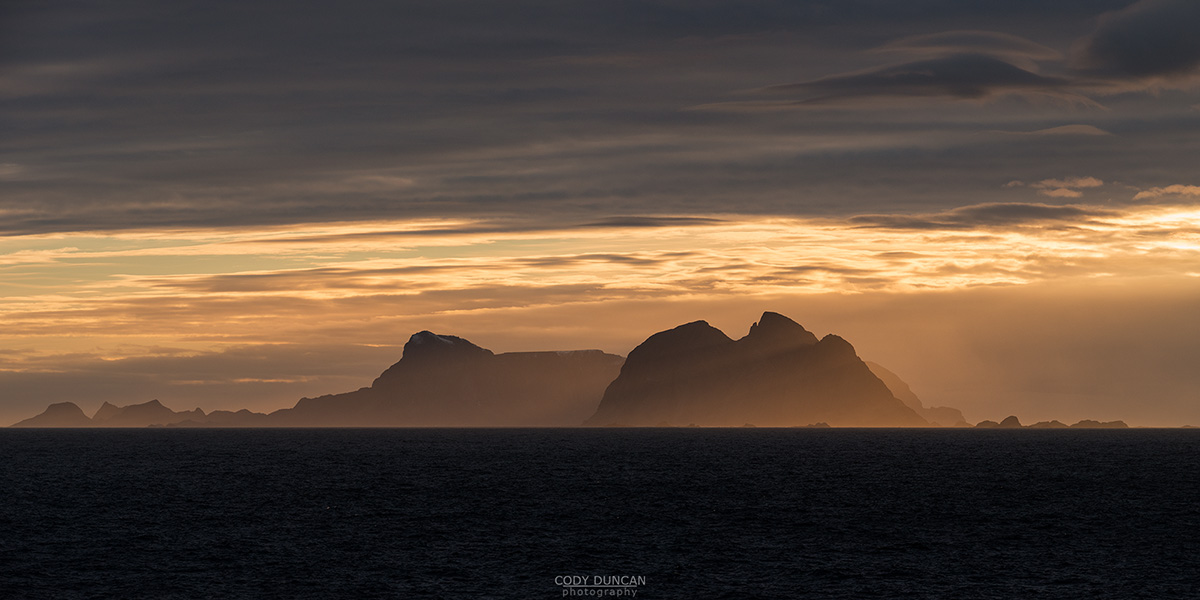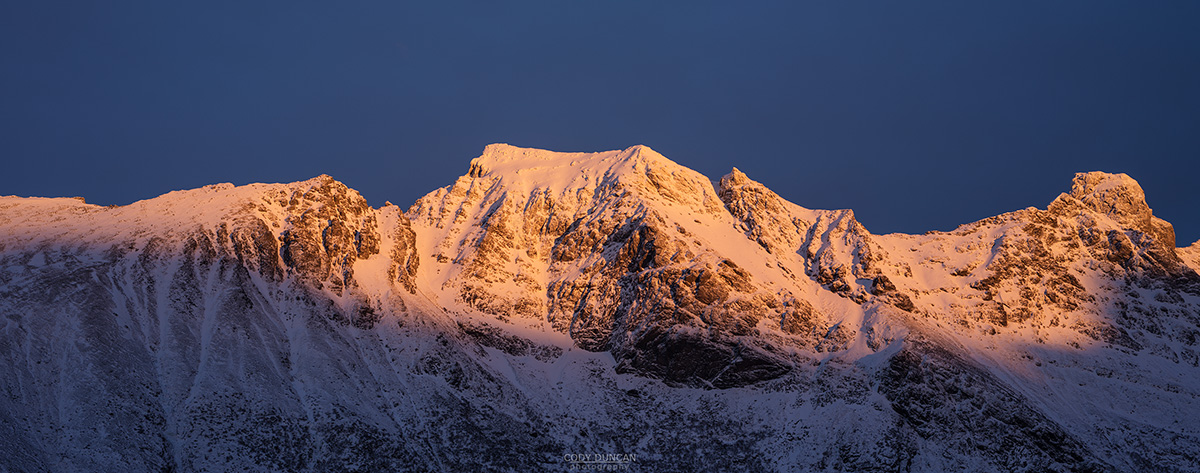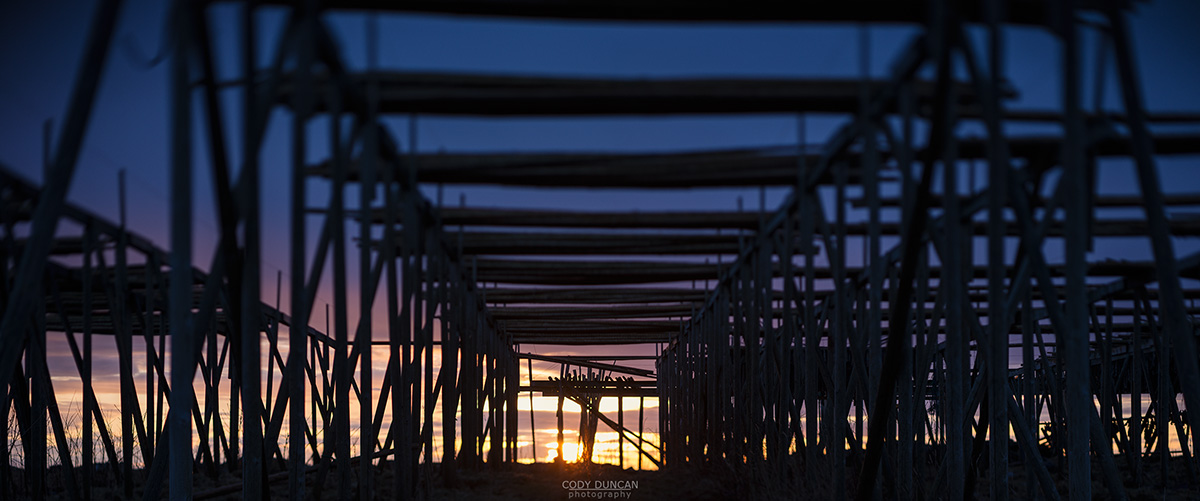
Snow covered winter landscape, Farstad, Vestvågøy, Lofoten Islands, Norway

Photo: Winter landscape, Vestvågøy, Lofoten Islands, Norway.  Feb 16, 2013.  14:22

The light on Lofoten is not always magical and quite often you’ll have to make due with much less than ideal conditions. This day in particular had been dull and flat, low clouds casting near contrast-less gray light over the land.  One of those days where I tend to drive in circles looking for something, yet often find nothing.

But Lofoten, particularly in winter, is more than glowing pink mountains and amazing sunsets.  The islands are often bleak, weary, and forlorn.  Skipping these moments means missing out on what the islands really are, while not always visually spectacular, the islands have more depth than the idealized illusion of them which we see posted all across the internet.

Camera Info:
Nikon D800
Nikon 24-70mm f/2.8
34mm
ISO 200
f 11
1/100 sec
WB Daylight
2 images – top, bottom
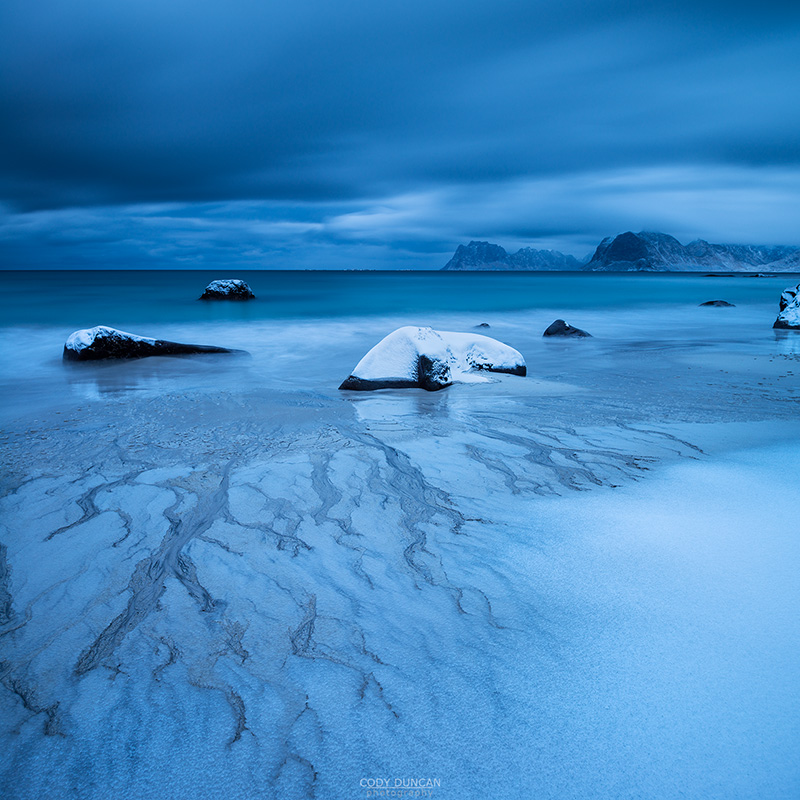
Ice coveres coastal rocks, Vik Beach, Vik, Vestvågøy, Lofoten Islands, Norway

Photo: Ice covered rocks at Vik beach, Vestvågøy, Lofoten Islands, Norway.  Feb 16, 2013.  16:40

I’m not quite sure what it is, but I often find myself to focus on certain places on any given trip to Lofoten.  In the past, I have driven past Vik beach quite literally dozens of times, yet never stopped to take a photo.  However in February 2013, I seemed to be photographing at Vik nearly every other day.  I’m not sure if it has anything to do with a particular location being more ‘in condition’ than other areas, or that I’ve just grown weary of other places over the years and look for something new.

Anyhow, while passing Vik on the way to camp at Utakleiv for the night I came across this scene.  It had been cold for several days and a few lights snows had fallen.  Had the ice on the rocks not been present, then I probably would have driven straight by this scene.  And while I feel the balance of the image is a bit off, I like the contrast of the white ice against the blue water, helping to and depth, and cold, to the image.

Camera Info:
Nikon D800
Nikon 24-70mm f/2.8
31mm
ISO 160
f 9
30 sec
WB Daylight
B+W 6 stop ND filter

Derelict Rorbu sits on edge of fjord, Vestvalen, Reine, Moskenesøy, Lofoten Islands, Norway

Photo: Abandoned Rorbu, Vestvalen, near Reine, Moskenesøy, Lofoten Islands, Norway.  Feb 17, 2017.  17:19

I posted a different version of this building a few months ago.  While I had been familiar with the location for many years, and had shot images from the building, I had never taken any images of the building, until this evening.

The last moments of light combined with low, heavy clouds provided the perfect atmosphere to accompany this abandoned rorbu for a scene that I waited years to come across.  I like to think I have seen everything Lofoten has to offer, but I have come nowhere close! Nearly every moment of every day is different, week after week, month after month, year after year.  I have rarely come across the same conditions in the same place twice.  One of the reason I never get bored with the islands; they are always changing!

While I don’t often tend to shoot architecture, this evening was perfect for this building.  Even to the detail of the mountain emerging from the clouds in the background.  I only had a short amount of time and then the sky opened up for the remainder of the night.

Camera Info:
Nikon D800
Nikon 24mm f/3.5 tilt-shift
24mm
ISO 100
f 8
20 sec
WB Daylight
2 images – top, bottom

Sunset at Bunes Beach, Moskenesoy, Lofoten Islands, Norway

Photo: Summer twilight over Bunes beach, Moskenesøy, Lofoten Islands, Norway.  August 16, 2013.  23:04

If you’re like me, and you like twilight, then even late summer on Lofoten leaves little time for sleep.  Only my second day on the islands and still jet lagged from travel, I was a little lucky to nap in the afternoons and not fully rise until the light was beginning to fade.

Bunes is a big beach!  I typically camp at the back of the beach, on the soft, grassy dunes, but from here it can be a bit of a trek before you actually reach the water’s edge.  What this means is that it’s usually not a simple task just to wander out for a photo or two, then head back.  It’s better to commit yourself for a few hours at a time, else you’ll spend more time walking than photographing.

I was lucky.  While the clouds were racing overhead, the wind on the beach remained calm.  With barely a glow left on the horizon, it was perfect lighting conditions for what I like to photograph on Lofoten.  Maybe a little more color could have been nice, but I still like the near mono-tonal quality of the blues.

Camera Info:
Nikon D800
Nikon 24mm f/3.5 tilt-shift
24mm
ISO 50
f 16
30 sec
WB Daylight
2 images – top, bottom
Olstind mountain peak rises from fjord, Reine, Lofoten Islands, Norway

Photo: Olstind Winter panoramic, near Reine, Moskenesøy, Lofoten Islands, Norway.  Feb 6, 2012.  16:10

Every time I travel to Lofoten I try and remind myself that I already have enough images of Olstind.  And yet every time I am there, Osltind provides me with something new, whether I want it or not.  And so, like sailers lured by the sirens, I find myself hopping across the rocks on the edge of the fjord, drawn towards Osltind.  The perfect mountain.

This particular day had been calm and cold.  The surface of the fjord began to freeze and the ice made an eerie sound as it gently broke against the rocks a few inches from my feet.  The sky was not quite what I was hoping, and the light a bit flat in the day’s final moments.  But with near perfectly still water, the reflection was perfect.

Camera Info:
Nikon D700
Nikon 24mm f/3.5 tilt-shift
24mm
ISO 200
f 8
.3 sec
WB Daylight
3 images – left, right, middle

Scenic winter view across Kjerkfjorden towards Vindstad, near Reine, Lofoten islands, Norway

Photo: Winter Reflection on Kjerkfjord, near Reine, Moskenesøy, Lofoten Islands, Norway.  Jan 6, 2010.  13:35

In the short days of early January the sun barely rises above the southern horizon.  If the sky is clear, then several hours of wonderful twilight is what a photographer will be rewarded with.

It is a rare event when all elements align perfectly, but when they do, there is perhaps no better place in the world to be than Lofoten, well, at least for those of us that like winter.

Nearing Reine, the fjord was almost perfectly still and they sky glowed pink.  In the distance, the snow covered mountains between Vindstad and Kjerkfjord reflected in the calm waters.  I knew I had precious little time on this day to get to as many places as possible.  Yet everywhere I looked was something amazing.  If I were able to stop the clock, then this this day could have lasted a full year…

Camera Info:
Nikon D700
Nikon 24-70mm f/2.8
70mm
ISO 200
f 8
1/40 sec
WB Daylight

View from Å towards end of Lofoten, Moskenesøy, Lofoten islands, Norway

Photo: Winter twilight, Å I Lofoten, Moskenesøy, Lofoten Islands, Norway.  Jan 6, 2010.  15:14

The first day of my January 2010 trip was finally coming to an end as I followed the light to the end of the road at Å I Lofoten.  And from there, proceeded to walk to the edge of the sea where the final glow of the short winter day was still holding onto a bit of life.

This location has become one of my favorite winter sunset spots over the last few years as the between January and early February the sun sets near the end of Lofoten in the distance.  Combined with a multitude of compositions, depending on how good the snow is, or not, it is a location that I usually walk away with something decent from.

Alone, as seemingly at the end of the world, I stayed out here until near darkness, wishing the light would last just a little bit longer.

Camera Info:
Nikon D700
Nikon 24mm f/3.5 tilt-shift
24mm
ISO 100
f 11
20 sec
WB Daylight
2 images – top, bottom
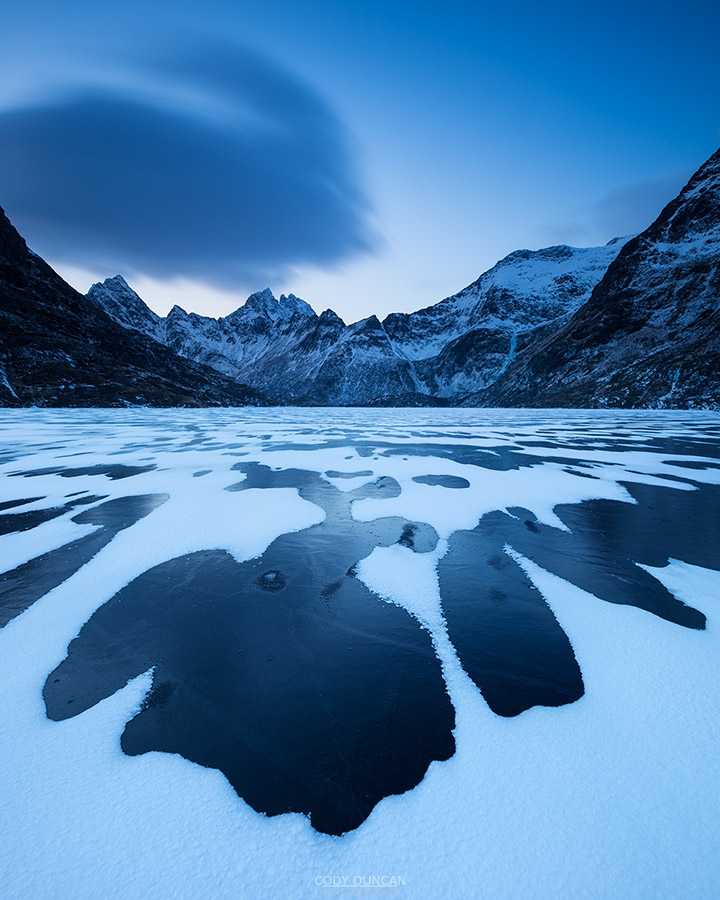
Lake Ågvatnet and snow covered mountain landscape, Å I Lofoten, Lofoten islands, Norway

Photo: Lake Ågvatnet in Winter, Å I Lofoten, Moskenesøy, Lofoten Islands, Norway.  Jan 6, 2010.  14:22

Having followed the light from Vestvågøy to the end of the road at Å on this short January day, and the only day I saw the sun on this trip, I was eager to get as much variety as possible.  While waiting for the light to fade a bit more before heading out to the coast for sunset, I wandered over to lake Ågvatnet, sublimely covered in a fresh layer of snow.

I took a few ‘normal’ images, ie. no tilt, but for some reason, the scene wasn’t doing much for me.  I’m not quite sure why, but I think it just felt a little out of balance and with no clear focal point.  Finally, I just decided to throw a full tilt on the lens, open up the f-stop for a shallow depth of field and focus on the pointy mountain in the distance.

This did the trick for me.  Combined with the soft light and fresh snow, this image has a bit more of an etherial feel that I typically shoot.  But I like it for some reason.  And the subtly of the image works well as a desktop background, which I currently use.

Camera Info:
Nikon D700
Nikon 24mm f/3.5 tilt-shift
24mm
ISO 200
f 4.8
1/60 sec
WB Daylight
2 images – top, bottom
Full lens tilt

driving on winter road with snow, Lofoten Islands, Norway

Photo: Heading to Haukland beach on winter roads, Vestvågøy, Lofoten Islands, Norway.  Feb 6, 2012.  8:57

This week’s photo is more for illustrative purposes than of something scenic.  With more and more people planning on visiting the islands in winter, it can be a bit of a shock to drive on the roads for the first time, especially if you are like me, and grew up in a temperate climate.

While my experience on the European continent is that they tend to keep roads snow free in winter, either by plow or grit, in Lofoten, this is not overly practical.  In big storms, the roads are cleared of deep snow and snow drifts, but overall, there always remains a layer of snow and ice covering any asphalt.   To deal with these conditions, the Norwegians (and Swedes) utilize studded tires from November to April.

While not like driving on dry asphalt, the studded tires work amazingly well.  In my estimate, I would say they retain about 70% the traction level of normal tires on dry conditions.  For road conditions like in this photo, you can more or less drive normally (but be weary on sharp turns).

Where driving conditions become dangerous is when the temperatures warm to 2-6 degrees above freezing and it begins to rain.  This turns all the hard, compacted snow of the roads into a layer of wet ice.  Scary and slippery!  The road plows are good at dealing with this and will have the main roads gritted and ice free within a few hours.  But I would suggest minimizing your driving during this period if possible.  I have gotten stuck a few times where I pulled down into an icy parking area and was unable to drive back out without considerable effort on my part to clear away enough ice to get a bit of momentum built up.

Camera Info:
Nikon D700
Nikon 16-35mm f/4
16mm
ISO 200
f 57.1
1/30 sec
WB Daylight

Stormy sky over Selfjord and mountains of Lofoten Islands, Norway

Photo: Ominous clouds fill the sky as I make my way towards Kvalvika beach, Moskenesøy, Lofoten Islands, Norway.  July 22, 2006.  19:24

I’m digging pretty deep into the archives for this one, mainly because Kvalvika beach has been on my mind a bit lately as I’m trying to come up with some plans for February, and this image is from my first ever camping trip to Kvalvika in the Summer of 2006.

It was early evening when my friends dropped me off at the trailhead for Kvalvika beach.  The clouds thus far in the day had been dramatic but the rain had held off so far.  Leaving the car and looking around, I was not quite sure what I was getting myself into.  I gave thoughts just to heading back to Stamsund, but I had already mentally committed myself to a couple nights camping at the beach, so I continued on with my plans.

A little ways up the trail I turned around for one last look over the fjord, this is the sight my vision brought.  I will admit to being slightly scared and worried if my tent would survive the night.  I have never seen a sky like this again in Lofoten.

By the time I began my descent to the beach a light rain was falling.  I managed to set my tent up among the grazing sheep of summer before the torrential rain began, and that it did.  Continuing more or less unbroken for the next two days until I packed my wet tent up and began the hike back over the hill.

Camera Info:
Nikon D200
Nikon 18-70mm f/3.5
46mm
ISO 100
f 5.6
1/200 sec
WB Daylight