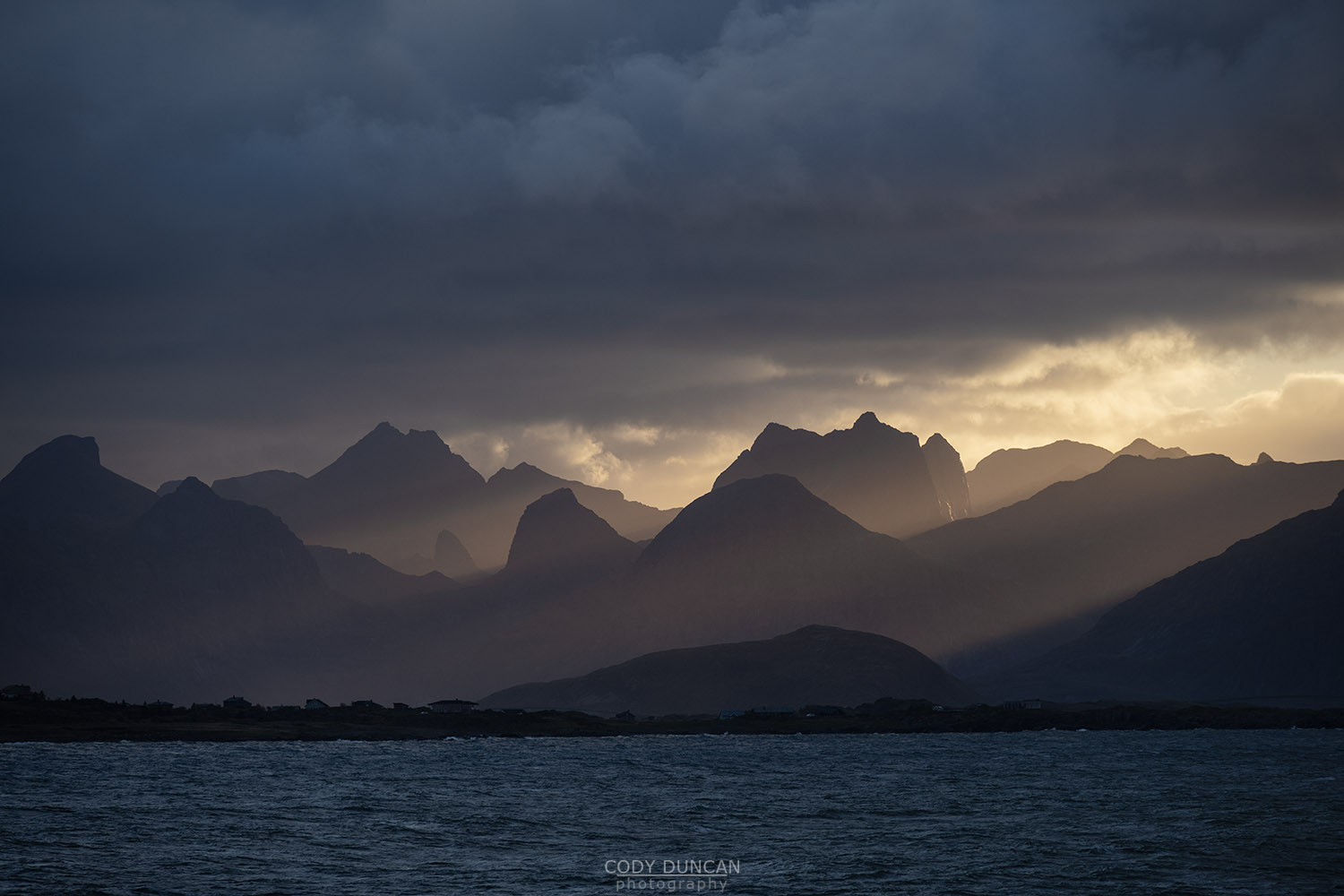
Photo: Rays of evening light shine across the distant mountains of Moskenesøy, Vareid, Lofoten Islands, Norway. October 7, 2021. 16:44
This weeks photo is more or less the exact same location and focal length (200mm) as last week’s photo – Friday Photo #507 – yet quite different light conditions and mood. As I wrote last week, the autumn (and late winter when the sun is setting in the same location) is often a nice time to shoot sunsets out on the coastline near Vareid and Vikten.
I usually find it more beneficial go well before sunset, as it will be setting behind the mountains, so it’s best to be there with the sun higher in the sky so it can interact with the mountains better. In this case, sunset was at 18:00, so this photo is taken 1:15 before sunset. With the sun too low in the sky, all the mountains seen here will just be shadow and the scene will be relatively boring under conditions such as this.
With the sun higher in the sky and shining in from the west, it really shows the mountain layers of western Lofoten, with the 1029 meter high Hermannsdalstinden (hiking guide) rising in the far distance some 25km away.
Head over to my Instagram account for (almost) daily postings of the local conditions here on Lofoten: @distant.north
Camera Info: Nikon Z7 II Nikon 24-200mm f/4-6.3 200mm ISO 100 f 8 1/320 second WB Daylight
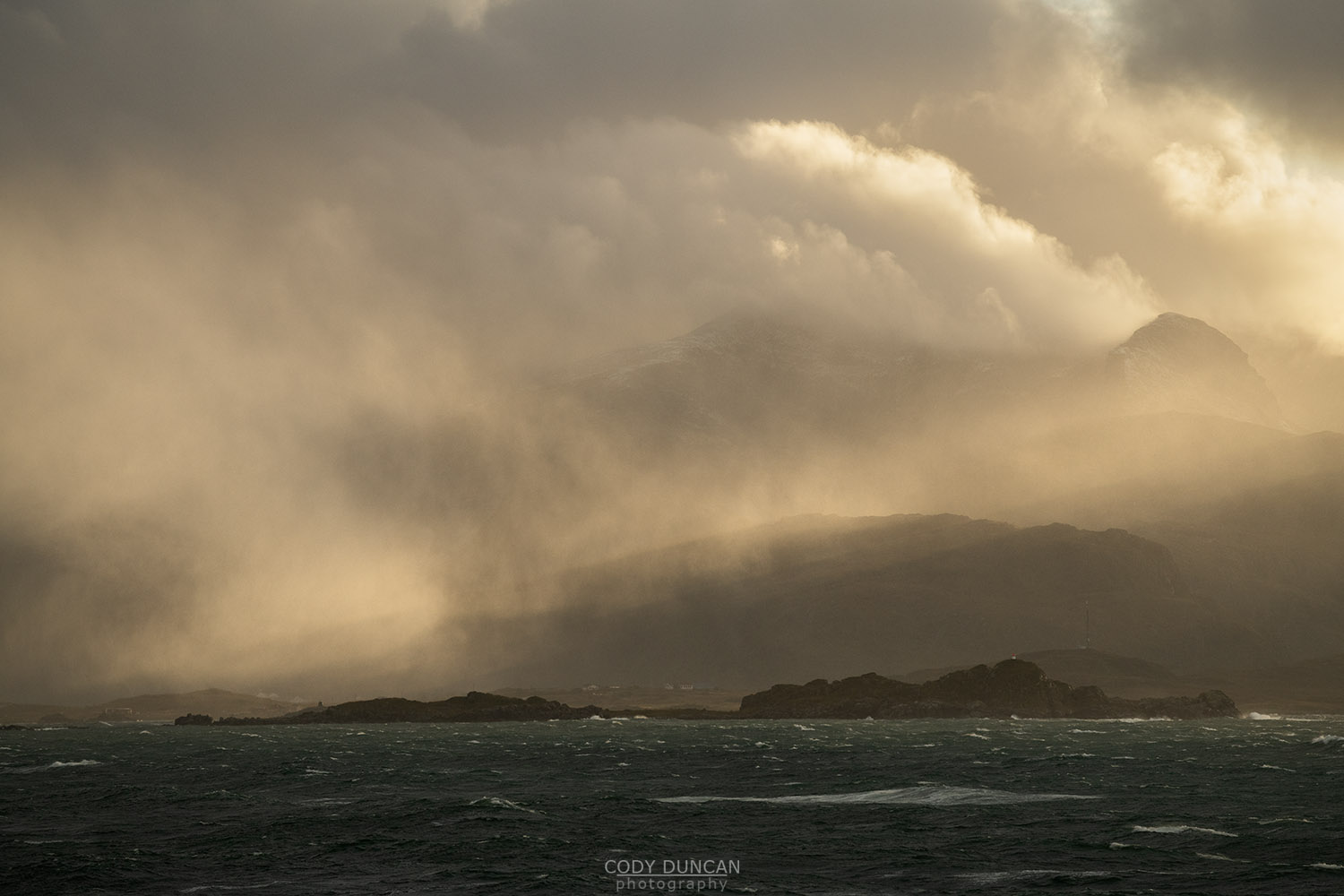
Photo: Autumn rain sweeps across distant mountains of Moskenesøy, Vareid, Flakstadøy, Lofoten Islands, Norway. September 24, 2018. 17:43
It is the autumnal equinox today marking the beginning of the sun’s journey to the south. For Lofoten, this is the time of year where one can really feel the days begin to shorten as the islands lose approximately 1 hour of daylight per week. For the northern side of the islands, this is also the time of year when the mountain shadows begin to grow as the sun sinks lower in the southern sky. For my house, the 20th of October will be the last brief moments of direct sunlight before it returns again on February 19th – 4 long months in the shadow of the mountains.
This was a stormy and blustery September day, just on the edge of being too stormy. Luckily, The clouds were broken up enough to allow some rays of light shine through as the next wave of snow flurries swept across the landscape. I was out on the coast between Vareid and Vikten, which often works well for sunset at this time of year as the sun shines across the distant mountains of Moskenesøy, often creating interesting patterns of light and shadow.
Head over to my Instagram account for (almost) daily postings of the local conditions here on Lofoten: @distant.north
Camera Info: Nikon D850 Nikon 70-200mm f/4 200mm ISO 320 f 6.3 1/640 second WB Daylight
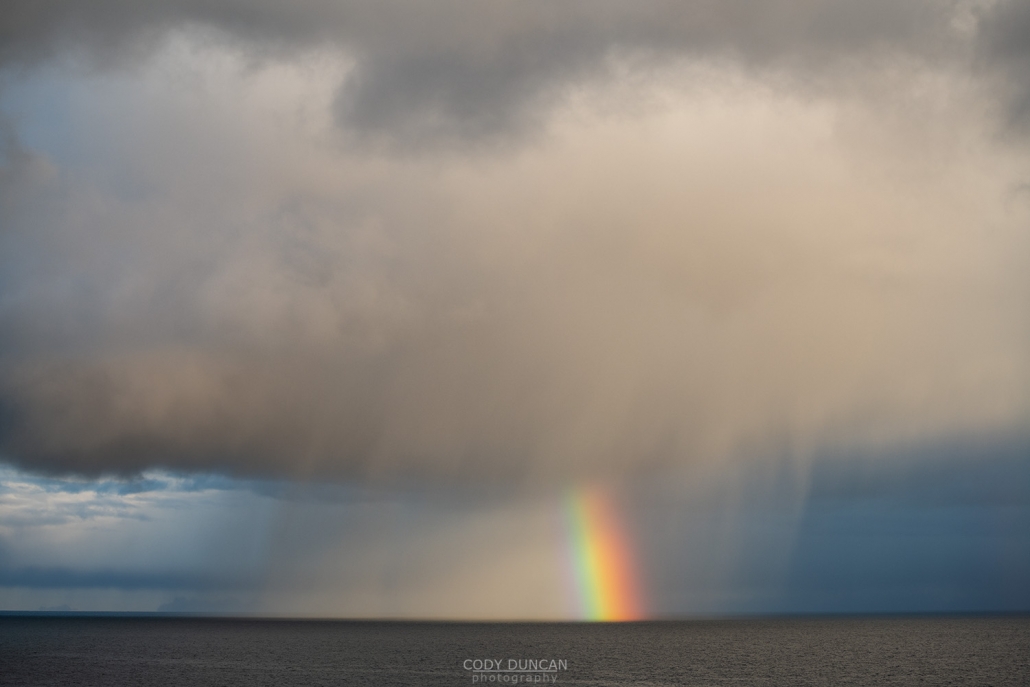
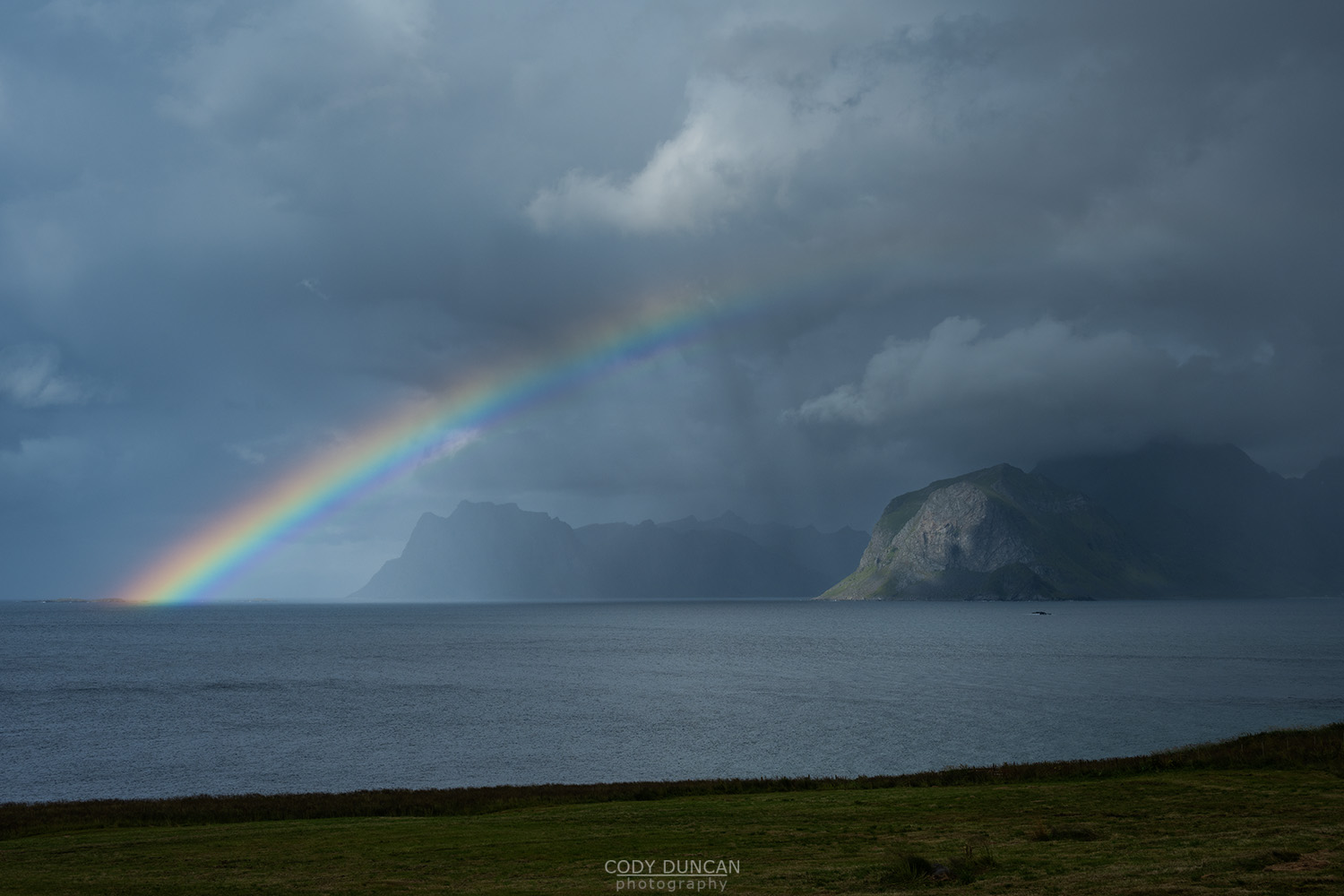
Photo: Autumn rainbow over Vestfjorden, Lofoten Islands, Norway. October 14, 2019. 16:12
Autumn is a quiet period on Lofoten. The hustle and bustle of summer has gone and the winds of the winter storms have yet to arrive. Often is it a somewhat gradual change in which I eventually notice that one day the world suddenly feels quiet. But not this year.
I spent the second half of August traveling with my brother and friends along the north coast of Spain. Fun, but hot! Without even returning home, I arrived back at Harstad-Evenes airport and immediately drove to Sweden to hiking 140km along the northern section of the Padjelantaleden trail and a middle section of the Kungsleden trail, back to my van which had been parked in Kvikkjokk. It was a pretty quick transition from 30˚c of Spain to several nights below freezing in the mountains of Sweden. From Kvikkjokk, it is a long 10 hour drive home.
Waking up in the morning after my arrival I immediately noticed the absolute silence of the land. Even the sea was silent. It was eerie. Like I was in some sort of post-apocalyptic movie and everyone and everything had suddenly disappeared. Some wind and rain has passed during the last week, brining a bit more life to the islands, but it is still quiet. Having been long overdue with mowing my lawn, it felt like I was making a great disturbance in my valley on a Tuesday afternoon.
So, after a month of travel, I haven’t taken a single photo of Lofoten in the week that I’ve been home. The weather has been little on the grey side, but there has still been some nice light to find if one has been willing to put in the effort – which I have not – as I’m mostly stuck behind the computer catching up on overdue work.
This weeks photo is from back in 2019. I thought I had posted it already, as I quite like the simplicity of it – just a rainbow over the sea. I was with a group out on the southern coast of Flakstadøy near Nesland waiting for the clouds to clear over some distant mountains when I sensed the light changing and this bright rainbow fell from a rain shower over the Vestfjord. From my position I knew there wasn’t anywhere I could get in time to use the rainbow as part of some other composition, as it was too far out at sea and away from any nearby mountains or coastline. So I switched to a 70-200 telephoto lens and simply used the rainbow and cloud as the only subjects – which they were. I usually like to include a sense of place in my images, I don’t think it was necessary.
Head over to my Instagram account for (almost) daily postings of the local conditions here on Lofoten: @distant.north
Camera Info: Nikon D850 Nikon 70-200mm f/4 82mm ISO 100 f 5 1/400 second WB Daylight
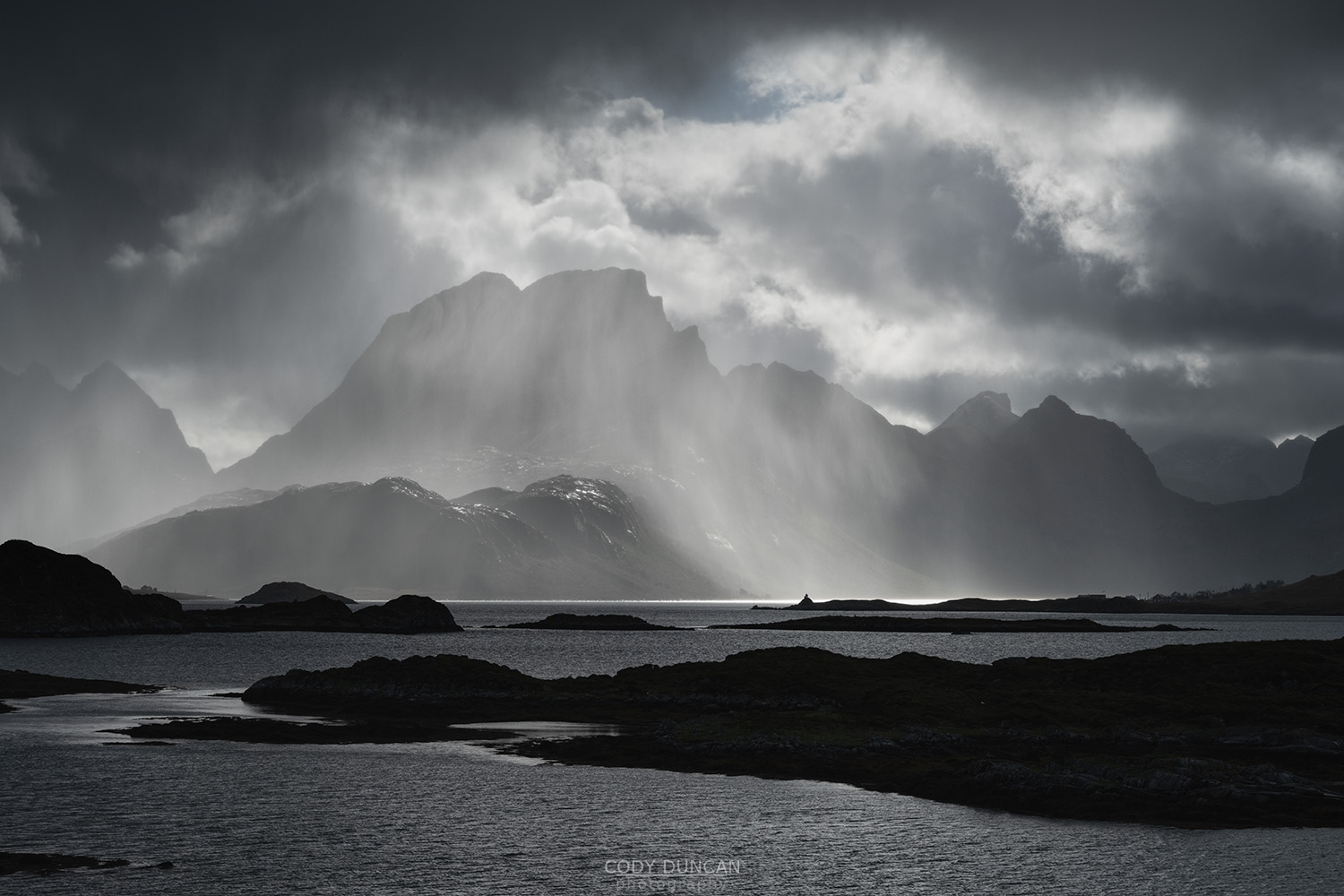
Photo: Autumn rain showers fall over Narvtinden, Moskenesøy, Lofoten Islands, Norway. September 13, 2021. 14:57
Compared to last weeks photo (Friday Photo #504) of somewhat boring and flat autumn rain, this week’s is a more dynamic version when bad weather should be embraced for the light it brings.
Lofoten’s weather changes quickly in the autumn. Two days previous to this it had been cloudless blue sky, the day before flat, grey clouds, and the evening after northern lights were dancing in once again clear sky. Four days with four completely different moods and photographic potentials. This is one of the reason that autumn is one of my favourite seasons on Lofoten; it is a dynamic time of year.
On days where I can see the rain is broken up in passing showers, as opposed to just one giant rain clouds covering Lofoten, I like to look for backlit showers in the late afternoon while looking west. Typically a day like this, if conditions remained the same, is unlikely to have much of a sunset if at all, as there are too many clouds concealing the lower horizon. Then it is often better to shoot mid mornings or mid afternoons with the sun higher in the sky, giving it more of a chance to shine through the gaps in the clouds. Although if you’re lucky, this type of weather might also produce epic rays of light near sunset of all conditions line up correctly.
Head over to my Instagram account for (almost) daily postings of the local conditions here on Lofoten: @distant.north
Camera Info: Nikon Z7 II Nikon 24-200mm f/4-6.3 75mm ISO 100 f 10 1/500 second WB Daylight
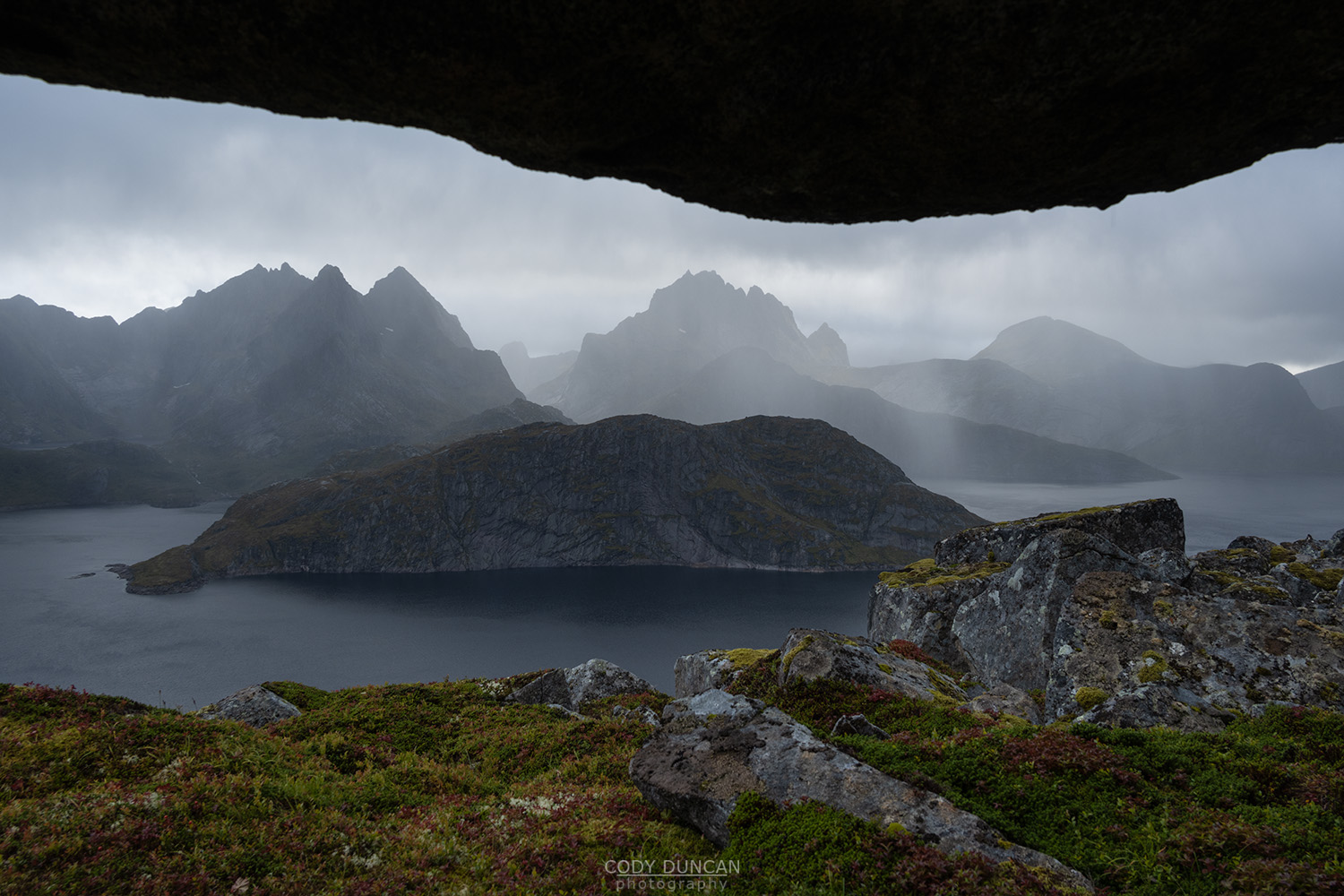
Photo: September rain over the mountains of west Lofoten above lake Solbjørnvatnet, Moskenesøy, Lofoten Islands, Norway. September 3, 2021. 16:33
As the calendar pages turn to September Lofoten enters the historically rainy and wet autumn period. September usually averages to just over double the total rainfall as August, and October brings even a bit more rain than that. Of course, these are just historical trends and some years are better than others if lucky, while others can be much worse!
For example, in 2021 September and July had roughly the same amount of rainfall. This wasn’t because it was a dry September, no, it was about average. It was because it was a terrible July, with roughly triple the rainfall than average. So, as far as last year was concerned, there was little difference between July and September’s weather. What this year will bring is anyone’s guess.
On this afternoon, I hiked up to the small mountain Tekoppstetten above lake Solbjørnvatnet in hopes of some nice shows of light in the passing rain. No light of too much interest arrived, just heavy rain and heavy clouds covering the landscape. Luckily, there’s a small cave to hide in to keep dry as I waited. But eventually, with the radar looking worse and worse I headed back down the muddy mountain path.
Head over to my Instagram account for (almost) daily postings of the local conditions here on Lofoten: @distant.north
Camera Info: Nikon Z7 II Nikon 24-200mm f/4-6.3 24mm ISO 100 f 9 1/50 second WB Daylight
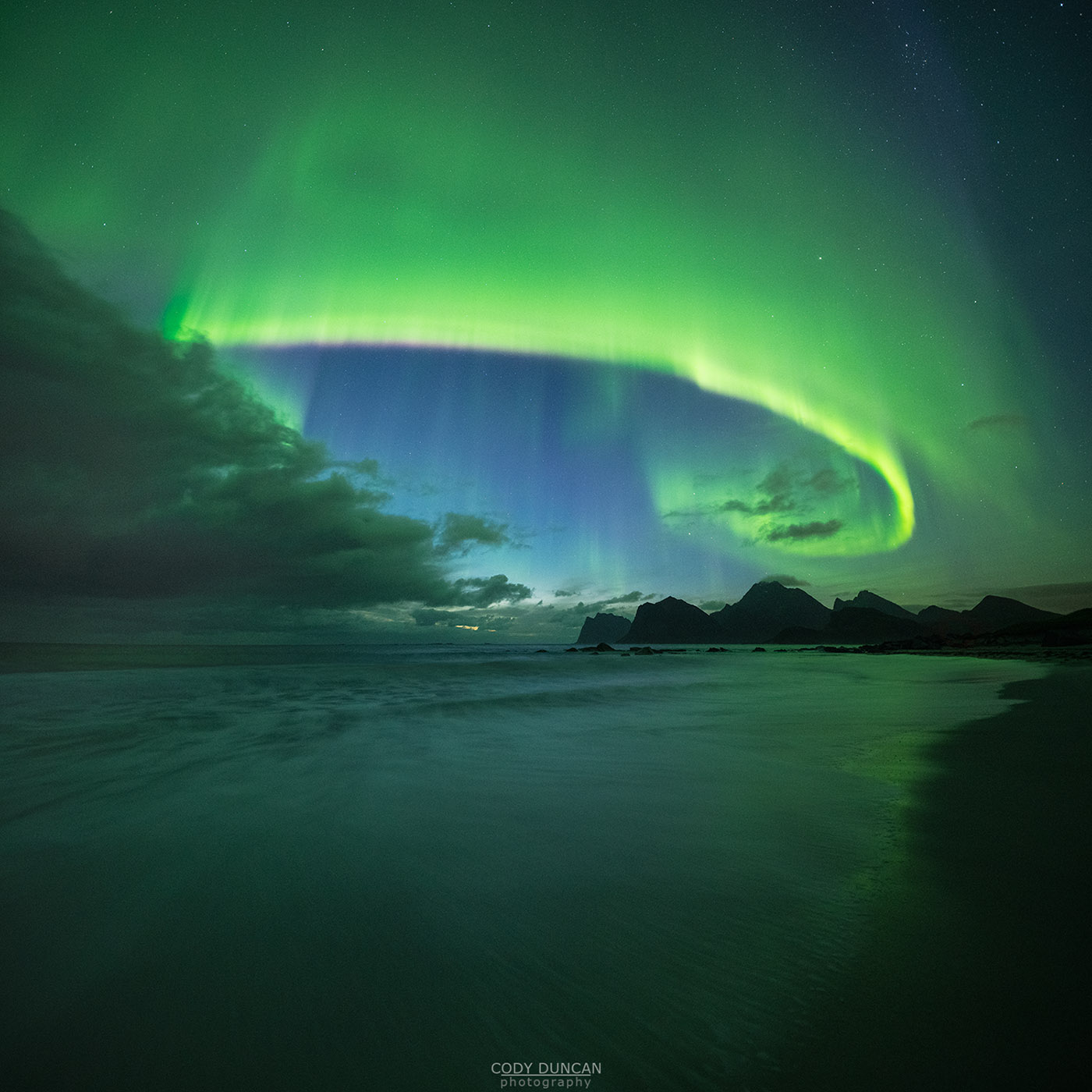
Photo: August northern lights spiral into the sky over Storsandnes beach, Flakstadøy, Lofoten Islands, Norway. August 31, 2020. 00:50
This week it is my yearly reminder that the northern lights are not just a winter phenomenon and can already become visible in the last week of August in the sky over Lofoten.
Lofoten’s aurora season runs roughly from August 20 – April 20; so they are visible from Lofoten for 8 months of the year! For the very early and late auroras to be visible, it will typically have to be from a moderate solar storm, pushing the northern lights fully overhead or even into the southern part of the sky. Low to moderate activity needs a little longer to be visible, as the northern horizon still glows quite bring into the first weeks of September and from the first week of April.
Happy aurora season for all those coming north in the next months. The sun’s activity is still increasing over the next years, so the northern lights will be more common than previous years – it just requires the weather to cooperate!
Head over to my Instagram account for (almost) daily postings of the local conditions here on Lofoten: @distant.north
Camera Info: Nikon Z7 II Nikon 20mm f/1.8 20mm ISO 2000 f 2 2.5 seconds WB Daylight
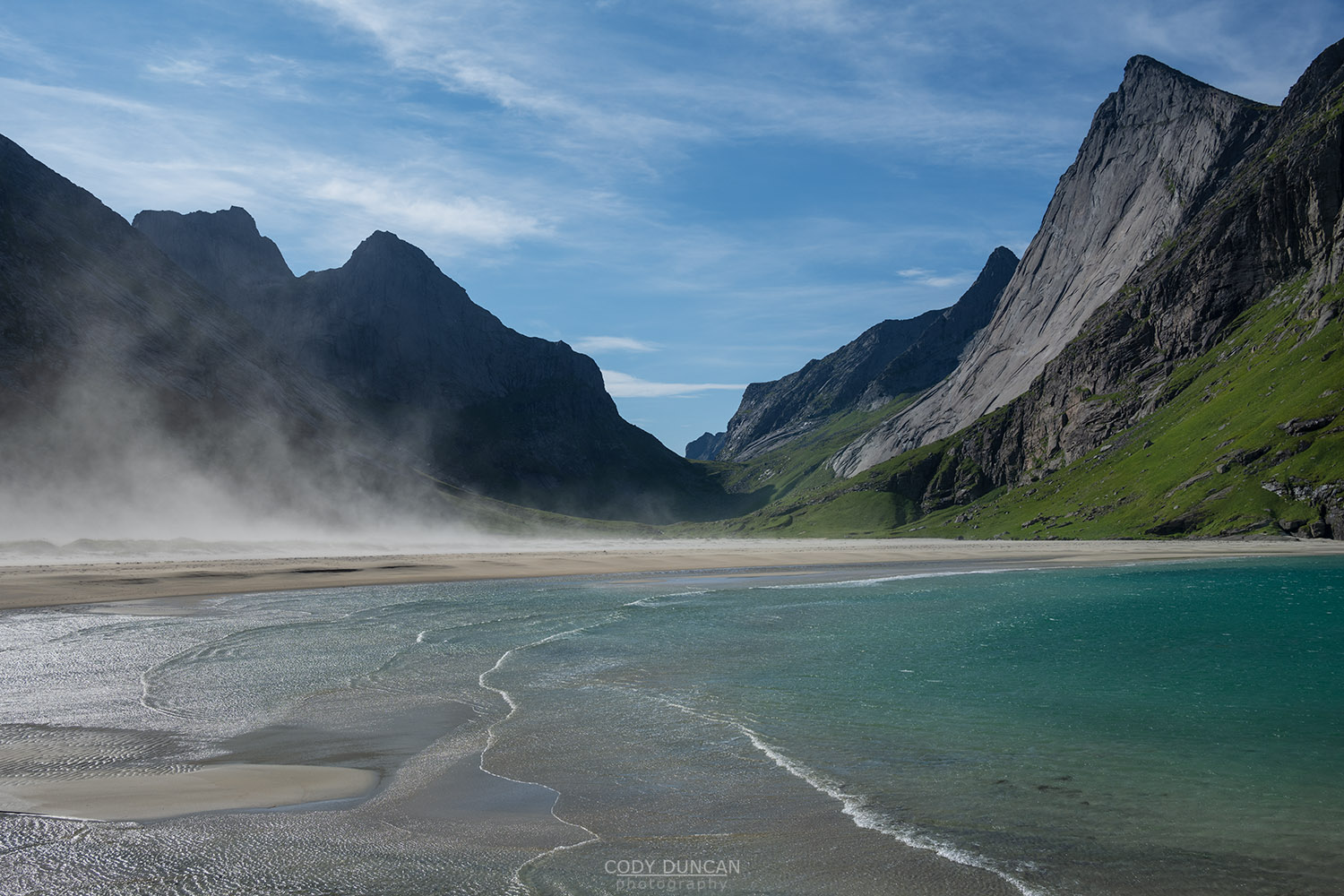
Photo: Clouds of beach sand blow across Horseid beach, Lofotodden national park, Moskenesøy, Lofoten Islands, Norway. August 8, 2021. 10:02
While the weather forecast looked decent for a couple nights camping at Horseid beach, already during the early morning hours of the first night I could sense the wind picking up do to the increased shaking of my tent. By the time I emerged from my sleeping bag, it was a proper wind storm blowing across the beach. I had planned for a 2nd night, but with conditions as they were, I decided to pack up and catch the ferry home – better to return later than a potentially broken tent.
August is typically my favourite month for camping on Lofoten, as the nights are finally long enough that carrying a tent makes sense. Otherwise, in June and July when I will typically be shooting the late night hours anyhow, I can just head home when I’m finished and enjoy the comfort of my bed – as well as a lighter backpack! But in August, the headlamp and tent begin to be carried more often.
Still technically summer and having checked the weather forecast, one still always needs to be observant of conditions and adjust plans accordingly. For this scene, it wasn’t just the wind that led me call my trip a day short, but also that the large clouds of sand that you can see in the center of the image were blowing right across the camping areas of Horseid, leaving everything covered in a fine dusting of sand. Walking back into the wind was also a struggle, and I kept to the right side of the beach to avoid as much blowing stand as possible, but it was still there, stinging eyes and skin for the 1km walk across the beach.
Head over to my Instagram account for (almost) daily postings of the local conditions here on Lofoten: @distant.north
Camera Info: Nikon Z7 II Nikon 24-200mm f/4-6.3 24mm ISO 100 f 8 1/640 second WB Daylight
Photo: Partial rainbow over distant mountains of Vestvågøy, Lofoten Islands, Norway. August 5, 2022. 16:22
Like last year, this year has also been a cool and wet July and beginning of August on Lofoten, with July receiving almost 2x the normal amount of rainfall. Though this isn’t too bad, considering areas along the Helgeland coast have had the wettest summer since 1900! I’ve been attempting to make a few trips over to Helgeland throughout the summer, but the long term forecasts simply show near endless rain most of the time.
The wet weather has also led to a significant number of mountain rescues so far this summer, including the death of a young hiker on Reinebringen in June (the second death on Reinebringen in a 6 month period, the previous being in December 2021). The trails of Lofoten, especially the popular ones which are over-eroded and generally unmaintained are in pretty terrible condition due to all the mud. Even whin the sun briefly shines, I’ve mostly been sticking to quiet, untraveled areas that are mostly off-trail, as its far safer than muddy, slippery trails where it is easy to have a quick slip and end up with a sprained ankle or worse.
Fortunately, with the rain comes rainbows. This day last week was full of them and I was quite distracted from work while always looking out the window. It would have been a nice day for mountains views and a good soaking, but a strong south wind was blowing across the islands, so better to keep to low ground. Luckily, my office window still has a decent enough view!
Head over to my Instagram account for (almost) daily postings of the local conditions here on Lofoten: @distant.north
Camera Info: Nikon Z7 II Nikon 24-200mm f/4-6.3 48mm ISO 100 f 8 1/320 second WB Daylight
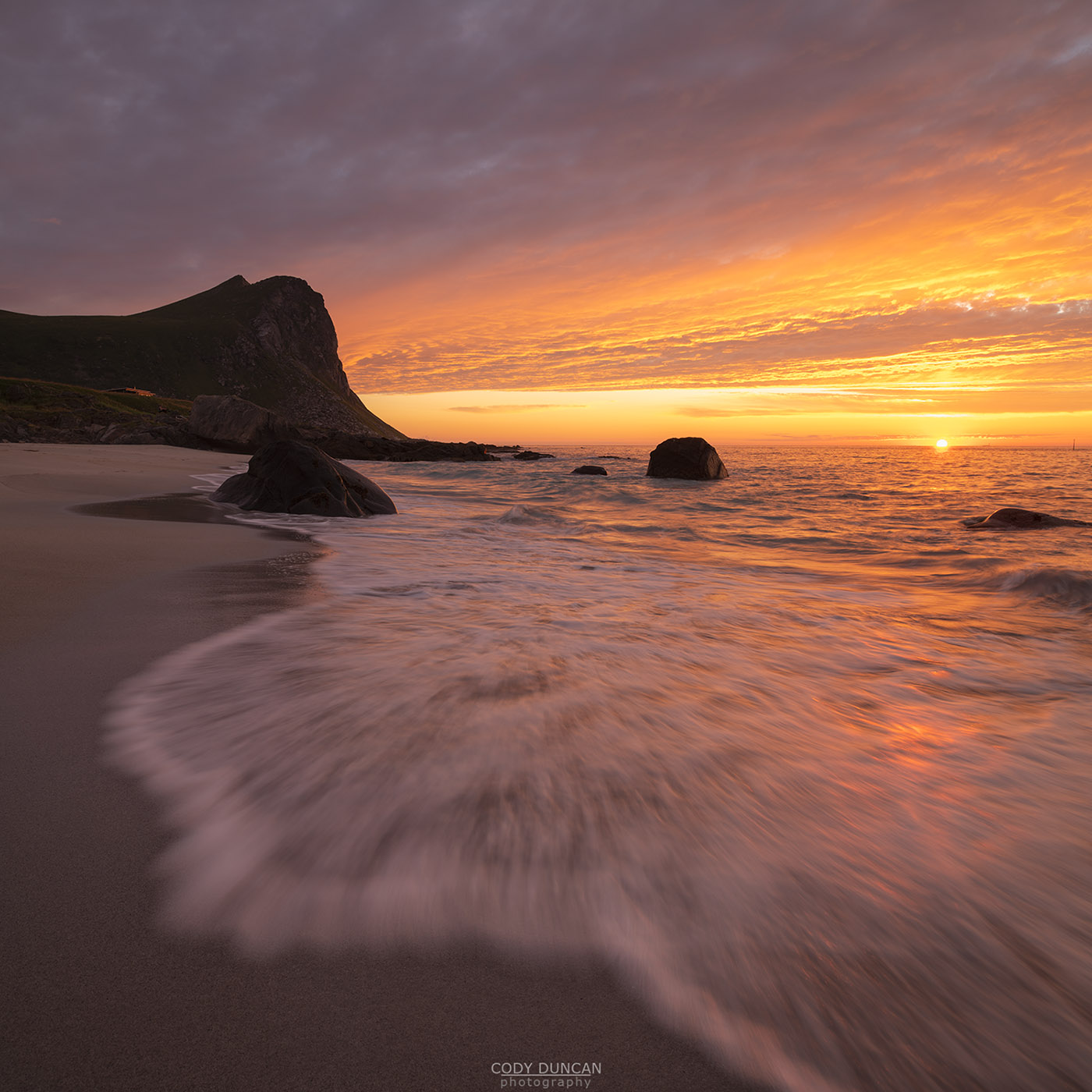
Photo: August sunset over Myrland beach, Flakstadøy, Lofoten Islands, Norway. August 3, 2020. 22:41
While the midnight sun of June and early July is simply a nice time for life on Lofoten, the real photography season of summer begins once the sun starts to fall below the northern horizon in the second half of July. The days are still endlessly long and the first visible stars are some weeks away, but now with the sun just barely below the horizon, the sunset – sunrise nights begin.
The most important factor though, is for the weather to cooperate. The best condition are for the northern horizon to be clear with moderate cloud cover over Lofoten. If the opposite occurs, a marine layer along the northern horizon and clear sky over Lofoten, the light simply fades out into a dull twilight. Luckily, I live facing directly north over the open sea, so even if all of Lofoten looks otherwise grey and gloomy, I can see what might occur once the sun hits the horizon.
Unfortunately, its not always that easy to plan in the ever changing weather and often times I head up into the mountains on nights which the light simply fades out. While other days, I think the weather looks terrible and then suddenly the sky catches on fire. At least I have a small beach I can quickly run down to to at least capture something. Though I think I probably have too many sunsets (and northern lights) from here now, so sometimes I’m even more lazy these days and just watch from my window. I guess I’m spoiled!
Head over to my Instagram account for (almost) daily postings of the local conditions here on Lofoten: @distant.north
Camera Info: Nikon D850 Nikon 24mm f/3.5 tilt-shift 24mm ISO 31 f 11 1/4 second WB Daylight
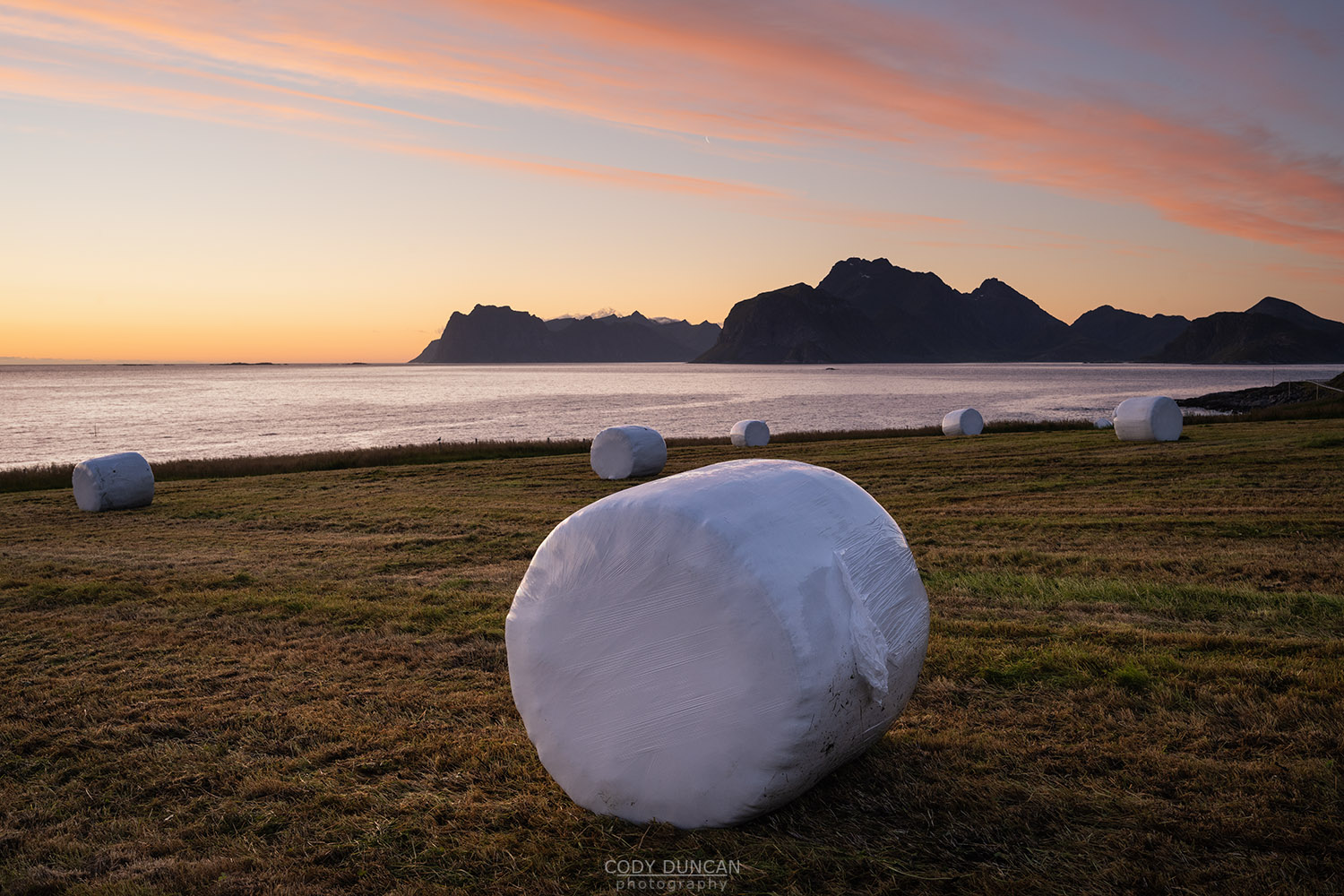
Photo: Norwegian Marshmallows – AKA tractor eggs – in freshly cut field in late July, Flakstadøy, Lofoten Islands, Norway. July 25, 2022. 01:42
Every year beginning sometime in mid July the summer harvest of the fields begin to provide winter feed for the few sheep still remaining on Lofoten. Until two years ago my neighbor used to farm this field, but he has since retired, leaving only one sheep farmer left in my small village. Even without local sheep, the grazing land remains quite important and other nearby farmers have taken over the cutting and harvesting of the fields.
A few weeks ago – Friday Photo #496 – I posted an image of the field on a stormy summer evening, still full of flowers but already becoming quite overgrown. It felt a little later of a harvest this year, even though the summer has been a good one and the overall feel of the landscape to me is that things are a few weeks ahead of ‘normal.’ Perhaps it was the fairly cold and wet weather in the second half of July this year that has seen them waiting.
And indeed they seemed to be in a hurry once the tractors did arrive; working until after midnight on both Saturday and Sunday nights. This picture was taken at near 02:00 early Monday morning just after they had finished wrapping the bailing the loose grass. And still later they returned to collect everything!
So for the farm meadows, the flowers are now gone for this year and harvested fields remain. In a while, once the grasses grow a little taller again, the sheep and lambs will be moved into the fields during the autumn after they’ve been collected from the mountains. And then they will also be gone, along with the migratory birds and one day I’ll stand out in my yard and notice that its eerily silent; all the life and noise of summer has gone. From then on, winter is not far away.
Head over to my Instagram account for (almost) daily postings of the local conditions here on Lofoten: @distant.north
Camera Info: Nikon Z7 II Nikon 14-30mm f/4 28mm ISO 100 f 10 1/13 second WB Daylight
We may request cookies to be set on your device. We use cookies to let us know when you visit our websites, how you interact with us, to enrich your user experience, and to customize your relationship with our website.
Click on the different category headings to find out more. You can also change some of your preferences. Note that blocking some types of cookies may impact your experience on our websites and the services we are able to offer.
Essential Website Cookies
These cookies are strictly necessary to provide you with services available through our website and to use some of its features.
Because these cookies are strictly necessary to deliver the website, refusing them will have impact how our site functions. You always can block or delete cookies by changing your browser settings and force blocking all cookies on this website. But this will always prompt you to accept/refuse cookies when revisiting our site.
We fully respect if you want to refuse cookies but to avoid asking you again and again kindly allow us to store a cookie for that. You are free to opt out any time or opt in for other cookies to get a better experience. If you refuse cookies we will remove all set cookies in our domain.
We provide you with a list of stored cookies on your computer in our domain so you can check what we stored. Due to security reasons we are not able to show or modify cookies from other domains. You can check these in your browser security settings.
Google Analytics Cookies
These cookies collect information that is used either in aggregate form to help us understand how our website is being used or how effective our marketing campaigns are, or to help us customize our website and application for you in order to enhance your experience.
If you do not want that we track your visit to our site you can disable tracking in your browser here:
Other external services
We also use different external services like Google Webfonts, Google Maps, and external Video providers. Since these providers may collect personal data like your IP address we allow you to block them here. Please be aware that this might heavily reduce the functionality and appearance of our site. Changes will take effect once you reload the page.
Google Webfont Settings:
Google Map Settings:
Google reCaptcha Settings:
Vimeo and Youtube video embeds:
Other cookies
The following cookies are also needed - You can choose if you want to allow them: