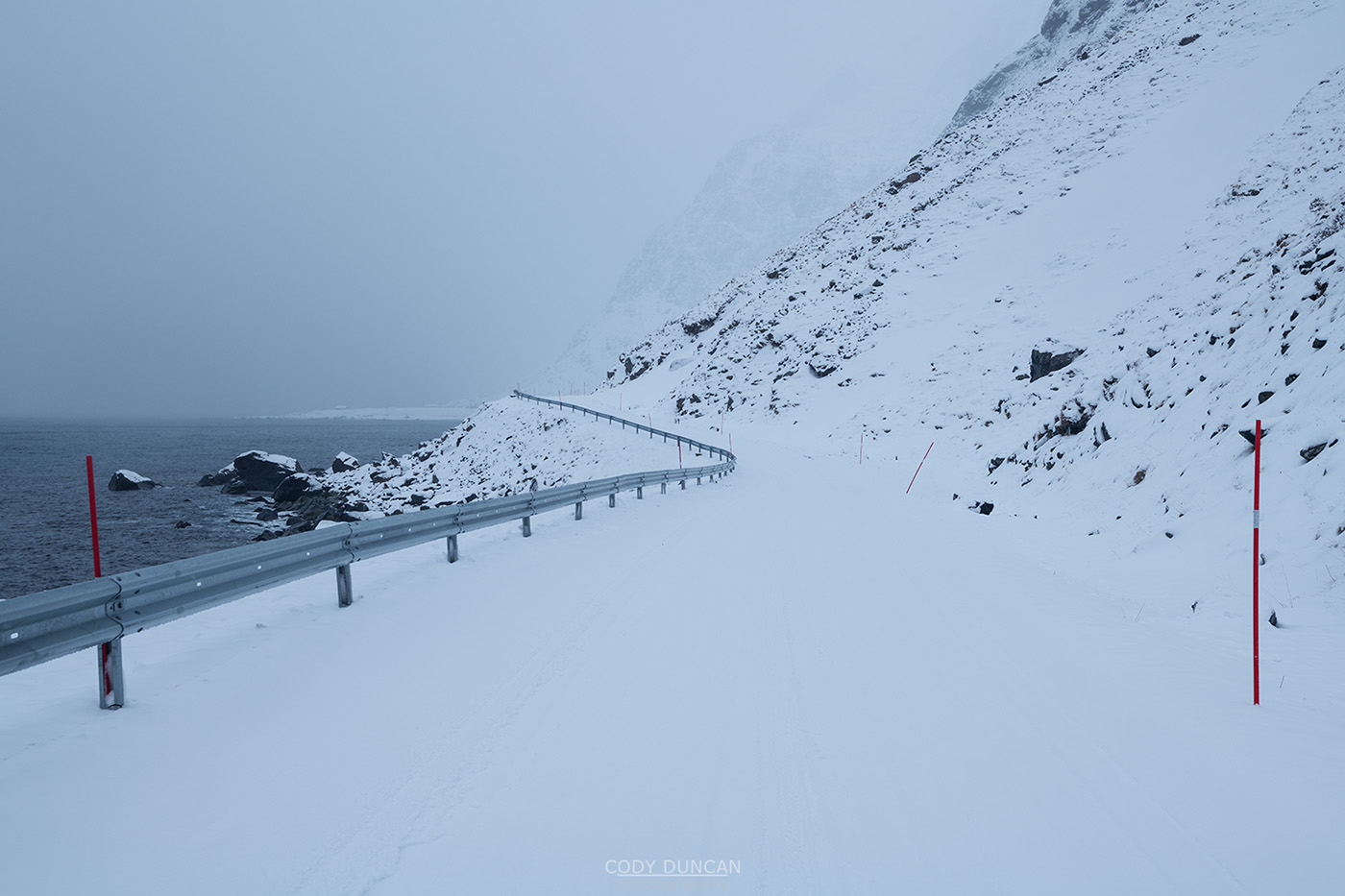
Photo: Difficult winter road visibility in flat light and fresh snow, Flakstadøy, Lofoten Islands, Norway. March 5, 2021. 15:59.

With Norway remaining essentially closed for last winter’s tourism season on Lofoten, the snowy roads in 2022 will likely be somewhat busier as photographers begin to travel again. Photographers and tourists that often are not experienced with winter driving conditions. So this weeks post is a bit of a safety post, which I do from time to time, for all the people chasing snowy beaches and northern lights over the next months.

Even in somewhat decent visibility as in this photo: no fog, sideways snow, its daylight, etc. You can see it is quite difficult to distinguish the right side of the road, even with the aid of snow poles. And what looks like plenty of room to pull over slightly will actually immediately see your car into a 1 meter deep ditch which begins just outside of the snow poles.

The flat light and lack of roadside objects of contrast make driving in these conditions quite demanding of attention, even more so in busy traffic or when the numerous large trucks heavy with fish are speeding towards you in the opposite direction down a road that is already uncomfortably narrow in summer.

For a more detailed article, see: Winter Driving

But for now, a few brief tips to keep you and others safe on the roads:

  • Never attempt to pull off the side of the road unless you are 100% sure of what is below the snow. Nearly all sections of road on Lofoten have drainage ditches immediately outside of the snow pole line. The road plows do an okay-ish job of cleaning out the roadside parking areas, but not always after a fresh snow storm. However, unless you have seen the roads in summer, I do not suggest pulling out into unknown depths of snow. This is a good way to get stuck.
  • Let other vehicles pass. With the above said about pulling off the road. If you are traveling especially slow, be polite and pull over at the next safe and visible pull out area. Signal clearly before doing so.
  • Do not park on the road! Especially so in regards to the E10. There are some nice roadside views, but unless there is a proper pullout, you cannot park on the road.
  • Be very careful of driveway and parking lot entrances. Driveway entrances are not always well marked, if at all, from the surrounding roadside ditches. The Parking at Haukland beach is a particularly treacherous one that always catches cars after a fresh snow.
  • Double any travel time Google maps give you for driving to a location in good weather. Triple the driving time in bad weather or darkness.
  • Stay home when its the best choice. There are several days each winter where it is simply unsafe and irresponsible to be out on the roads.
  • Be careful of side roads in periods of heavy snowfall. Especially so in early mornings or late evenings. When the snow is falling, all roads plows are out just to keep the main roads of Lofoten open. Smaller roads to rural villages or scenic areas might get temporary overlooked, and deep snow can build up quickly, especially in high winds. Uttakleiv beach is a good example of a location that is not always accessible during heavy snowfall.
  • Plan ahead in anticipation of any long drives. Weather conditions might dictate that if you are driving from Lofoten to Harstad/Evenes airport for example, you might need to adjust your schedule by a day or two. Beyond difficult and dangerous driving conditions, there are also several closure points, such as the Gimsøy bridge, which can block travel between west and east Lofoten, even for periods over 24 hours.
  • Most importantly: Enjoy your trip! Lofoten is not going anywhere anytime soon. You cannot control the weather, so there is no point in trying to fight it. The weather does what it does, so just go with the flow. You’re on Island Time up here…

Head over to my Instagram account for (almost) daily postings of the local conditions here on Lofoten: @distant.north

Camera Info:
Nikon D850
Nikon 24-70 f/2.8
36mm
ISO 100
f 10
1/25 second
WB Daylight
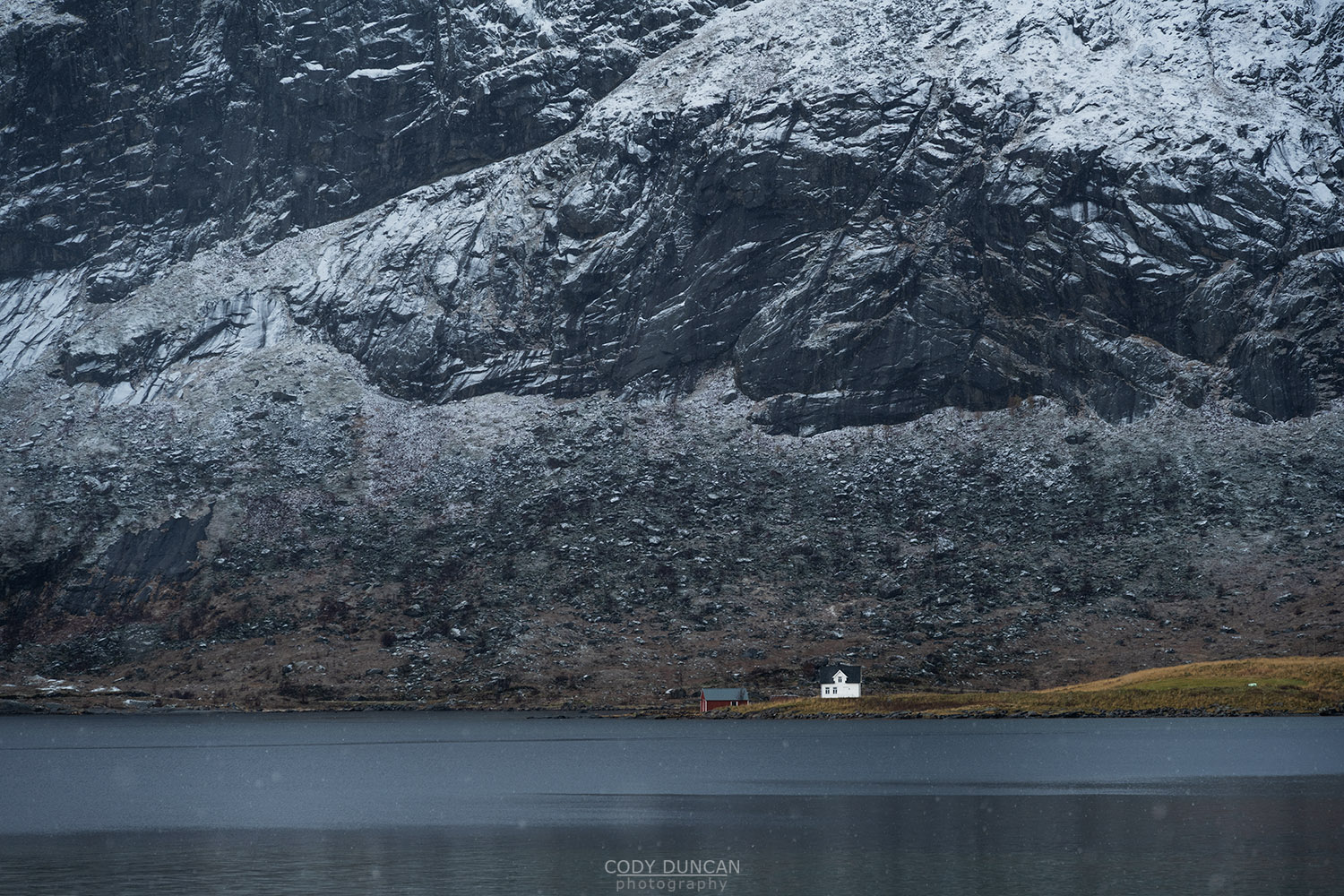
Photo: A house between the mountains and the sea, Flakstadøy, Lofoten Islands, Norway. October 18, 2021. 13:02

With a dusting of autumn snow to add contrast to the otherwise flat light of a snowy October afternoon, this lone house out on the fjord’s edge at Bø, was particularly nice looking on this day. I’ve passed by this house thousands of times, in all sorts of weather, and usually I don’t stop. But this time, the subtly of the moment was worth a quick photo.

It is not a dramatic image. In fact, its actually pretty boring. But Lofoten isn’t pure drama 24 hours a day, 365 days a year. Many, if not most days, there isn’t much spectacular happening. And that is perfectly fine! And so here is a photo of a simple house beside the sea and below the mountains on a flat, overcast, and snowy October day.

What I do think works about the image, and is the reason I stopped this time, is the separation of the cool, slightly snowy background with the brighter autumn colors of the field immediately next to the house which adds a bit of contrast and separation that the flat light was unable to while still retaining a fairly neutral look to the image overall.

Head over to my Instagram account for (almost) daily postings of the local conditions here on Lofoten: @distant.north

Camera Info:
Nikon Z7 II
Nikon 24-200mm f/5.6-6.3
160mm
ISO 100
f 7.1
1/160 second
WB Daylight

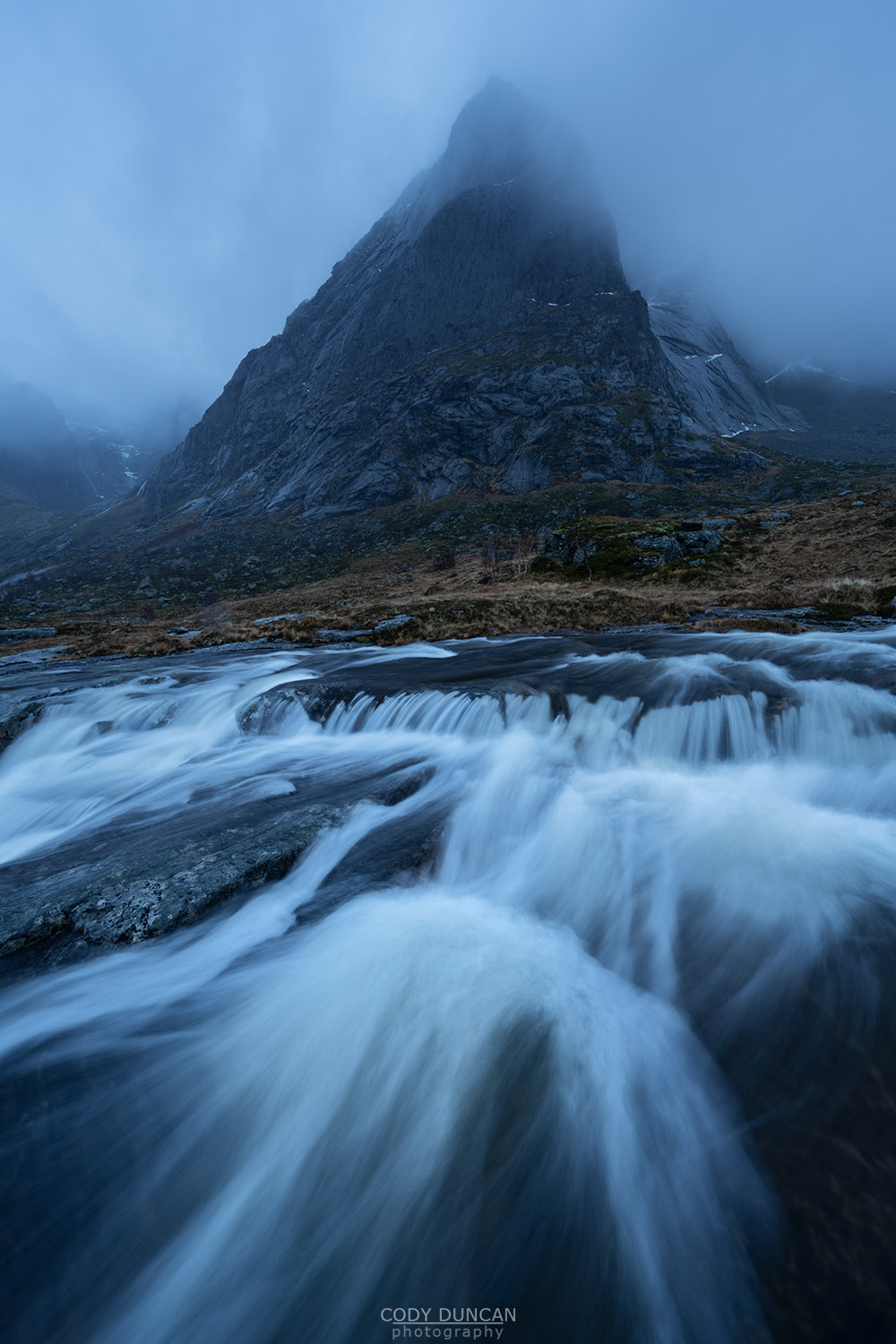
Photo: Mølnelva river flows below Stortind mountain peak after days of heavy rain, Flakstadøy, Lofoten Islands, Norway. November 16, 2021. 12:52

In what seems like a repeat of last year, it has so far been a windy and wet November. Looking back over the last month, it has rained/snowed on 27 out of 30 days! The last few days in particular have brought some quite heaving rain, with localised flooding across some parts of Lofoten and elsewhere in northern Norway.

It was only a month ago (Friday photo #459) that I posted a picture of this location – Mølnelva flowing below Stortinden. But in heavy rain, or should I say, just after the rain has stopped, its an easy location for me to access that always seems to have something new to offer. Usually if I’m passing by to elsewhere and I see the the water level is high, I’ll stop and go wander around for a bit. Though, much of the scene depends on what the clouds are doing around Stortinden, and if the summit is even visible. If not, then its not worth stopping for the most part.

Tuesday, after a night and morning of heavy rain, the clouds eased off slightly for the afternoon – and by slightly, I mean just not torrential rain. The mountains had come alive with tiny ribbons of water flowing down seemingly every rock face. And so as I passed by Mølnelva on my way back from checking things out a bit further west, I made a brief stop.

With the polar night still a few weeks away, November is already a pretty dark month. More sun under heavy clouds. Even shooting at 13:00, I could already achieve a shutter speed over a second without the need for any filters – though I liked the flow of the water better in this image with a shutter speed of 0.6 second.

Hopefully the rain stops soon and I don’t have to shoot this location too many more times over the next months!

Head over to my Instagram account for (almost) daily postings of the local conditions here on Lofoten: @distant.north

Camera Info:
Nikon Z7 II
Nikon 14-30mm f/4
14mm
ISO 31
f 13
0.6 second
WB Daylight

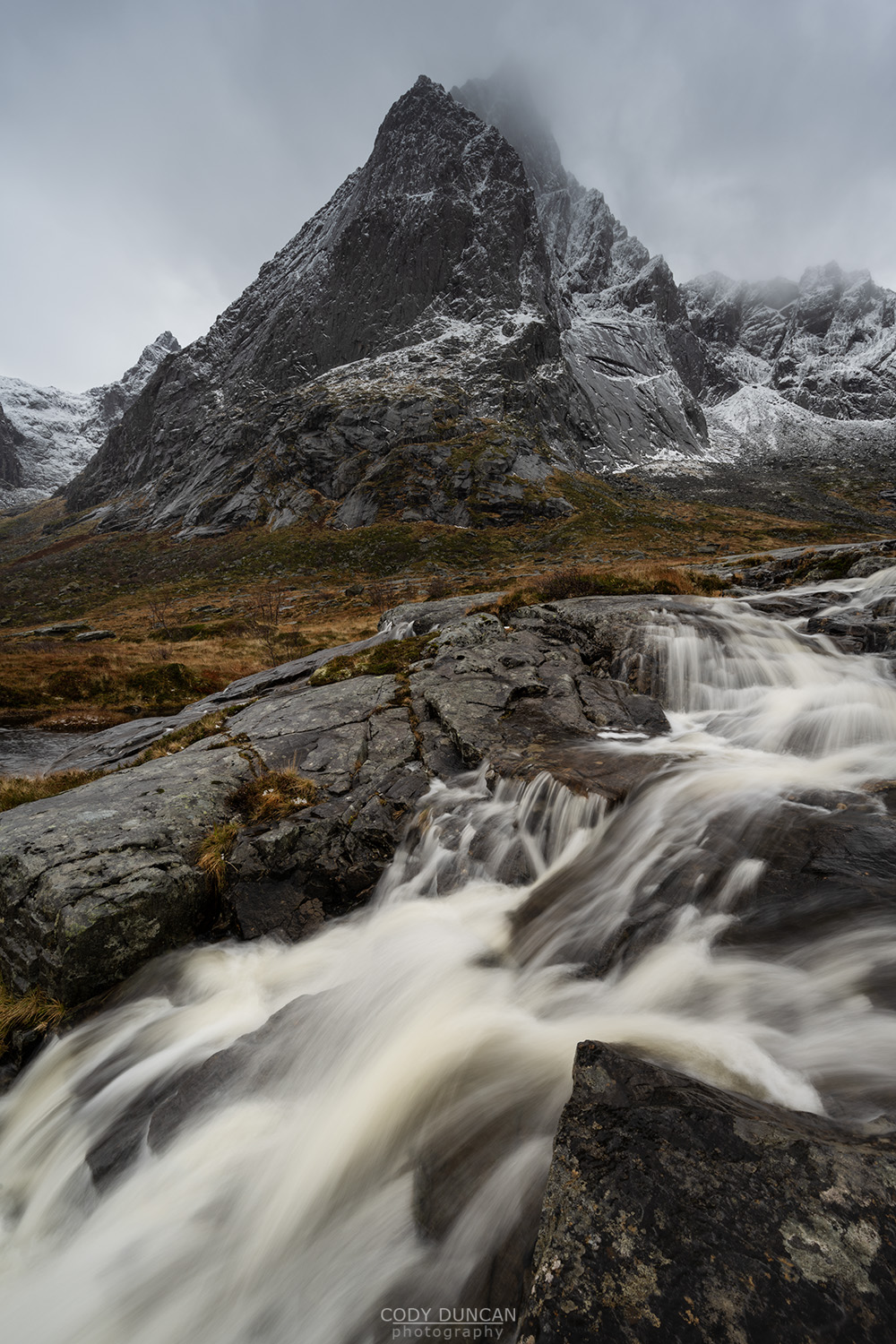
Photo: Snow-dusted Stortinden rises over flowing waters of Mølnelva river, Flakstadøy, Lofoten Islands, Norway. October 17, 2021. 15:00

The first real dustings of autumn snow finally seem to be sticking around the peaks this week, dropping down to about 350m or so over Lofoten. Even the roads have begun to get icy in the last days, so it is good that I have my winter tires on already – The date for this in Nordland is from October 16.

The weather this day was mostly terrible, with a fully overcast sky and regularly passing rain/sleat/hail showers. I actually only left the house in mid afternoon because I was bored and didn’t feel like doing computer work, so with no plan, I just drove west. With a lot of rain in the last days, I could already see that the flat series of small waterfalls which flow over the slabby rocks on the western side of Kilanpollen were flowing higher than normal. So I pulled over in the small pullout and headed up the river.

This is a fairly reliable scene which usually produces a decent photo when the conditions are right – such as for this image – nothing special, but nice enough for a bleak, grey afternoon. Soon after I arrived, rain began to fall again, but I think this added with a bit of atmosphere as some clouds formed over Stortinden and darkened up the sky overall, which had otherwise been a bit on the bright side. The water was flowing strong enough that I didn’t need to use an ND filter to capture the flow. And when I did for some different compositions later on, the water was actually a little too soft, so I think this shorter shutter speed worked better to still retain a bit of the detail in the water.

Head over to my Instagram account for (almost) daily postings of the local conditions here on Lofoten: @distant.north

Camera Info:
Nikon Z7 II
Nikon 14-30 f/4
14mm
ISO 31
f 14
.4 second
WB Daylight

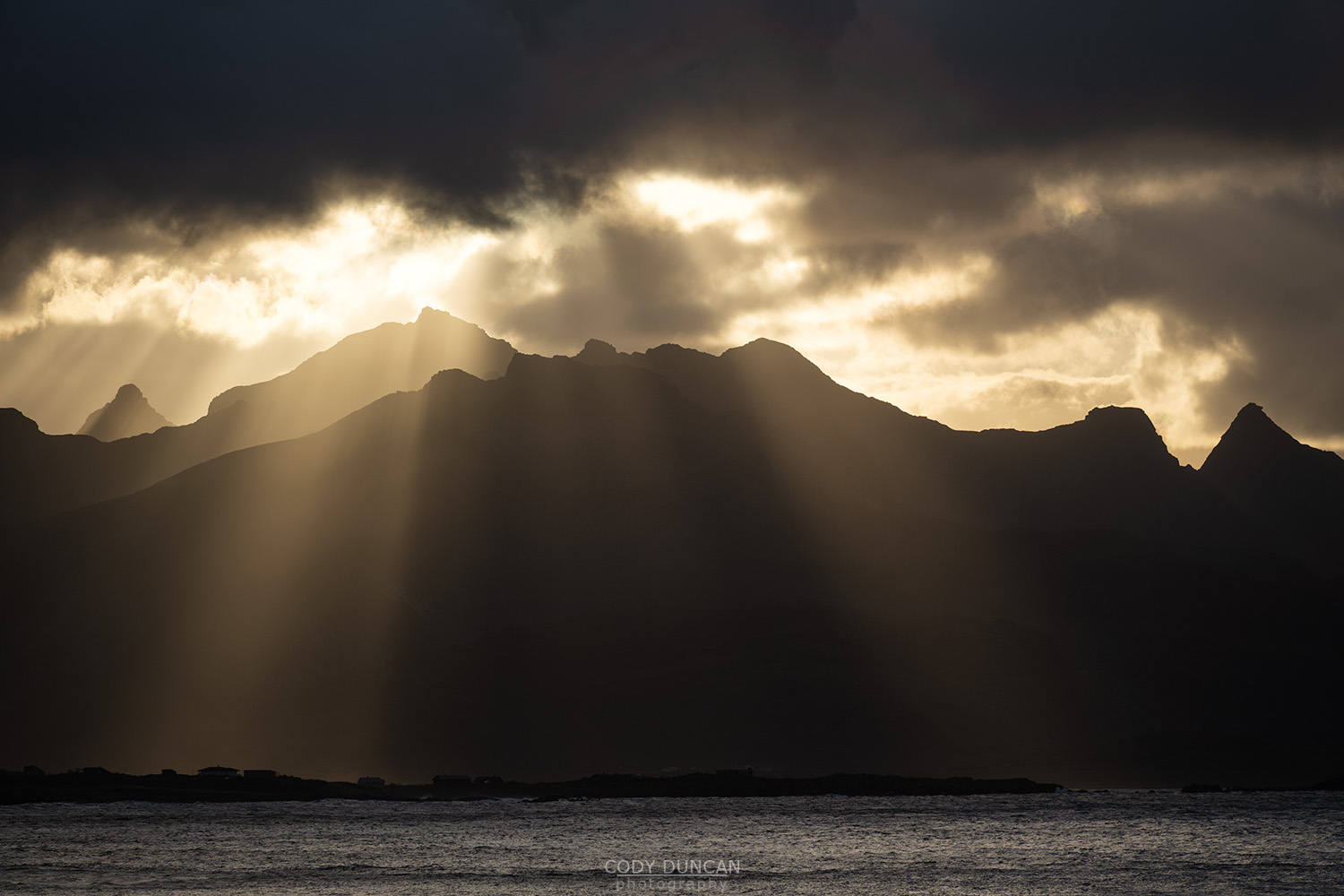
Photo: Sun rays shine over the mountains of Moskenesøy, Lofoten Islands, Norway. October 7, 2021. 16:36

October has been off to a mostly cloudy and rainy start this year. But in-between the grey, there has been some nice moments of light. Autumn is usually a time of dynamic and interesting weather here on Lofoten, and yesterday was one of those days.

I spent the morning and afternoon shooting around Uttakleiv with my Swiss group from Amazing Views tours. The (nearly) new moon meant quite extreme tides, with the AM having a super low tide like I rarely seen, while mid afternoon, combined with large swell, saw waves sweeping high across the rocks. The same location but two completely different moods just due to the tide.

When it came time to move on, we had decided to go to Unstad for the sunset. However, as a little more of the western horizon came into view, I changed plans and decided heading to the Vikten area would likely produce better results. As we descended into Nappstraumen tunnel, I could already see a hint of the light show that was happening in the far distance over Moskenesøy. Turning towards Vikten, the light rays were shining over the mountains. One of those moments where one has to be quick, as the light might not last long. But it lasted long enough…

Head over to my Instagram account for (almost) daily postings of the local conditions here on Lofoten: @distant.north

Camera Info:
Nikon Z7 II
Nikon 24-200 f/4-6.3
200mm
ISO 100
f 8
1/800 second
WB Daylight

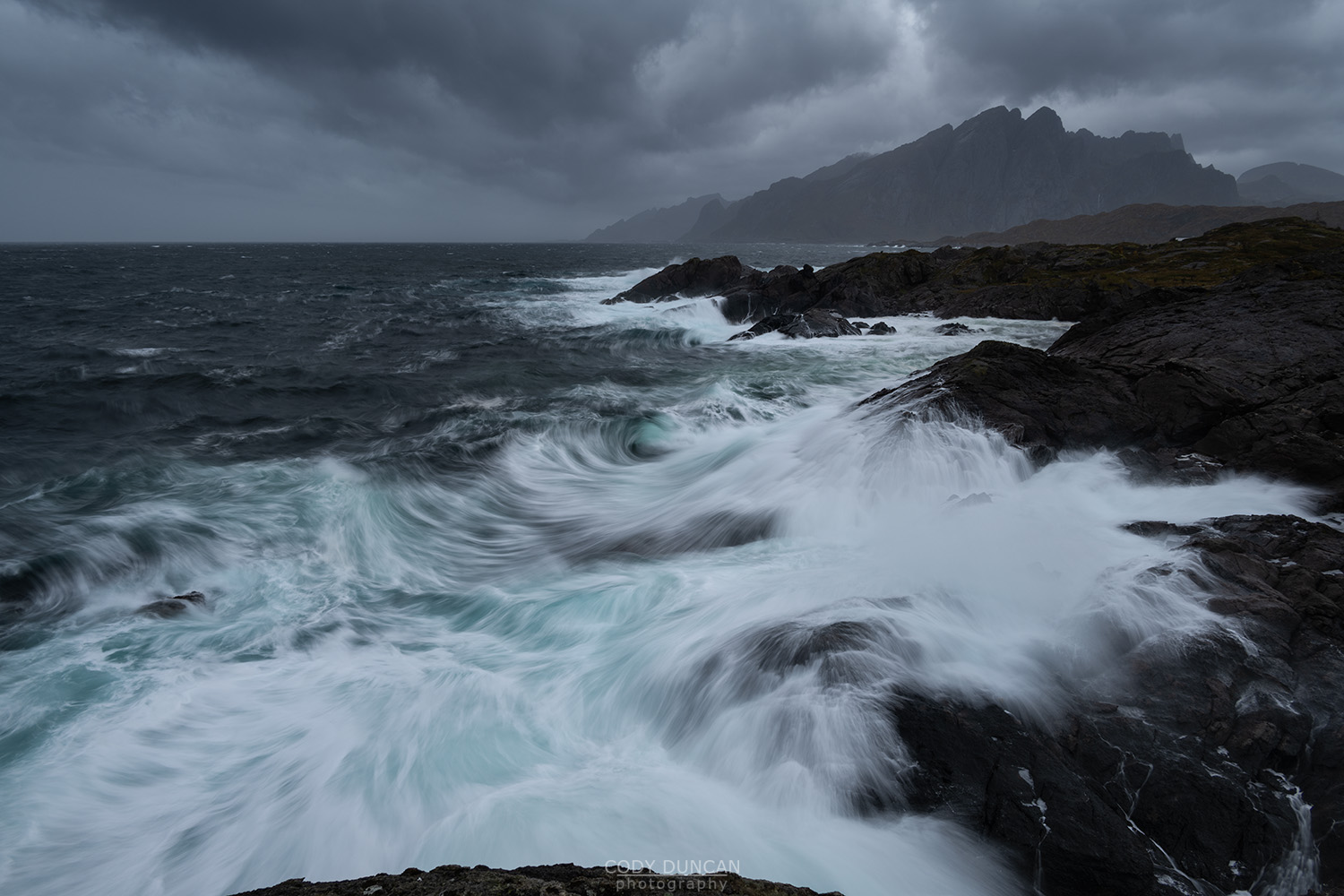
Photo: Waves from the year’s first autumn storm crash over the rocky coastline at Nesland, Flakstadøy, Lofoten Islands, Norway. September 22, 2021. 14:58

The year’s first autumn storm, or høststorm, in Norwegian, swept across Lofoten and most of the Norwegian coastline on Wednesday. Heavy rain and high winds brought both flooding and structural damage, including several washed out roads. Out driving around in the afternoon as the storm was beginning to subside, the mountains were absolutely flowing with water – I don’t think I’ve ever seen so many waterfalls before!

The morning was filled with heavy rainfall, but by mid afternoon I could see on the radar that the sky would dry up somewhat, and so I headed out looking for some photos. These storms always come out of the southwest, which is a semi-awkward direction on Lofoten to get the full visible effects of the storm, especially the crashing waves. The bridge between Flakstadøy and Moskenesøy was closed from high winds, so I decided to stay on Flakstadøy and not head west to Å, where the waves might have been hitting the strongest.

Luckily, the coastline near Nesland is also a good location for large swells coming up the Vestfjorden, and so I headed there to see what what happening. Although I should note that the several kilometres of dirt road below steep cliffs gave me a bit of hesitation, as with so heavy rain, rock and mudslides can often occur in the area – and I’m surprised my road remained open as well.

Rounding the last turn from Skjelfjord and out onto the exposed coast I could already see waves crashing high into the sky. Perfect! Arriving at the parking area and heading out to the cliffs, the air was full of mist and sea spray, giving me a constant soaking. The waves were breaking wildly and crashing high up the rocks. Almost too much chaos.

I experimented with several different shutter speeds, but in the wind and sea spray, it was a little hard to see what I was actually capturing. And between shots, it was nearly a full time job wiping off my lens. I wanted to capture some of the chaos and flow of the sea, while also showing some scale. Though I think this image is lacking on the later part, as looking at the image on my screen in no way represents what it was like standing there and feeling the crashing of the waves into the cliffs below me – and then the soaking of saltwater as the wind swept the mist over me. It was an absolutely tremendous amount of water which was moving around in a beautiful dance of chaos.

Head over to my Instagram account for (almost) daily postings of the local conditions here on Lofoten: @distant.north

Camera Info:
Nikon Z7 II
Nikon 24-200 f/4-6.3
24mm
ISO 31
f 14
0.6 second
WB Daylight
3 stop ND filter

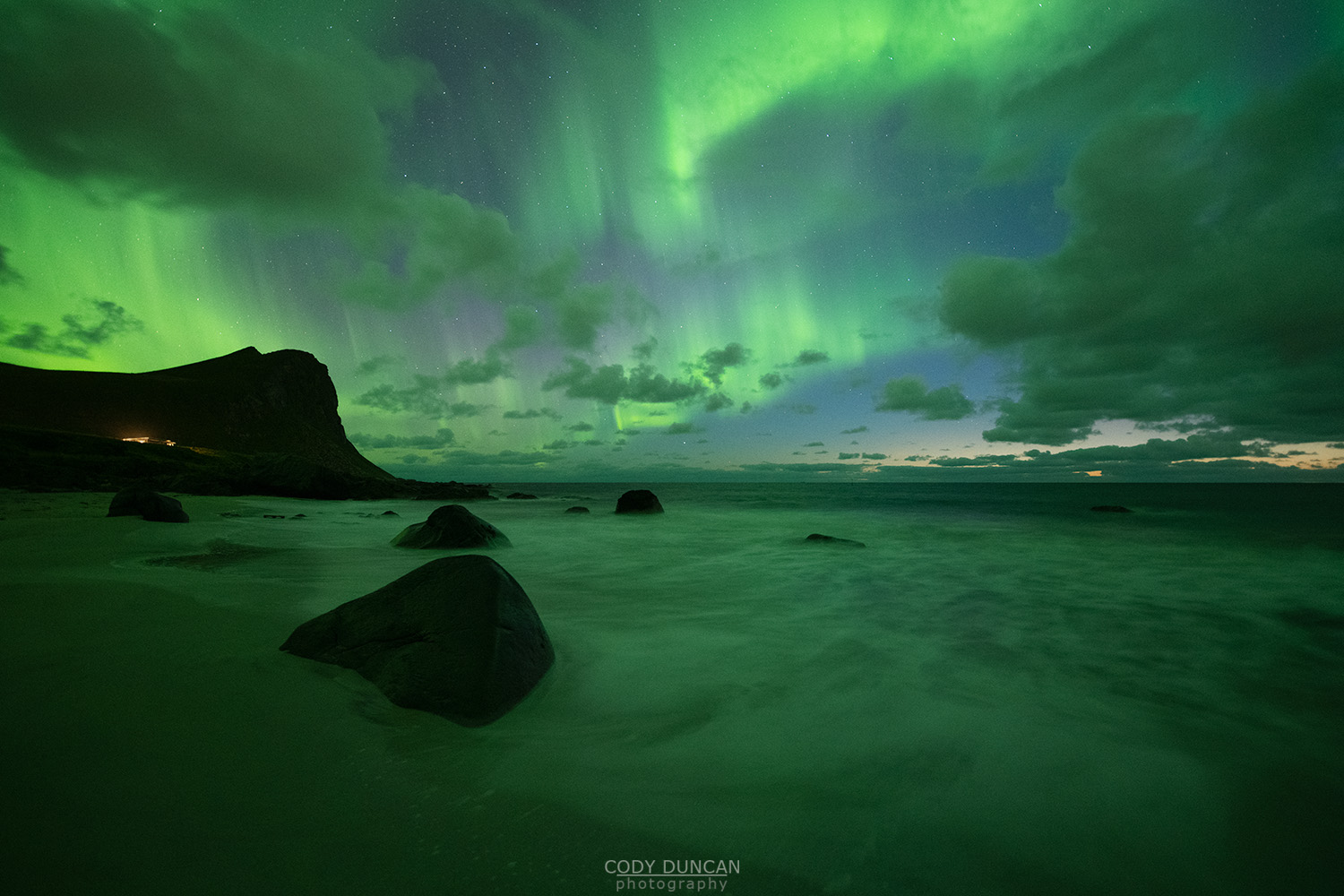
Photo: First northern lights of the season, Flakstadøy, Lofoten Islands, Norway. September 4, 2021. 01:18

After last weeks post (Friday Photo #452) wonder when I might see the northern lights for the first time this season, an unexpected clearing of the clouds occurred after midnight and I saw the first dancing aurora of the 2021-2022 season. Luckily I was still awake and quickly headed out the door and down to my beach.

It was still pretty cloudy overall and the ocean was stormy from the days of wind – which means my boots eventually got flooded by a crashing wave. But the aurora itself was quite active were I could see it. If the sky had been perfectly clear, then it probably would have been quite a nice show!

Since then, it’s been back to wind and rain for the rest of this past week. Although it looks like there might be a clear night or two coming up on the weekend, so maybe that will be my second chance for the season. Fingers crossed.

Head over to my Instagram account for (almost) daily postings of the local conditions here on Lofoten: @distant.north

Camera Info:
Nikon D850
Sigma 14mm f/1.8
14mm
ISO 2000
f 2
6 seconds
WB Daylight

Photo: Misty clouds blow over Stortinden mountain peak, Flakstadøy, Lofoten Islands, Norway. August 19, 2021. 21:17

A cold wind has been blowing out of the north for the last week. And while the sun has emerged from time to time, the mountains have mostly been concealed behind the clouds, like most of this summer has been. But there is a change in the air, subtle, but there. That our short arctic summer is slowly fading away to the first signs of autumn color among the blueberry bushes and birch trees.

But beyond the blowing wind, the crashing waves, the sideways rain, the return of the northern lights; there is another sign that summer is soon over. Silence.

It is a subtle change and not always one I immediately pick up on, but one day I notice something missing; the sounds and liveliness of summer. The chirping, screeching, cawing birds that keep me up on summer nights are suddenly gone. The fields around my house are silent.

This is the opposite of spring, where one day in late march I will see the first pair of oystercatchers sitting on a rock during my drive to Leknes. But perhaps I’m looking out for this more as it is a sign that winter will (hopefully!) soon be over. But in late summer I’m not even sure when I last saw an oystercatcher. Was it 1 week, 2 weeks, more? It is just sometime around now that I notice my garden has gone quiet, save for a crow or two circling around at random. And so as the migratory birds have gone south, the sun is slowly doing so as well.

It wasn’t until late evening that I headed out yesterday. The north side of Lofoten was covered in a heavy, low clouds, but things were breaking up on the southern side of the islands, eventually with fully clear sky over the Vestfjord. I wasn’t heading anywhere in particular, just maybe looking for something interesting when I saw the clouds blowing over Stortinden. The scene wasn’t ideal, as the river is barely flowing at the moment – it is better in spring, or after a heavy rain. But the scene was dynamic enough for me to put in at least the minimal effort to walk a little to a familiar location. Luckily I got there just in time, as within a few minutes the summit was completely concealed in clouds and the moment was gone.

Head over to my Instagram account for (almost) daily postings of the local conditions here on Lofoten: @distant.north

Camera Info:
Nikon Z7 II
Nikon 14-30mm f/4
14mm
ISO 31
f 13
8 seconds
WB Daylight
3 stop neutral density filter

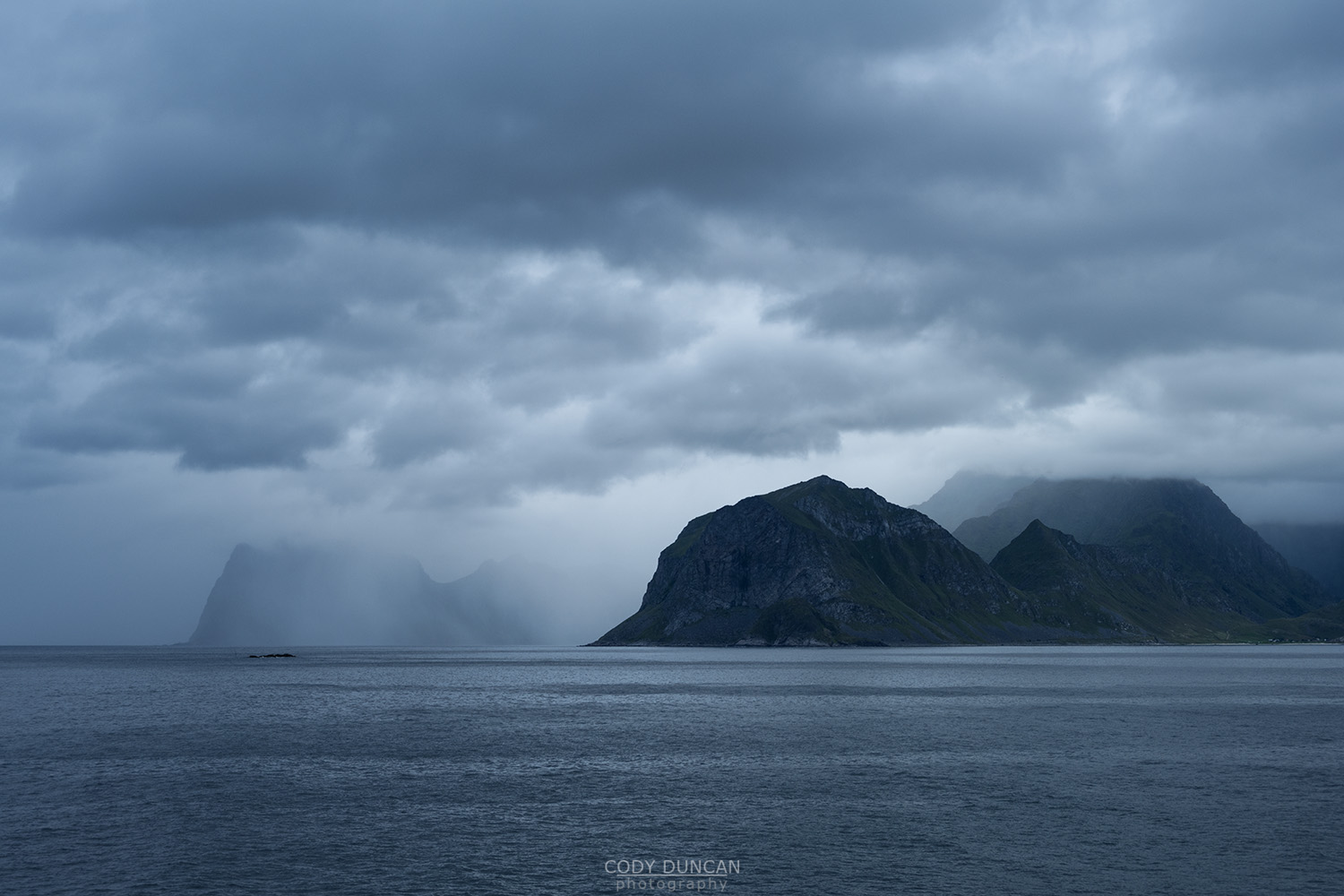
Photo: The lost summer: Dark rain clouds conceal the summit of Himmeltindan from across Nappstraumen, Flakstadøy, Lofoten Islands, Norway. August 4, 2021. 09:51

What started off looking like a promising summer in early June has mostly ended up as a wet and cool one. With only a few days here and there of sunshine between continuous weeks of low clouds and rain, even my neighbours have commented on how poor this summer has been thus far. A few weeks ago, tired of the rain, I even booked myself a last minute trip to Svalbard – where it was warmer on my arrival there than it was on Lofoten. Though the sun did eventually return for a few days while I was in the north – and with luck, Lofoten will hit 20˚c again this weekend.

But the overall appearance of this summer has been like this photo. Well, not even like this photo, as there is at least some nice drama in the clouds. This summer has just been flat grey a majority of the time. While I thought July was on the cool side, it ended up only being slightly below average. Perhaps it was the missing sun that made it feel cool. What was above average was the rain, nearly 3x wetter than normal – 116mm vs. normal July of 39mm.

August is often a month of transition from summer to autumn as the weather becomes more dramatic and the winds blow stronger. But as Lofoten has not really had a summer this year, who know what the next weeks will bring. Optimistically, we will have a warm and dry autumn – it cannot rain forever, right? However, with the border now open to northern Sweden, I’m personally setting my sights on the long, empty trails for my autumn wanderings.

Head over to my Instagram account for (almost) daily postings of the local conditions here on Lofoten: @distant.north

Camera Info:
Nikon Z7 II
Nikon 24-200 f/4-6.3
54mm
ISO 100
f 8
1/200 second
WB Daylight

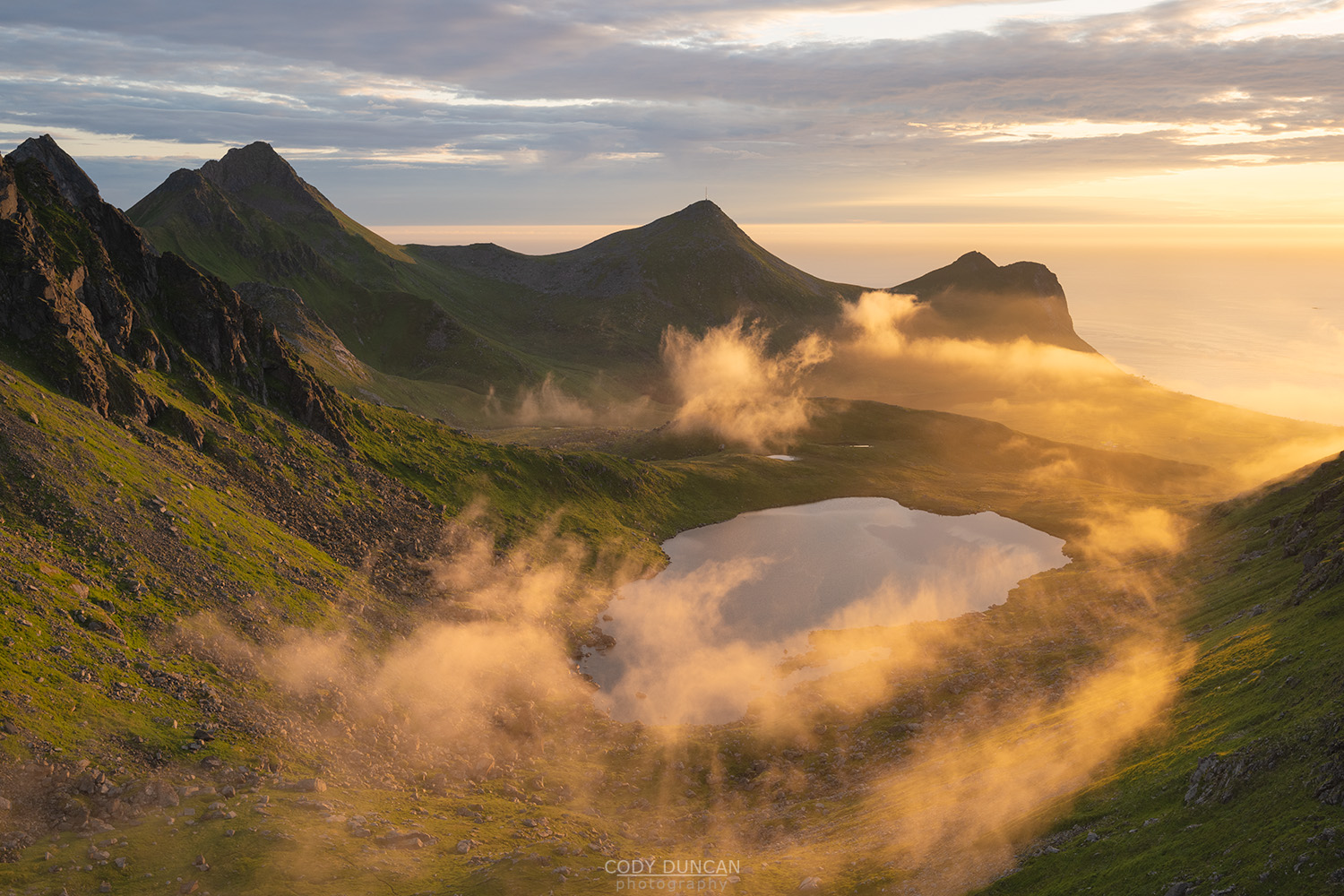
Photo: Misty clouds swirl over Storvatnet above Myrland, Flakstadøy, Lofoten Islands, Norway. July 14, 2021. 23:15

There is a particular type of weather where the forecast shows sun, while a heavy, low cloud remains over the mountains – something similar to a high fog. Often though, this can be quite localised and more frequent with a north wind. So the southern side of Lofoten eventually is filled with sun, while isolated areas and valleys on the northern side of the islands can still remain in clouds and fog and the moist sea air impacts with the mountains. This was one of those types of days.

It is actually quite hard weather to predict and can often change quite rapidly. Usually, whatever weather you are looking at will have changed within 10-20 minutes. Particularly if planning on hiking and you see some cool clouds over a particular mountain, it will have completely changed in the the hour or two of hiking required. Often, the best plan is not to over think, but just choose a location or mountain, perhaps one with some flexibility to move around if conditions suddenly deteriorate and you end up in a whiteout with no visibility at all.

This particular day I was driving around and over thinking about which area to visit. It wasn’t until around 20:00 that I headed up the trail from Nappskaret, in the general direction of Middagstind, but not particularly fixated on getting to the summit. This was already the 3rd day in the week I had found myself in this area, and had already been up Okstinden a few days before. So I was just open to whatever the conditions would dictate.

And as it turns out, I ended up elsewhere, nearby a small little pond after scrambling up some steep sheep trails. I’ve been looking at this pond for a while, but never been, as it is the opposite direction of where I usually travel. But on this evening, it seemed like a pretty good area to be at, proving views over Storsandnes beach, Nappstraumen, and across to Himmeltindan in the northeast, as well as down to the valley of Myrland in the west – which had been covered in clouds for most of the day.

When I arrived, there were misty clouds blowing around the various mountain peaks, but these eventually faded and disappeared as the July evening sun still remained high overhead. I sat around waiting, not so much for any change in weather, but more so that the sun would move out of the background of my composition. It turns out this was a bit of luck, as I might otherwise had headed back home already content with a few decent photos for the evening. But as I waited, the mist returned.

I had semi-packed my backpack and moved off to a different area when I noticed the mist beginning to swirl around the outer mountains of the valley. Soon, it formed over the lake and blew in below me, illuminated by the late evening sun and almost perfectly filling the scene. It was a quite dynamic few moments and then the clouds vanished again and I could walk home…

Head over to my Instagram account for (almost) daily postings of the local conditions here on Lofoten: @distant.north

Camera Info:
Nikon Z7 II
Nikon 14-30 f/4
27.5mm
ISO 100
f 10
1/40 second
WB Daylight