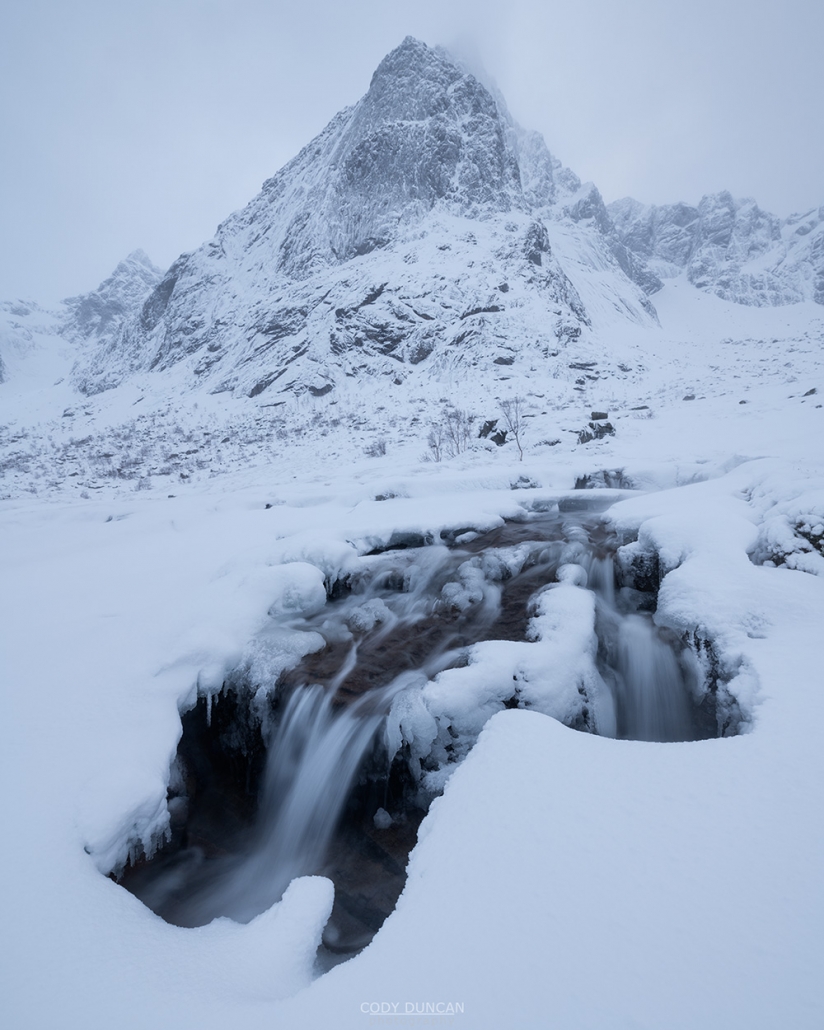
It has been a strange winter photo season this year on Lofoten. The commonly popular places in former years – Uttakleiv, Haukland, Unstad, Reinehalsen overlook – seemed almost deserted at times, while more random and isolated places seem to have grown in popularity. Case in point, Mølnelva.
This small cascading river flowing across some slabby rocky just next to the E10 never seemed to popular in previous years. This year however, while I was out trying to take a couple last images for the update of Seasons on Lofoten: Winter ebook, it seemed to always have a crowd of photographers each time I drove by. It wasn’t until late on some stormy afternoon that I finally found the location deserted.
Perhaps it is a bit of confirmation bias – I was specifically looking at the river, so always noticed it was busy, while I’ve driven by it 1000’s of times before without paying much attention. But this wouldn’t be the only ‘lesser known’ location I’ve seen quite busy on Lofoten this winter photo season.
Maybe people are getting a little tired of the classic views and looking for something new. Maybe there’s some social media popularity about a certain location that I haven’t known about – though this mostly seems isolated to the Instagrammer drone flyers, who love to copy a shot once its been ‘found.’ As though it is some new discovery and hasn’t been there forever.
I don’t know…
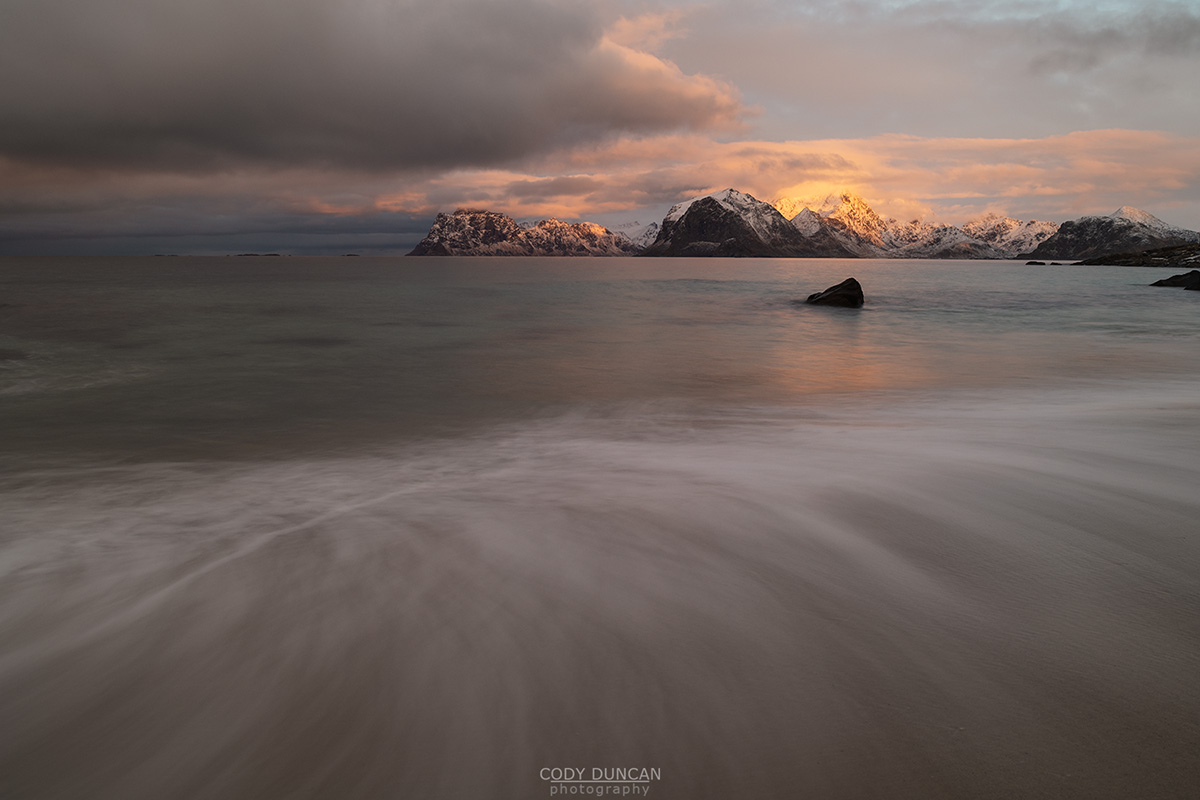
Camera Info: Nikon D850 Nikon 14-24 f/2.8 14mm ISO 31 f 16 0.6 second WB Daylight
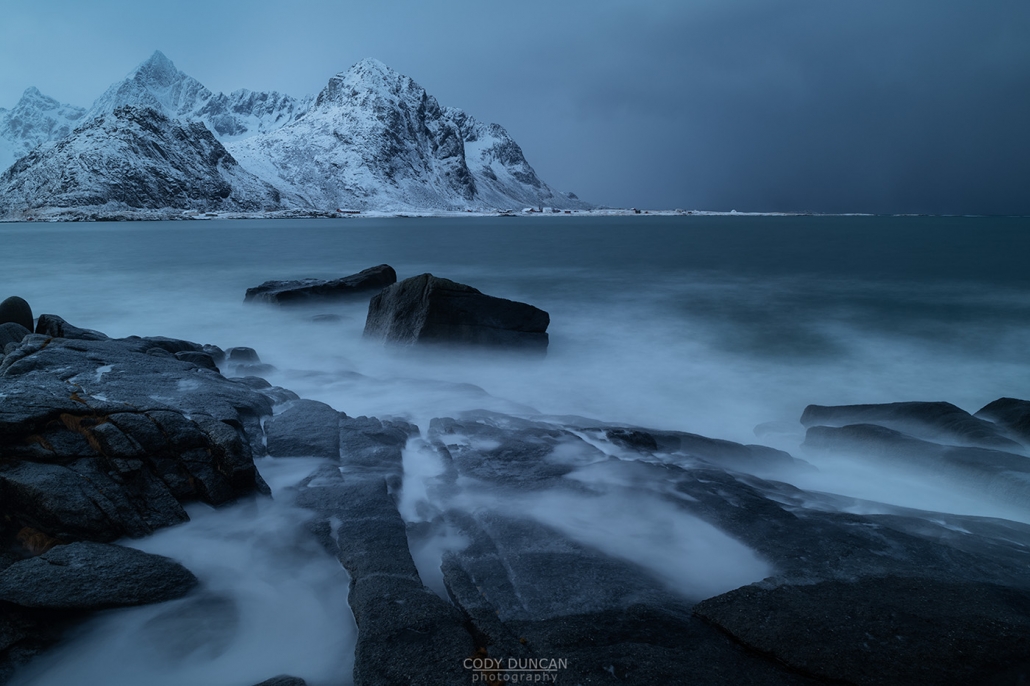
Photo: Rocks and ocean, Flakstadøy, Lofoten Islands, Norway. February 13, 2020. 12:49
It has been a grey winter this year. So far, half way into February, I’ve seen the sun four times. Ikke bra! (as one would say in Norwegian). I’ve maybe missed it a couple other times as when not guiding I’m almost entirely stuck behind the computer trying to get the 4th edition of Seasons On Lofoten – Winter ebook finally published. But anything I missed would have only been short moments of light between the seemingly ever preset clouds of 2020.
This week will be a short post. All my brain power is on book editing and design. Frankly, I’m exhausted. What was just meant to be a small updated to some info turned into an additional 130+ pages and images for a new detailed destination guide section in what is basically an entirely new ebook. And, since I’m not the best businessperson in the world, all this work will be a free update for anyone who’s bought the previous editions, even going back to first edition for $5 in 2015 – The new version will be $18, just FYI. This project has been a burden on me since Christmas, so I’m looking for it to be finished soon! Hopefully by this weekend – something I’ve said since mid January…
And yet, as much as I want to be finished, I want it to be good. So even yesterday and today I’ve been out photographing a couple locations to be included in the destination guide, having had to wait for the right conditions – which this year means, ‘not rain.’
This image is one of the new photos from yesterday, taken on a quiet section of Flakstadøy. To find out more, you’ll have to get the 4th edition of the ebook. 🙂
Camera Info: Nikon D850 Nikon 24-70 f/2.8 40mm ISO 100 f 10 8 seconds WB Daylight 6 Stop ND filter
Photo: Heavy grey sky over Flakstadøy, Vareid, Lofoten Islands, Norway. January 24, 2020. 14:15
I only saw the sun twice in January this year – Once on Lofoten and once on Senja. The rest of the time the sky has mostly been filled with heavy clouds so far this year. Though last Friday there was a fantastic pink sunrise, I just couldn’t get anywhere before the light was gone. But overall, it has been a wet and grey start to the year – almost complete opposite to least year which had fantastic light much of the time.
A few days before this photo I was driving by and saw a photographer get completely soaked by a huge wave and the on shore north wind. I decided against stopping there with my group, as an ocean shower didn’t seem like the best welcome to Lofoten on their first day. But later in the week the weather calmed slightly and it was ok to shoot without killing cameras or getting washed to sea. The light was flat with heavy snow approaching in the distance – but at least it was snow! As the forecast had called for rain much of the week.
Initially I had been shooting a shorter exposure to capture the crashing waves. But as the sea was a bit too stormy, the image felt too busy to me – too much white of the water in the foreground, just chaos. So I stuck on a 6 stop ND filter and tried something longer. It lost the energy of the sea, but produced a slightly more abstract look to the foreground which seemed to work better with the flat grey light of the day.
Camera Info: Nikon D850 Nikon 24-70 f/2.8 24mm ISO 64 f 11 30 seconds WB Daylight 6 stop ND filter
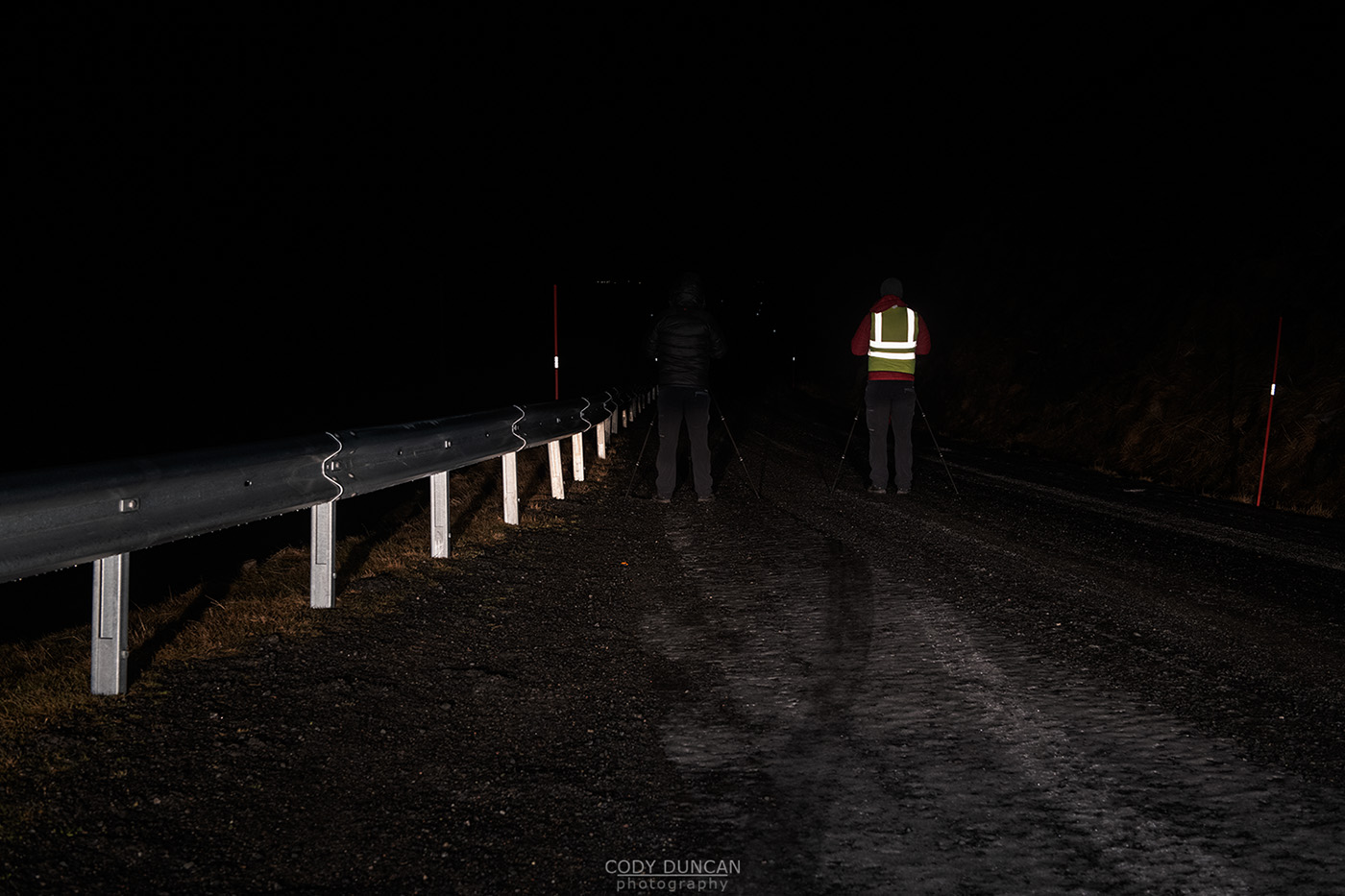
Photo: Are you invisible or visible when standing on the roads? Lofoten Islands, Norway. January 15, 2020. 16:41
The weather continues to be mostly terrible here on Lofoten, but I’ve been out and about the last week attempting to shoot some missing images for the winter ebook update (coming by the end of the month hopefully!). I can already notice the roads getting a little busier with rental cars as and have bumped into a few tour groups as the first photographers of the winter season are beginning to arrive. And especially in this horrible weather and darkness, visibility is an issue!
Photographers like to dress in black. I don’t know why. Perhaps it’s merely that the shops only carry winter gear in dark colors, or maybe some nationalities dress different than other. But there are a lot of photography Ninja’s standing on the roads of Lofoten during winter.
If you’ve ever been here, you’ll notice nearly all the locals utilise some variety of reflective clothing when out on their evening walks – and even during the day at this time of year where it’s still quite dark. And trust me, as someone who drives here year round, it really makes a difference! I’m glad I can see the people when they’re walking.
In the last years, some of the rental car companies and rorbuer have begun placing hi-vis vests in the cars and cabins. And hopefully the trend continues. And I’ll admit that I myself am not always so good at this either, especially during tour season when I spend a lot of time near the roads.
For the winter ebook update I’m starting to write a little more about safety, especially on the roads, as I witness a lot of dangerous behaviour during the winter season. One of the sections will be about this, visibility.
The other night during a pause in the rain I went down the road to try shoot a photo to illustrate the difference. I stood on the left dressed in all black and on the right I changed into brighter clothing and a hi-vis vest. The image is lit from my vans headlights. I merged the two photos together to illustrate the difference. And what a difference it is!
So now imagine someone is photographing the northern lights in the middle of the road – which happens a lot! There’s a car coming, the passenger is pointing at the sky and telling the driver to hurry up as the lights are amazing. The driver is looking at the gps trying to see how far away the beach is. The photographer is focused on the northern lights and doesn’t really notice the car coming. Which person is the driver hopefully going to see standing in the middle of the road?
Visibility is safety for everyone here in winter…
Camera Info: Nikon D850 Nikon 24-70 f/2.8 45mm ISO 800 f 7.1 .4 second WB Daylight
https://www.68north.com/content/2020/01/friday-photo-367-visibility.jpg9331400Codyhttps://www.68north.com/content/2016/12/68north-logo-V4.pngCody2020-01-17 09:46:552020-01-17 09:46:58Friday Photo #367 – Are You Visible?
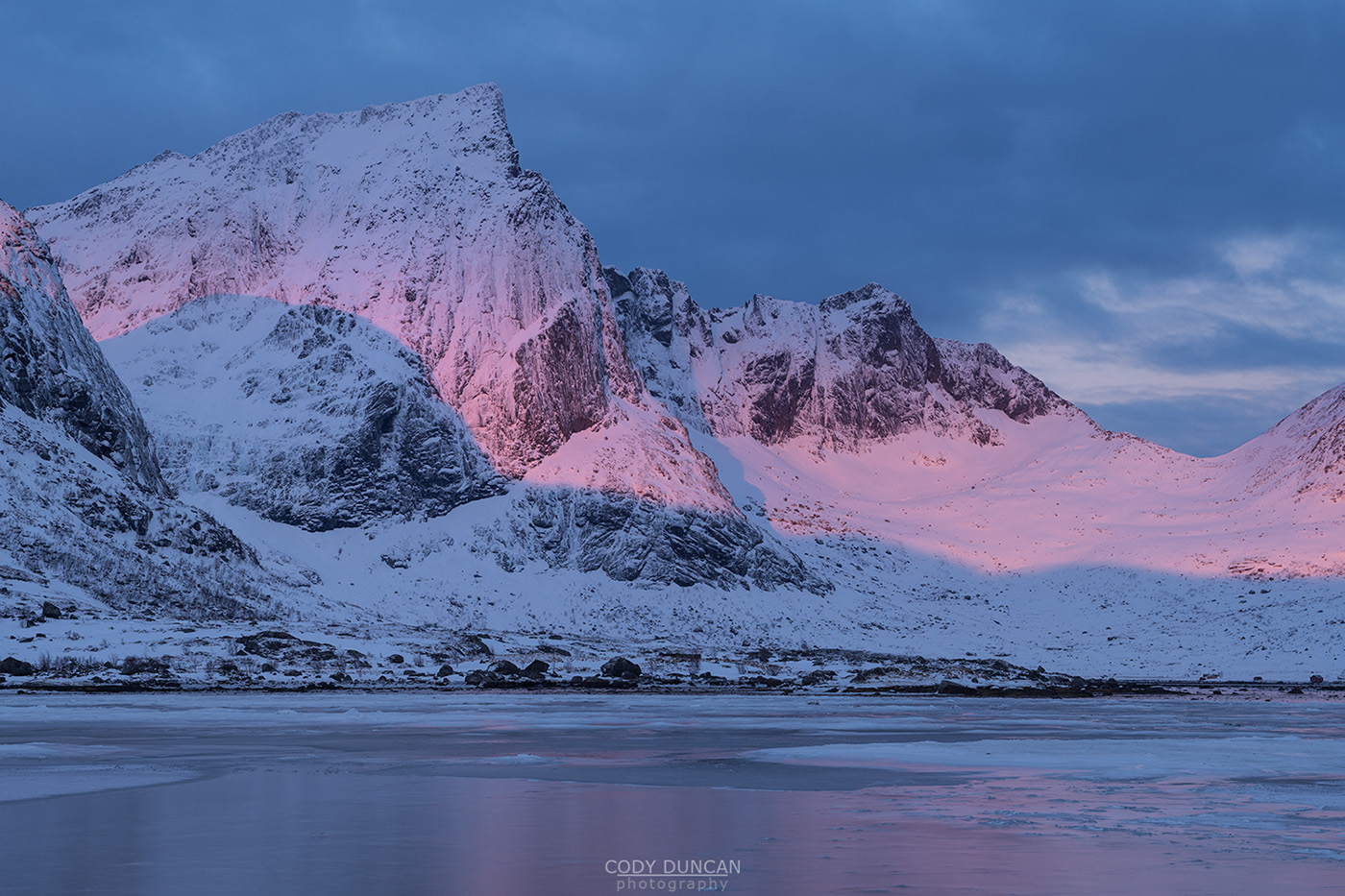
Photo: Winter dawn over Stortind, Flakstadøy, Lofoten Islands, Norway. February 21, 2019. 08:06
It is something from the archives today. Lofoten has had a stormy start to 2020, and not in a good way. I went to Uttakleiv today to try and shoot something, but was bombarded by hail within a few minutes of my arrival. I bought myself one of those home weather stations for Christmas – the other night it recorded over 35 meter/second wind casts – that’s over hurricane speed winds! No wonder I didn’t sleep much as my house was making sounds I’ve never heard before.
My head is also a bit short of words this week. Originally I had planned to release a new hiking eBook for the 140km Padjelanta trail in north Sweden. But as hiking season is still months away, an no one, even in Sweden, has heard of the Padjelantaleden anyhow, I put it on pause. Instead I’ve been focusing on a new update for the Seasons on Lofoten – Winter Ebook.
But I’m afraid I got a little ambitious! The update will add somewhere around 130 pages, 100 images, and 15,000 words. I’ve spent about 100 hours so far in front of the computer since the new year, with plenty more to go, to try and get it out before my winter tour season kicks in – I should have a tour now, but no one booked it – one cheapest winter photo tours offered on Lofoten, you could have had it for yourself… 🙂
So at least I have another week to work on the eBook, but it will be tight. And as the update is free, even if you bought the original eBook for $5 in 2015, I don’t want to kill myself for what is basically volunteer work on my behalf – especially since the current edition is already fine, and probably the best photo guide to Lofoten anyhow. But it will soon be better!
In the process of the the new eBook update I’ve had to dig through my archives a bit to find some locations that I photograph on occasion but never seem to publish images from – something of a problem when you live in a place that you photograph so often. I have so many images that I’ve shot, yet don’t have the time to edit, so they just sit there. But in the new update I’ve needed some images from specific locations, so it’s good to look through the archives from the past couple winters.
This image was one of those ‘5 minutes of light’ sunrises. It went from grey, to pink on the mountain, back to grey within a few short minutes. There was no time to move to a new location, I just had to shoot what I could see. Luckily I was on the frozen ice at Flakstadpollen when the first pink on the summit of Stortind appeared. It wasn’t the best composition ever, but at least it was something.
Camera Info: Nikon D850 Nikon 24-70 f/2.8 56mm ISO 100 f 11 1/10 second WB Daylight
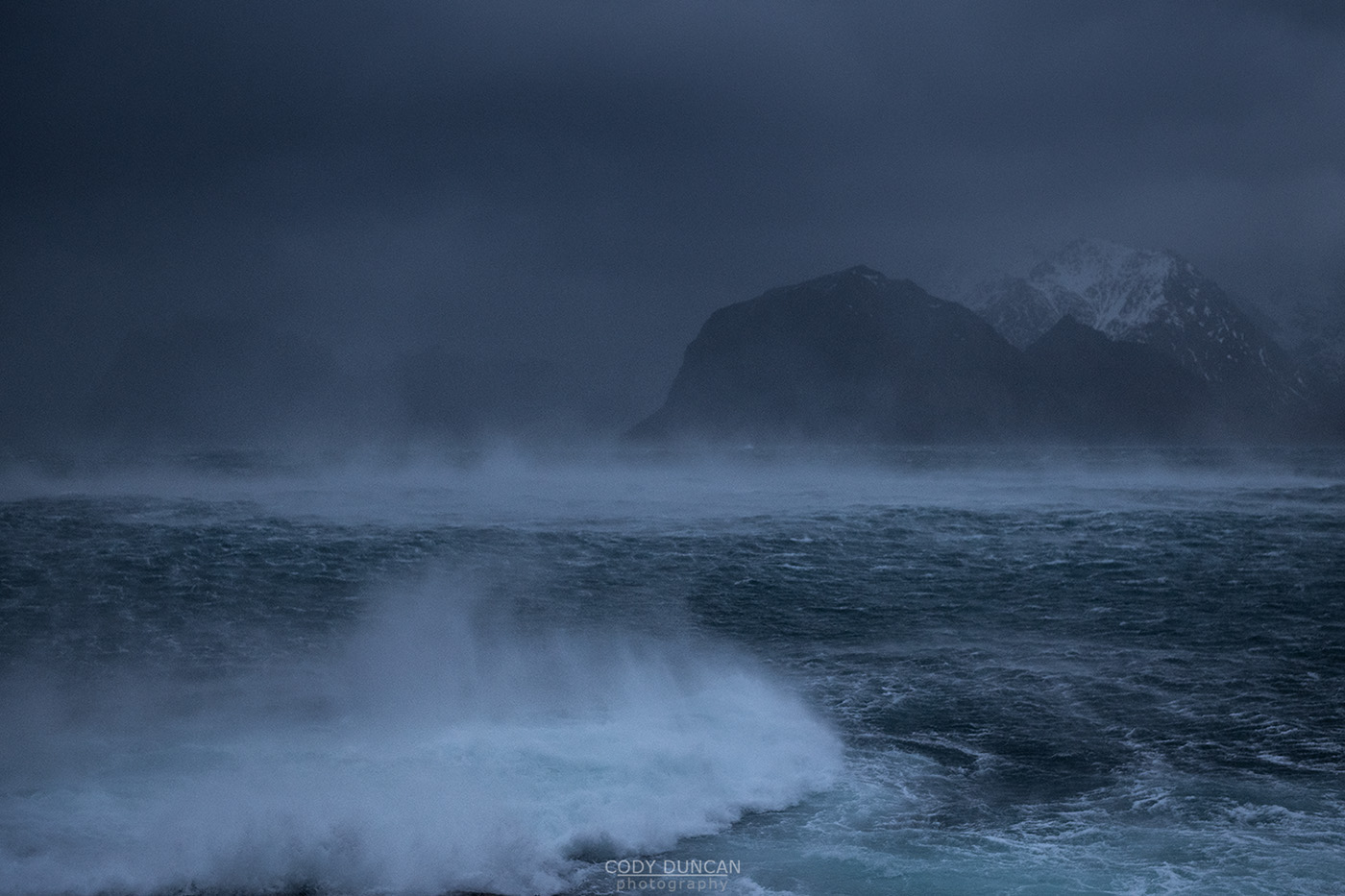
Photo: New year, new storms – Lofoten enters 2020 with a blast of wind over Nappstraumen, Flakstadøy, Lofoten Islands, Norway. January 2, 2020. 13:38
What was a somewhat calm New Year’s eve on Lofoten has turned into a series of passing storms in the first few days of the new decade with local ferries canceled and even the Hurtigruten coastal ship holding fast and port and skipping Lofoten. And the winds will still continue tonight and into Saturday, so hold fast.
It was eerily warm yesterday in much of Norway, and down south in one of the fjords it was 19˚C or so, a new heat record for winter. Up here it was a little cooler, but still a mild 9˚C with a heavy sideways rain and house shaking wind casts. I could see the wild ocean outside my kitchen window, so once the heaviest of the rain passed, I headed out to the coast to see if I could manage anything.
Not trusting the weather, I actually drove about 400 meters down the road to a pullout. The wind was even more brutal there and shook my van like it was a boat at sea as I attempted to park, then wait for a calm moment to open the door. The wind and rain came in waves and I did my best to scramble down onto some rocks and find a place to sit, which was difficult enough – standing was impossible.
With the polar night ending this weekend, it was still quite dark in mid afternoon with the sky dark and grey. I did my best to steady myself and my camera, but it was more or less impossible – and this image if of questionable sharpness. It is hard to capture the real fury of the wind in a still image. Especially since the best time to shoot is when the cast winds hit and rise the sea into a tempest. Then it’s a fight between steadying yourself, keeping the tripod from falling over, and shooting an image – which basically means pressing the shutter button with a rough idea of what might come out.
Camera Info: Nikon D850 Nikon 24-70 f/2.8 56mm ISO 1000 f 3.2 1/200 second WB Daylight
364 ÷ 52 = 7 years of Friday photo posts – you can go checkout my first post from January 11, 2012 – Friday Photo #1. Some weeks I’m not quite sure how I continue, what more can I write about that hasn’t already been said?
When possible, I try to post as current of content as possible, or maybe some special conditions or something. That way I can at least keep it as a bit of a news feed. I’ve even thought of starting some sort of online news-ish report that maybe would come out once a month or so, as there is a lot of tourism related stuff which is discussed in the local news papers and such, but only in Norwegian – even though it is actually visitors who should know about it.
In the times coming up, when I’ll be away on photo workshops for extended periods of time and have to write multiple posts in advance I find myself running out of words more frequently. Though this is also do to ebook updates, which also remove my motivation for writing – my head only has so many words in it!
The posts will keep coming – but if anyone has any topics they’d like to hear about suggestions are appreciated!
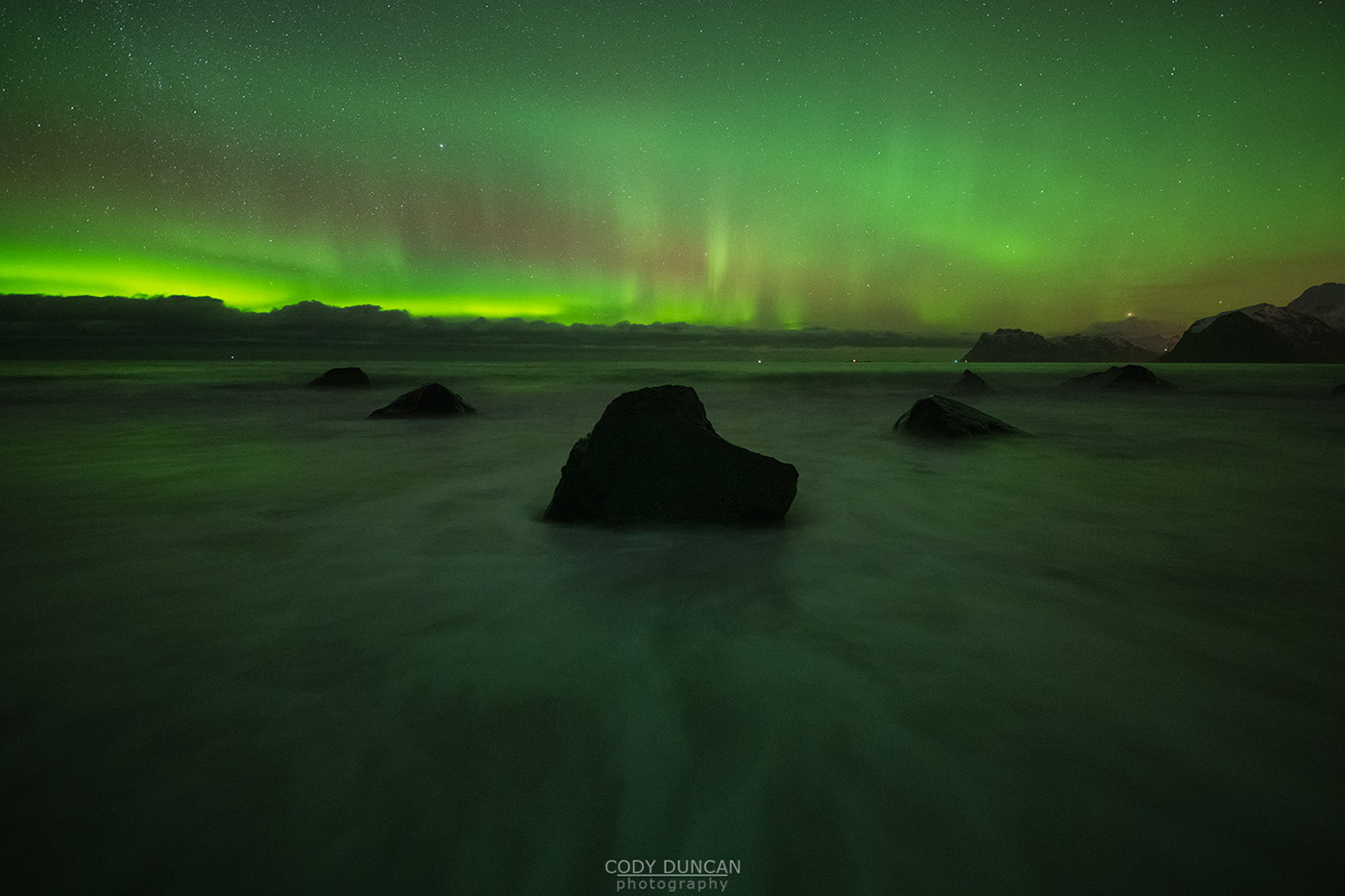
I guess none of the above actually had anything to do with today’s photo – A small little aurora late on Christmas evening. Overall, it has been a pretty poor season for northern lights so far, with many quiet or low activity nights, even with clear skies. Though I am also a little pickier than I used to be, and if I only see a faint glow low on the horizon, I often don’t even find the motivation to walk down to my beach only a few minutes away. And truth be told for this photo, if It hadn’t been Christmas, I probably wouldn’t have gone out and stuck with Netflix for the evening instead.
I have made some updates to the northern lights page. There is more to come, but I want to get the information out to people who have bough the Seasons on Lofoten – Winter ebook first – with the 4th edition coming out in late January hopefully.
I want to try and provide a little more clarity about photographing the aurora and different levels of brightness, etc. Or that is to say, photographically, a 30 second exposure with a kp2 can make the sky look just as green and ‘full’ as a 1 second exposure with a kp5 – but this is just for the camera and the viewer of the finished photo – which for some people might be all that matters. For the person standing there, these will be wildly different experiences – perhaps even a bit anticlimactic and ‘ehh’ on the kp2 side, to shouting with joy at the sky dancing in a full solar storm as coronas swirl overhead of kp5.
I sometimes get a little annoyed reading online content and reporting about northern lights. First when some travel blogger spent a night in Tromsø and saw some crappy dull aurora and then writes half a book about the aurora not being that great or like in the photos. No! they just experienced a low activity aurora in a short period of time – the sky does not dance every night! If it did, then it wouldn’t be special anymore…
And there is the reverse of this is with the same experience, low level aurora, but making it seem like they had fantastic aurora’s night after night to fulfil some expectations that their trip was productive, or to impress followers or sell products or something. This story often comes from the ‘aurora chasers.’ Bragging about sleepless nights driving hundreds of kilometres through winter storms. Ya, thanks guys for making it look cool to drive sleep deprived on dark icy roads. I guess it’s not your family or friends who might meet one of you head on after you’ve drifted to the wrong side of the road.
But maybe the above is one of the reasons I keep writing these articles – And perhaps that is the root of this website – to describe Lofoten how it is. No marketing BS from tourism agencies looking to fill hotel rooms. No ’OMG! 10 BEST SECRETS!’ lists to get referral link sales from Youtubers who spent 2.5 days here flying their drone over Reine before darting off to the next destination for the next ‘OMG! 10 BEST!’ list. And no steepened and dramatised mountains with photoshopped auroras from Instagram influencers looking grow their followings just as they have done to the mountains to sell their Lightroom presets. Just plain Lofoten – the good and the bad…
Happy new year folks, see you in 2020!
Camera Info: Nikon D850 Sigma 14mm f/1.8 14mm ISO 2500 f 1.8 8 seconds WB Daylight
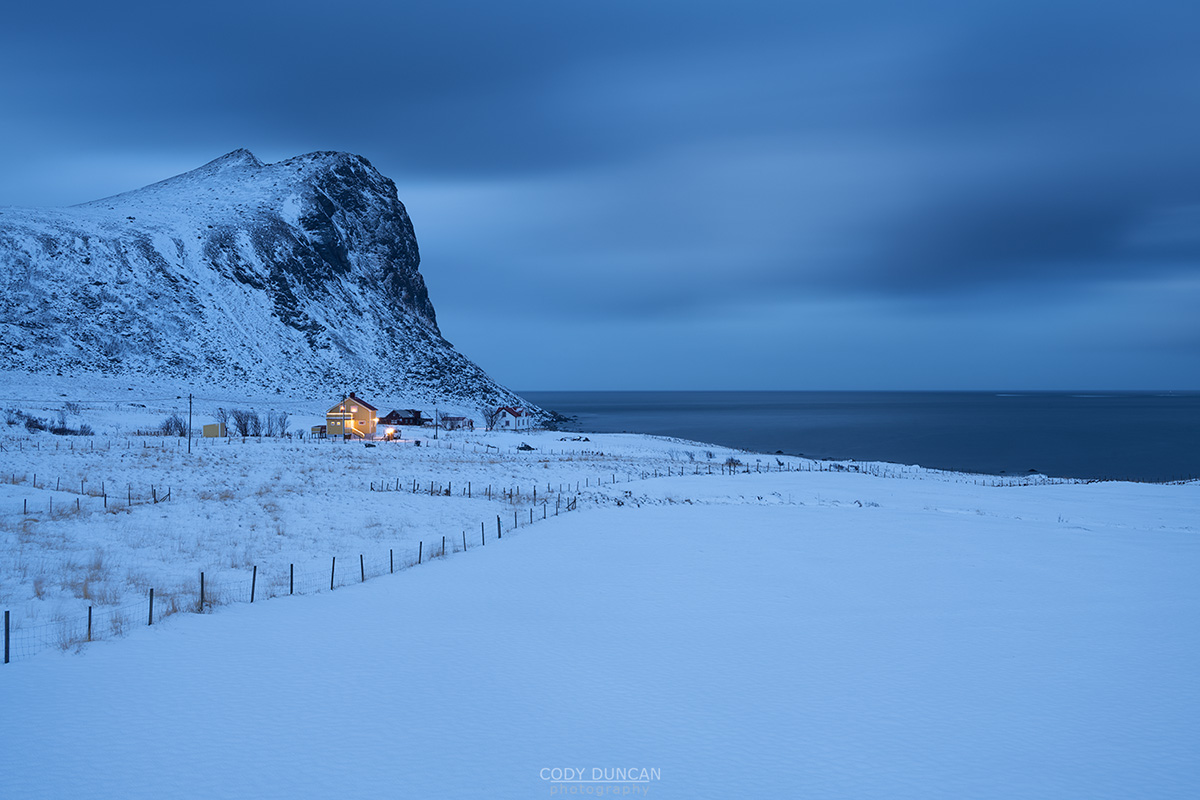
Photo: No neutral density filters needed – Mørketiden – the polar night over December’s winter landscape, Flakstadøy, Lofoten Islands, Norway. December 11, 2019. 14:15
The polar night has reached Lofoten – The sun will not shine on the islands again until the first weeks of January once it rises above the southern horizon again. December is the dark time of year here in the north. We live are lives in brief moments of twilight before the night covers the land again.
For those living on the southern side of the islands, noon can mean a horizon full of color in a continuous sunrise/sunset. For those of us on the north however, we live in perpetual twilight and darkness. A world of soft pastel pinks on a good day and blues and greys on the rest. The Christmas lights decorating my neighbors’ houses are the only colors I see in my valley now.
Lofoten has been getting hit with some heavy weather lately. It seems as soon as one storm ends, the wind switched directions and arrives from the other side. Luckily I decided to take a southern holiday this year at the end of November, and missed the worst of things. But this wind has been blowing strong since my return, and there is no doubt more to come during the next months – It is more common than I fall asleep to the sounds of my house shaking in the wind than not.
I photographed this from my hallway window. I had been down at the beach earlier in the day and would have likely posted one of those photos today. But once I was home, the light of my neighbour’s house caught my eye in the afternoon darkness – during a brief pause in the day’s snow and rain. While the beach photos were nice, they were just kinda normal winter photos. This, to me, was a better illustration of the polar night and the land I’ll live in until the sun returns.
Camera Info: Nikon D850 Nikon 24-70mm f/2.8 32mm ISO 31 f 14 76 seconds WB Daylight
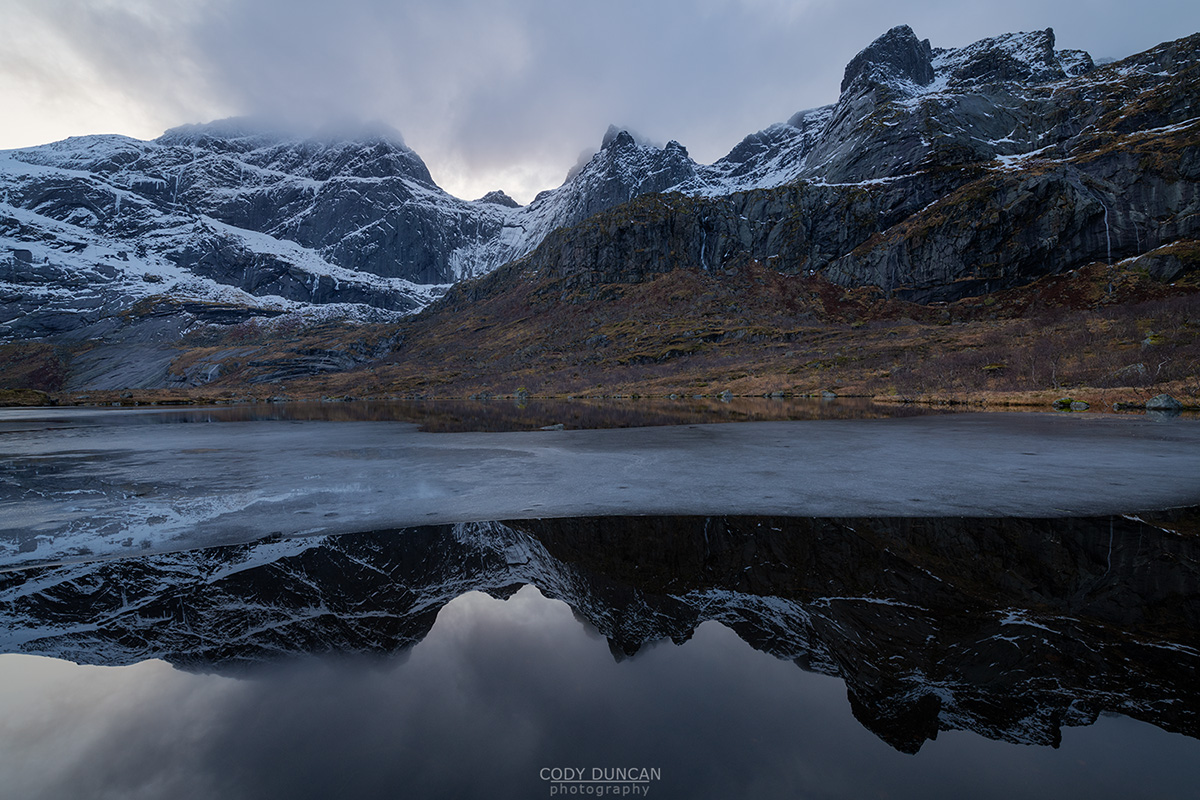
Photo: Mountain reflections in partially frozen lake, Flakstadøy, Lofoten Islands, Norway. November 21, 2019. 13:23
The cold snowy weather and early winter that Lofoten experienced at the beginning of November has shifter to warmer, wet and stormy weather over the last week. What had once been a fully snow covered landscape – enough for my first ski trip of the year – has mostly melted away in the November rain, and once frozen lakes have thawed in the mild weather.
But this is normal. The cold, white November was actually the slightly unusual weather. I was hoping we would head into full winter, but the islands are once again in waiting mode until the next snow arrives.
One thing is for sure though, the quickly disappearing sun. With barely 4 hours of daylight at the moment, the Polar Night is just around the corner. With the snow of early November, I kinda didn’t notice the darkness. But in these grey, cloudy days of the last week, I really began to notice it. Even at noon, it has felt depressingly dark already! And with each passing day it only gets worse. I don’t like November.
Living on the north side I don’t get any light anymore. I thought there might be a little break in the clouds on the souther horizon, so I went and took a drive Thursday for today’s post, to see if I could find any light. There was a bit, but nothing too special and so somehow I ended up on the road to Nusfjord.
After all the rain, the mountains are filled with waterfalls. A distant once, with a flowing river, caught my eye, and so I hiked across the thoroughly boggy land to get a little closer. Turns out the view from the road was better than near the base of the waterfall, so it wasn’t to photogenic. But this small lake I passed on the way looked much nicer with a near perfect reflection.
I initially wanted a tighter composition, but I could never get the mountains in balance. So I went wide, which seemed to work out nice enough. Though I never really like the November brown, I might have to keep this in might for September, with golden trees filling the foreground.
Camera Info: Nikon D850 Nikon 14-24 f/2.8 14mm ISO 100 f 8 1/13 seconds WB Daylight
Photo: The distant summit of Olstind illuminated in November’s afternoon light, Flakstadøy, Lofoten Islands, Norway. November 14, 2019. 13:47
After the early start to winter of the last week – I even managed to get in my first ski tour or the season on Vestvågøy – The rain has returned since the middle of the week. Much of Lofoten is now covered in a sheet of wet ice thanks to the melting snow – and many of the side roads are quite scary to drive at the moment. So I’m using a bit of a head cold as an excuse to stay home – busy working on ebook updates anyhow.
The sun never gets very high in the sky anymore. It left my village some weeks ago and will leave the rest of Lofoten in a few more weeks. Those living on the southern side of Lofoten now get to experience the full days of sunrise-to-sunset light. For us living on the northern side, we re lucky enough to be able to see some light off in the distance, our only reminder that the sun is still here as the mountains cast their long shadows over my village.
I should have driven down to Storsandnes beach, but the thought of the road wasn’t very tempting. So instead I made the short walk down to my beach – which was already scary enough! The beach has been covered in seaweed recently from one of the last storms and the waves weren’t crashing over the rocks that I would have liked. So I ended up taking a somewhat more abstract approach. Though I still think this is nothing too special either. I should have gone to Storsandnes…
Camera Info: Nikon D850 Nikon 24-70 f/2.8 24mm ISO 100 f 9 2.5 seconds WB Daylight 6 stop ND filter
We may request cookies to be set on your device. We use cookies to let us know when you visit our websites, how you interact with us, to enrich your user experience, and to customize your relationship with our website.
Click on the different category headings to find out more. You can also change some of your preferences. Note that blocking some types of cookies may impact your experience on our websites and the services we are able to offer.
Essential Website Cookies
These cookies are strictly necessary to provide you with services available through our website and to use some of its features.
Because these cookies are strictly necessary to deliver the website, refusing them will have impact how our site functions. You always can block or delete cookies by changing your browser settings and force blocking all cookies on this website. But this will always prompt you to accept/refuse cookies when revisiting our site.
We fully respect if you want to refuse cookies but to avoid asking you again and again kindly allow us to store a cookie for that. You are free to opt out any time or opt in for other cookies to get a better experience. If you refuse cookies we will remove all set cookies in our domain.
We provide you with a list of stored cookies on your computer in our domain so you can check what we stored. Due to security reasons we are not able to show or modify cookies from other domains. You can check these in your browser security settings.
Google Analytics Cookies
These cookies collect information that is used either in aggregate form to help us understand how our website is being used or how effective our marketing campaigns are, or to help us customize our website and application for you in order to enhance your experience.
If you do not want that we track your visit to our site you can disable tracking in your browser here:
Other external services
We also use different external services like Google Webfonts, Google Maps, and external Video providers. Since these providers may collect personal data like your IP address we allow you to block them here. Please be aware that this might heavily reduce the functionality and appearance of our site. Changes will take effect once you reload the page.
Google Webfont Settings:
Google Map Settings:
Google reCaptcha Settings:
Vimeo and Youtube video embeds:
Other cookies
The following cookies are also needed - You can choose if you want to allow them: