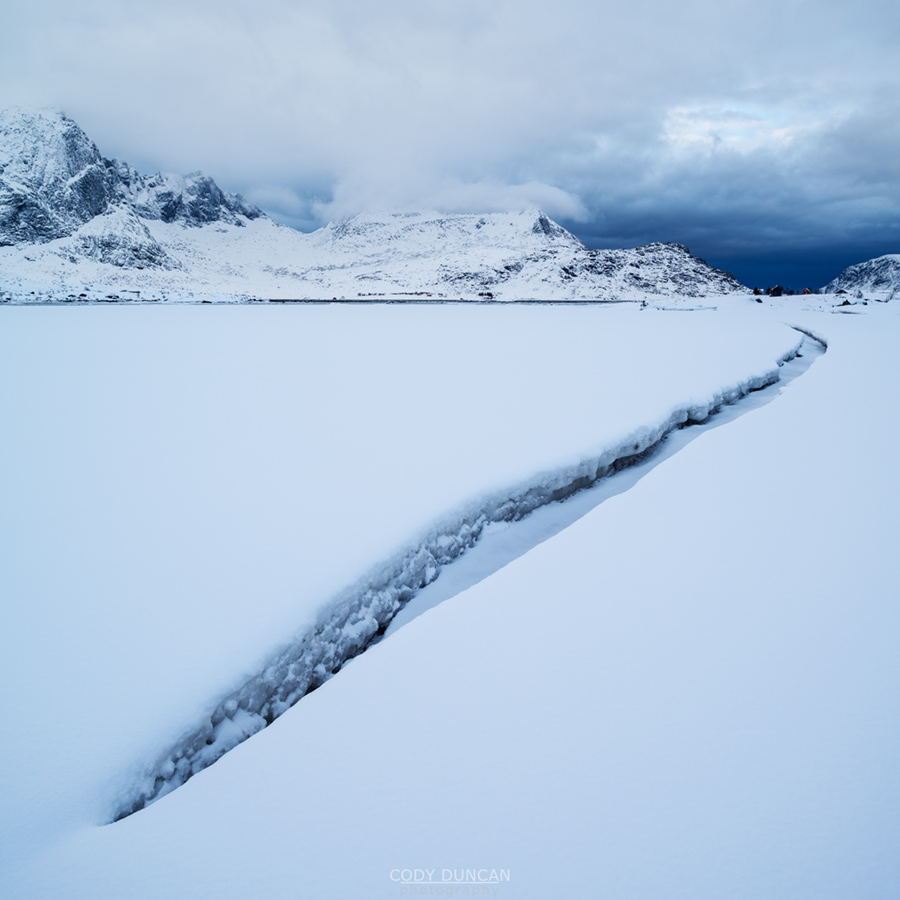
Snow covers sea ice in inner Flakstadpollen, Kilan, Flakstadøy, Lofoten Islands, Norway

Photo: Frozen Sea ice in Inner Flakstadpollen, Flakstadøya, Lofoten Islands, Norway.  Feb 14, 2013.  09:01

As the second half of February arrived this year, the previous weeks of cold, but clear and calm weather came to an abrupt end.  Heavy clouds rolled across the islands and the beautiful light of the low winter sun was taken over by a flat, dull gray.  At least there was still a decent coat of snow that had yet to be too covered in footprints.

I often arrive to the islands in less than ideal conditions, often missing some brilliant light by a day or two.  But I always feel a need to get those first few photos.  I have been to the islands enough now to know that I need to be patient, but as days 1, 2, 3 pass by and I’ve hardly touched my camera, I sense a growing frustration within myself to get out and shoot something.  Oftentimes this can be a fruitless quest, but every once in a while, something interesting will appear despite all efforts of the light working against me.

This image only existed for a few day.  Thanks to a fresh coating of snow that had fallen overnight, ‘cleaning’ up the sea ice, which by itself, was not especially photogenic.  Luckily, despite the crowd of photographers on the islands this February, I was the first to come across this scene, finding it still untouched; though most groups only hang around Reine anyways, going for the ‘hero’ shots made popular by several photographers better known than myself.  But that is good, as I often find that I have the rest of the islands to myself.  Free of footprints in the snow, and to wander as I please.   Perhaps I shouldn’t give away too many secrets though…

Without the crack in the ice, this scene would not have worked at all as it would have been too flat and boring.  And I think in situations like this, one needs to resist the urge to punch up the contrast to some hyper-realism that didn’t exist.  The light was shit, as it often is on Lofoten in winter.  But using shape and form, there is still the possibility to find something interesting.

This is a scene where the 24mm tilt-shift lens is really is a valuable lens for Lofoten, often due the the sheer vertical relief of 800-1000m mountains rising directly from the sea.  Much winder than 24mm, and there are distracting elements on the edges of the frame.  But with a normal 2/3 crop, the tops of the mountains would be lost, unless getting low enough to the snow where the crack would then lose separation and definition.  I guess one could always crop from a wider lens, but I don’t really like to do that.

Camera Info:
Nikon D800
Nikon 24mm f/3.5 tilt-shift
24mm
ISO 100
f 13
1/30 sec
WB Daylight
2 Images – Top/Bottom
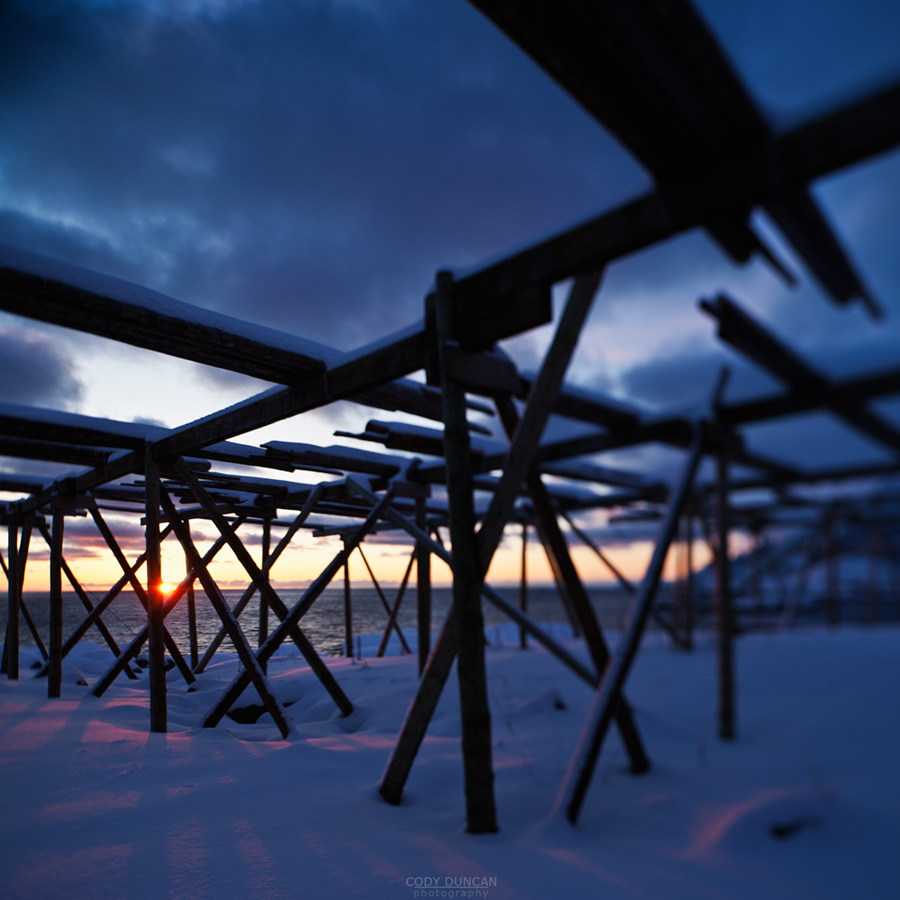
Winter sun silhouettes empty stockfish drying racks, Lofoten Islands, Norway

Photo: Winter sun at midday, Hamnøya, Lofoten Islands, Norway. January 6, 2010. 12:50

By the end of the first week of January, the sun is just barely beginning to wake from its winter hibernation. Not even fully crossing the horizon, the sun slowly arcs the southern sky before the long winter night returns by mid afternoon. While I had already made a half dozen trips to the islands by this point, this was my first real journey into the heart of winter.

Alone and cold, my only shelter from the fierce storms that blasted the islands was my tiny rental car, unable to even fully recline the seats to sleep. I spent and average of 20 hours per day wrapped in my sleeping bag, reading by the light of my headlamp to pass the time, drifting in and out of sleep when I could. Snow fell so heavily on several days that the only place I could park so sleep for the night was next to bus stops on the E10 where a snow plow would hopefully arrive by mid morning to dig me most of the way out. But it was over these 5 days that I took some of my brilliant photos of the islands to date. I embraced to cold and the darkness and used it to my advantage.

This image is from my first full day on the islands. The night had been turbulent and stormy (I had yet to learn that Utakleiv is generally not a good place to sleep in a car in winter), but as dawn arrived, the islands clear and calm. By midday I found myself in the west as the sun was beginning to break the horizon. It seemed to just sit there, halfway between sea and sky.

Despite the fact that the horizon was clear, the clouds overhead never developed much color. The mountain behind me were glowing a brilliant pink, but I also wanted to capture something looking towards the sun, even though the scene was actually somewhat boring to tell the truth. So after unknowing getting my car stuck in the snow (I had to get pulled by some guy in a tractor I found clearing the streets a little later), I walked over to the cod drying rack, still sitting empty this early in the year. Trying a few composition, I eventually decided something a bit more abstract might fit the scene better. So I ’tilted’ the lens all the way to throw most of the frame out of focus and help lead the viewer towards the sun.

Camera Info:
Nikon D700
Nikon 24mm f/3.5 tilt-shift
24mm
ISO 200
f 5.6
1/160 sec
WB Daylight
2 images – top/bottom
Full lens tilt

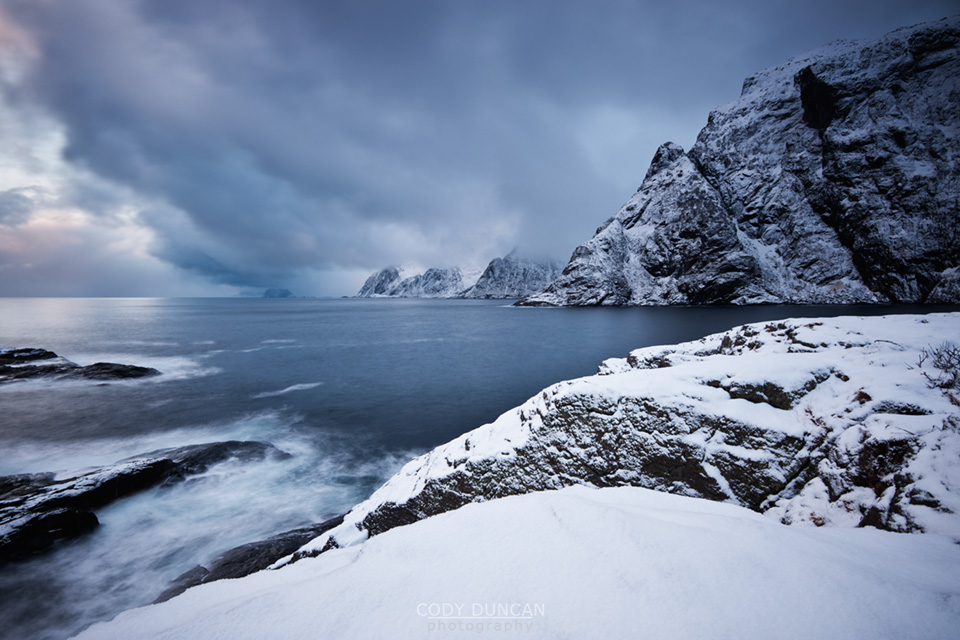
Dramatic scenery at snow covered coastline, Å I Lofoten, Lofoten Islands, Norway
Photo: Approaching winter storm, Å I Lofoten, Moskenesøya, Lofoten Islands, Norway.  Feb 12, 2012.  15:27

The last full day of my February 2012 Lofoten.  After nearly a week of positive temperatures and horrible rain, the thermostat fell below zero and snow once again fell upon the islands.  In late afternoon, I headed back to one of my favorite winter locations, the cliffs beyond Å.

It was one of those classic Lofoten winter days of snow flurries sweeping across the islands.  If you try and run from the weather on days like this, you’ll never get a shot if it’s more than a few minutes from your car.  You wait on the edge, watching as the next wave of snow heads towards you, shooting until the last minute.  Then you hide your camera under your jacket, turn your head away from the wind and wait until the snow passes, if it passes.

With luck, you only have to stand there 10-15 minutes until the clouds once again rise and a brilliant fresh layer of snow covers the land.  You try to shoot what you can as you watch the next cycle approach.  Repeat ad infinitum.  Winter on Lofoten.

Camera Info:
Nikon D700
Nikon 16-35 f-4
16mm
ISO 100
f 11
10 sec
WB Daylight

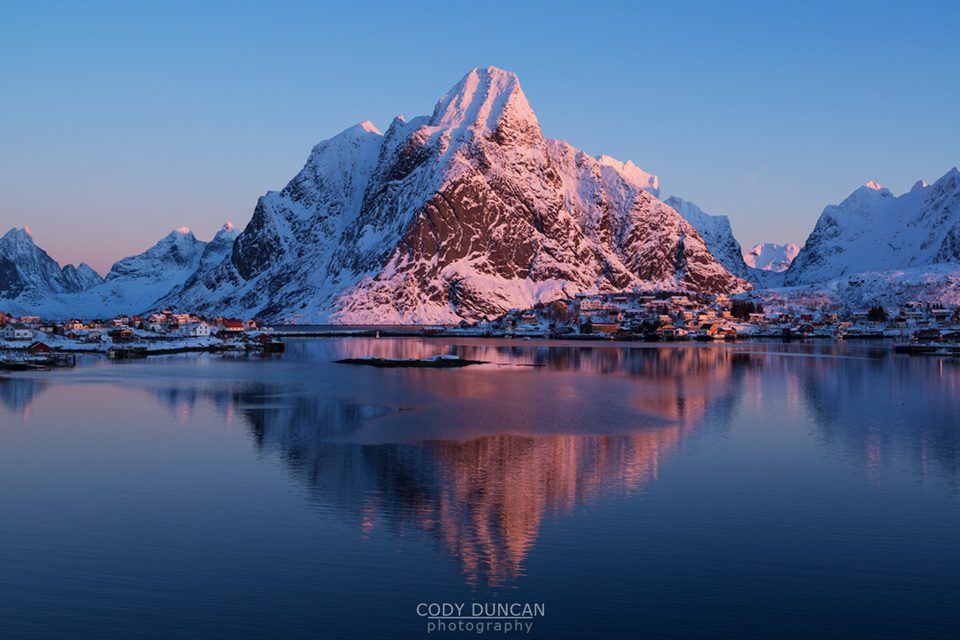
snow covered Olstind mountain peak glows pink in winter sunrise, Reine, Lofoten Islands, Norway
Photo: Pink dawn, Reine, Moskenesøya, Lofoten Islands, Norway.  Feb 19, 2013.  08:16

This is perhaps what Winter photography on Lofoten is all about, mountains glowing pink in the low hanging sun.  In mid January, this would be your view the entire day.  However by mid February, the sun rises sufficiently high were only the first hour of the day will provide this sort of light.

Having stayed up somewhat late the previous night shooting a fantastic display of the Northern Lights I was perhaps a bit sluggish to leave my sleeping bag this morning; also aided by the fact that this was the coldest day of the entire trip.  Lucky for me, the sun moves slow in the north, leaving enough time for a lazy photographer to prepare for the day.

Having slept in the car at the parking lot in Å, not my preferred sleeping place, but all the others were covered in deep snow, I figured heading to the tourist viewpoint in Reine would probably be my best bet.  The upper view point was already crowded with others, so I headed down to the lower one, which few people seemed to visit for some reason.  I like the view from here better anyhow.  And so, I now have yet another image of Olstind, a mountain that I’ll probably never grow tired of photographing.

Camera Info:
Nikon D800
Nikon 24-70 f-2.8
40mm
ISO 100
f 10
1/30 sec
WB Daylight

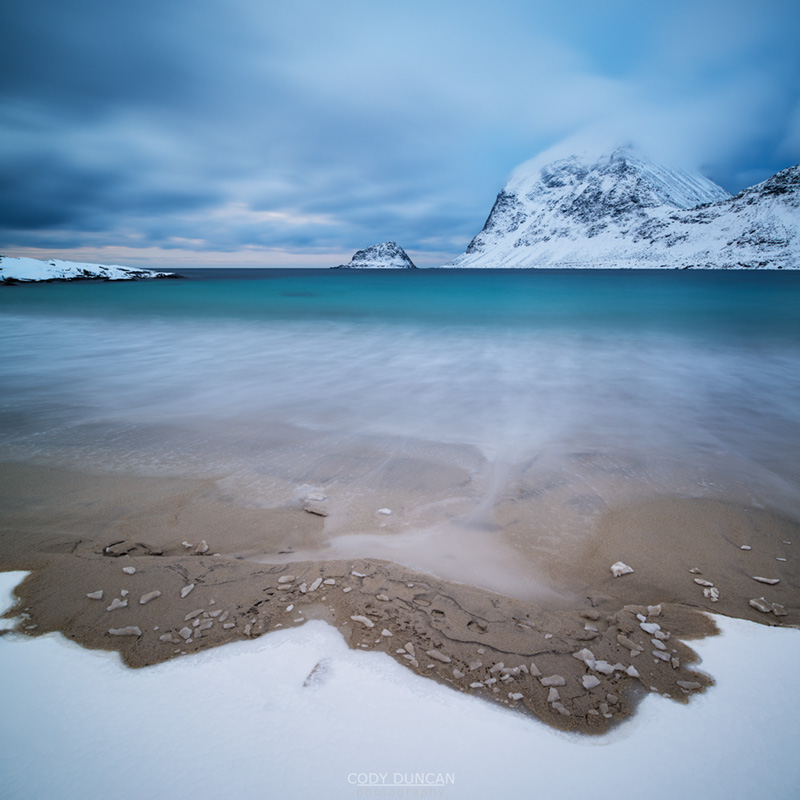
Sea and snow meet at Vik Beach, Vik, Vestvågøy, Lofoten Islands, Norway
Photo: Winter tide, Vik Beach, Vestvagøyå, Lofoten Islands, Norway.  Feb. 16, 21013.  17:19

For several days a layer of low clouds had enveloped the islands and concealed the sun.  Flat, gray light was all there was to be found over most of Lofoten.  Finally, as evening arrived I headed out towards Utakleiv, where I planned to spend the night.  I was originally going to stop at Haukland beach while on my way, but there was already a crowd of other photographers there – and for some reason, I’m a bit self-conscious about invading another photographers ‘working space.’  Nothing more annoying than composing a shot and have some dude, or usually a workshop group, as numbers bring boldness, set up a tripod in the middle of your scene.  But I digress, a rant for another day perhaps…

So I instead headed towards Vik beach, which sat empty.  I had good luck with my timing as the incoming tide was meeting the snow line on the beach, which I often find an interesting motif.  The clouds here on the north side of the island also began to show some texture as they first met with the mountain wall of Lofoten.

There seem to have been a sheep or two which had wandered up and down the beach, leaving a maze of footprints in the otherwise almost completely untouched snow.  This reduced the possibilities of including more foreground in the composition and meant I needed to keep just to the water’s edge.  But in the end, I think it worked out quite okay.

Camera Info:
Nikon D800
Nikon 24mm f/3.5 tilt-shift
24mm
ISO 50
f 16
25 sec
WB Daylight
6 stop B+W ND filter
2 images – top/bottom

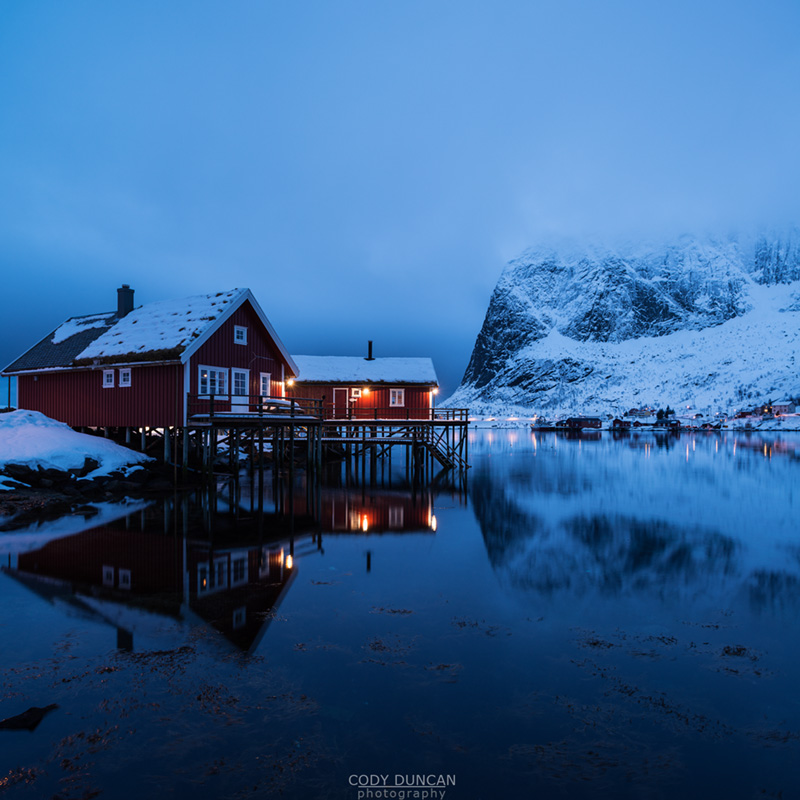
Traditional Rorbu cabin reflects in fjord in evening light, Valen, Reine, Moskenesøy, Lofoten Islands, Norway

Photo: Valen Rorbu, Moskenesøya, Lofoten Islands, Norway.  Feb 17, 2013.  17:00

Heavy skies had covered the islands for several days.  After spending the afternoon at Å, waiting for a sunset that would never arrive, I returned to the area of Reine while waiting to meet a friend in the early evening.  I sat close to the fjord at waited for any possibilities of light, but nothing.  The clouds hung low, concealing the mountain peaks.

As I was leaving the car, heading in the opposite direction, towards a view of Olstind, I saw the lights of this Rorbu turn on as the inhabitants returned from a day at sea.  Perhaps not what I would normally photograph, the gloomy weather drew me towards the light and this scene.  I made my way down the snow covered slope to some rocks just above the water, perilously perched on the snow and not knowing where one misstep would put me into the sea.

I took a few photos until the fishermen left and the lights turned off.  A moment of good timing or I would have missed the photo.  I think the heavy clouds concealing the summits of the distant peaks helps add to the atmosphere of this photo.  I can feel the darkness of Winter in this image.

Camera Info:
Nikon D800
Nikon 24mm f/3/5 tilt-shift
24mm
ISO 100
f 8
3 sec
WB Daylight
2 images: top, bottom

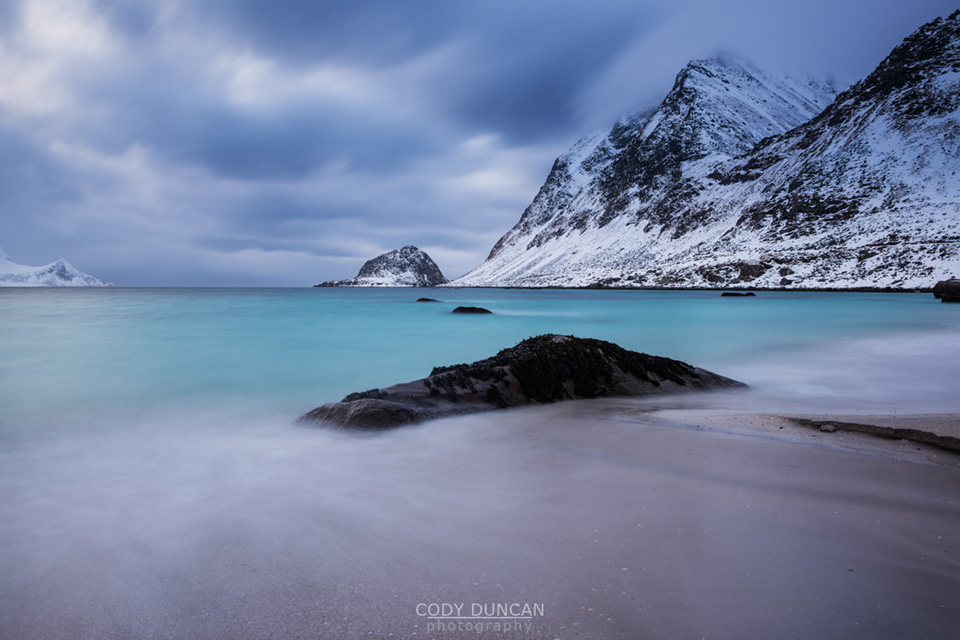
Haukland beach, Vestvågøy, Lofoten Islands, Norway

Photo: Haukland Beach winter, Vestvågøya, Lofoten Islands, Norway.  Feb 20, 2013

After a week of fairly cold temperatures and calm conditions, the weather began to change on this day.  Winds and increasing temperatures swept across the islands.  Rain instead of snow now fell and setting up a tripod became difficult.

I was planning on spending the night at Utakleiv, but after a quick trip out to the beach, it was quite obvious that I wouldn’t be taking any photos there.  So I headed back through the tunnel to Haukland beach and relatively calmer conditions – though I still had to wait for a lull in the breeze before attempting to take a photo.  The sea was rough, and crashing high up on the beach, so after a few minutes of observation, I found myself just at the edge of the high water line.  Then comes the waiting game…

Finally, after what seems like forever, the next set of waves arrives, pushing the sea just to the edge of my tripod legs.  With luck, the wind also remains calm for the 25 second exposure to keep my light backpacking tripod from shaking too much.  Moments later, drops of rain begin to fall from the clouds and photography is over for the day.

Camera Info:
Nikon D800
Nikon 24-70 f/2.8
24mm
ISO 50
f 16
25 sec
WB Daylight
Filer – B+W 6 stop ND

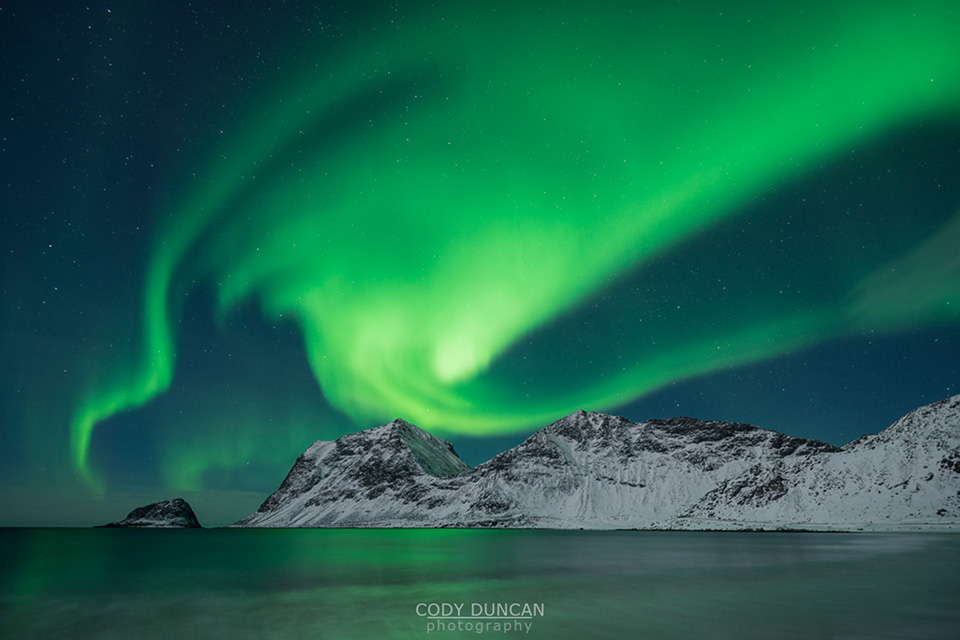
Aurora Borealis - Northern Lights shine in sky over snow covered mountains from Vik beach, Vestvågøy, Lofoten Islands, Norway

Photo: Northern Lights fill sky over Vik beach, Vik, Vestvågøya, Lofoten Islands, Norway. February 19, 2013.  21:48

I almost missed this one due to laziness. One of the, if perhaps the only, benefits of sleeping in a car during Winter in Lofoten is that you don’t really have anywhere to go, so it’s no problem to wait all night in search of the Northern Lights. This night however, was the first night after a week on the islands (and sleeping in a car) that we would stay at a hostel. I was looking forward to sitting back and relaxing, a warm dinner and maybe a beer or two. But as the evening arrived clear and calm, I knew it would likely be another late night Aurora hunting.

We left the hostel in Ballstad around 9:00pm and headed towards Utakleiv. I had shot the Northern Lights here a few days before, but I knew there would be several other viewing options: Haukland, Vik, Vikveien, depending on where (if) the lights decided to show up. Luckily I wouldn’t have long to wait on this night. Shortly after arriving in Utakleiv a faint green glow appeared in the northern sky. At that moment, Utakleiv was a bit on the windy side, which it often is, so I decided to head back to Vik beach where I knew I would be far enough from the mountains if the Aurora stayed low in the sky.

Soon, that faint glow turned into a bright streak rising into the sky. A few moments later, everything intensified and that magical dance of the Northern Lights filled the sky. 20 minutes later, the glow faded and the lights were gone; almost leaving me thankful for having an early night but glad my effort was briefly rewarded.

In the first week of this February trip, I took more Northern Lights photos than last years 8 weeks north of the Arctic Circle combined. I definitely had some luck on my side this time!

Technical Info: Most of the common info suggests to shoot the Northern Lights with your lens wide open. I think a lot of this thinking is from the old days of shooting with 100-400 ISO film. Today, when you can easily crank up most modern DSLRs to ISO 1000+, a fast lens is less important. I like to stop down slightly to help with a bit more overall sharpness; especially when shooting a ‘landscape featuring the Northern Lights’ type of photo, not just the Lights themselves in the sky. The moon was at about a quarter on this night, giving enough light to illuminate the snow covered mountains. Though it could have been a bit brighter in my opinion. Again, I go slightly against the common conventions here, which suggest a dark, moonless night when shooting the Northern Lights. I like to have enough light to include the rest of the landscape into the photo – that’s why I’m on Lofoten and not someplace else!

Another piece of advice when shooting in the dark is to check the exposure with the histogram, not just estimating the exposure by eye. Your eyes will have adjusted to the darkness, so what looked like a properly exposed image on the back of your camera will likely be a stop or so under exposed once you’re back on a computer and under normal lighting conditions.

Camera Info:
Nikon D800
Nikon 16-35mm f/4
16mm
ISO 1000
f 4.5
20 sec
WB Daylight

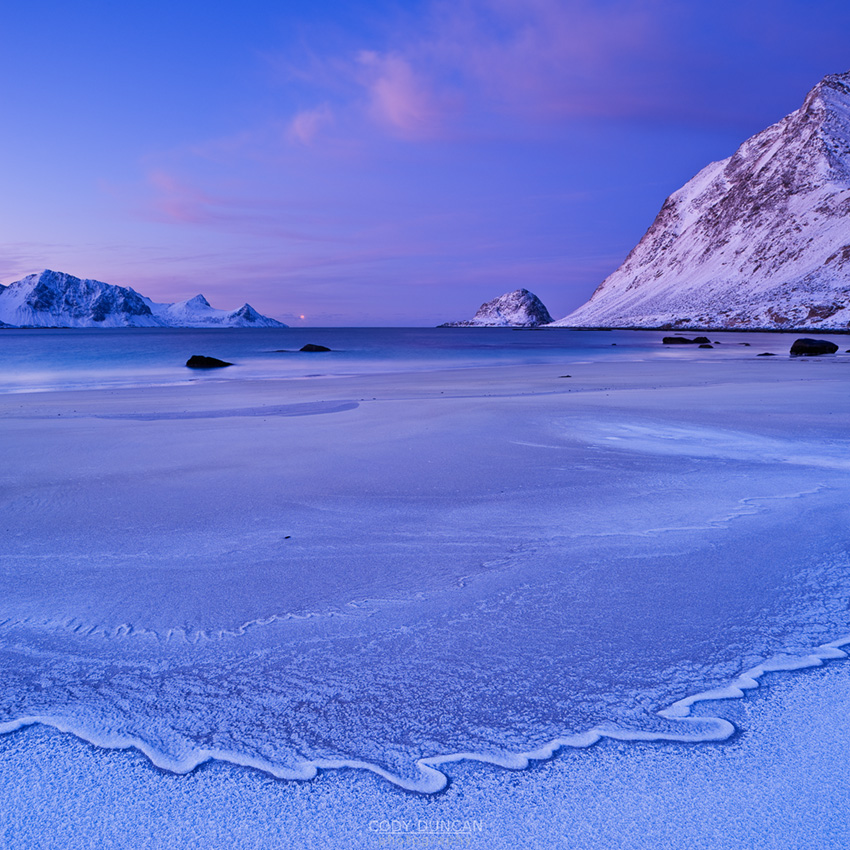
Frozen tide at Haukland beach in winter, Vestvagøy, Lofoten islands, Norway

Photo: A frozen tide line on Haukland Beach in the day’s first light, Vestvågøya, Lofoten Islands, Norway.  Jan 6, 2010.  09:55

Having arrived on the islands the previous day, I spent the night sleeping in my rental car out by Utakleiv beach.  It was a stormy, uncomfortable night, and I worried that my car might get blown off the ice covered parking area and into the sea.  Fortunately, exhaustion from nearly 2 days of travel and little sleep meant I was actually shut my eyes for a while.

In the morning, I awoke to near silence, only the sound of gently crashing waves below me.  Leaving Utakleiv, I came upon this scene at Haukland Beach, just on the other side of the tunnel.  It had been cold for several days, and the beach lay littered with chunks of ice, frozen from the river that runs through the beach, and washed back ashore from the tide.  The nights wind seemed to have scoured away most of the snow from the beach, leaving only a thin, ice coat over the sand.  Overhead the sky glowed a brilliant pink as the sun was preparing to rise above the horizon for the first time in nearly a month.

I spent some time photographing the ice and then wandered closer to the shore where this scene caught my interest, where the high tide line frozen into the sand.  In the distance, the moon hung low over the sea while waves gently lapped the shoreline.  I stayed until my feet were so cold that I had to go back to the car and heat them up again.

This day ended up being one of my most photogenic days ever on the Lofoten Islands, and I there are many images that I still consider to be my favourites over 3 years later.  There will likely be more ‘Weekly Photo’ post with images from this day.

Technical info:  The final photo consist of 3 images, shifted vertically so I could get the 1:1 crop.  And for this scene especially, I think 1:1 works well.  With 2:3 format, it would appear too narrow if framed vertically, while horizontally I would have needed to shoot too wide not to cut off the top of the mountain.  I shot at f/16 and ISO 100 because I wanted a long(ish) exposure the flatten out the sea.  I also need quite some depth of field.

Camera Info:
Nikon D700
Nikon 24mm f/3.5 tilt-shift
24mm
ISO 100
f 16
10 sec
WB Daylight
3 Images – top, middle,  bottom. For square format
No Filters

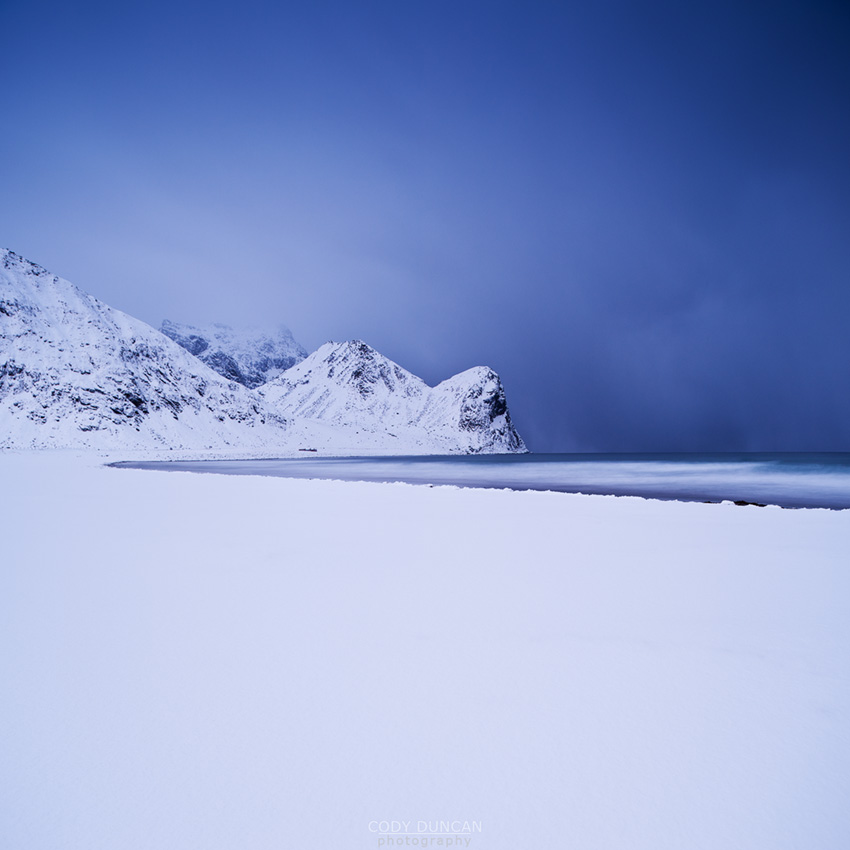
Snow covered Unstad Beach in Winter, Lofoten islands, Norway

Photo: Snow covers Unstad Beach in the day’s last light, Unstad, Vestvågøya, Lofoten Islands, Norway.  Jan 7, 2010.  16:30

A second composition following on the footsteps of Weekly Photo #1, Winter at Unstad Beach.  You can read more of the overall story of the day HERE.

When shooting in winter, and especially with fresh snow, it’s always important to take a moment to scan the overall scene and possible compositions and then proceed to work your way ‘into’ the scene.  IE, don’t immediately rush to the water’s edge and start shooting, as you’ll now have footprints over what previously would have been an untouched beach.  I often almost walk in a circle on my way to a scene, being careful to avoid spoiling future compositions.  If it’s one thing I’m annoyed by, it is footprints in an otherwise unspoiled landscape (applies to sandy beaches as well).

So, after feeling I had gotten the most of of the rocky areas of the beach (weekly photo #1 HERE), I proceeded to move to the sandy part of the beach.  Here is where good timing and luck also came to my aid: the combination of clearing winter storm with an incoming tide.  The incoming tide part is important.  If the tide had been outgoing, then there would have been a section of the beach already cleared of snow.  It would still look nice, but not as nice as this image, where the tide runs directly to the snow line.  Though maybe this is just a matter of personal opinion on my behalf.

I like the blank, almost abstract nature of the scene.  I have other compositions, including ‘normal’ 2/3 crops, but I think the 1:1 format helps create some tension between foreground and sky.

Technical info:  The 1:1 format is from two images, shifted vertically.  Ie: a top image and bottom image.  I don’t like to crop to 1:1, shooting two images provides a bigger file and more info to work with.  When moving elements are present in a scene, it’s best to try and keep them within a single frame, such as the sea in this image.  Otherwise it can sometimes present difficulties later.  Thus my choice to shift vertically and not horizontally.  [When using a long exposure such as this, it really isn’t too important.  But it’s a good thing to keep in mind for other scenes.]

Also, I again kept my WB on ‘shade’ setting to keep the blue channels from clipping, allowing for a better overall exposure.

Camera Info:
Nikon D700
Nikon 24mm f/3.5 tilt-shift
24mm
ISO 200
f 5.6
25 sec
WB shade
Two Images – top, bottom. For square format
No Filters