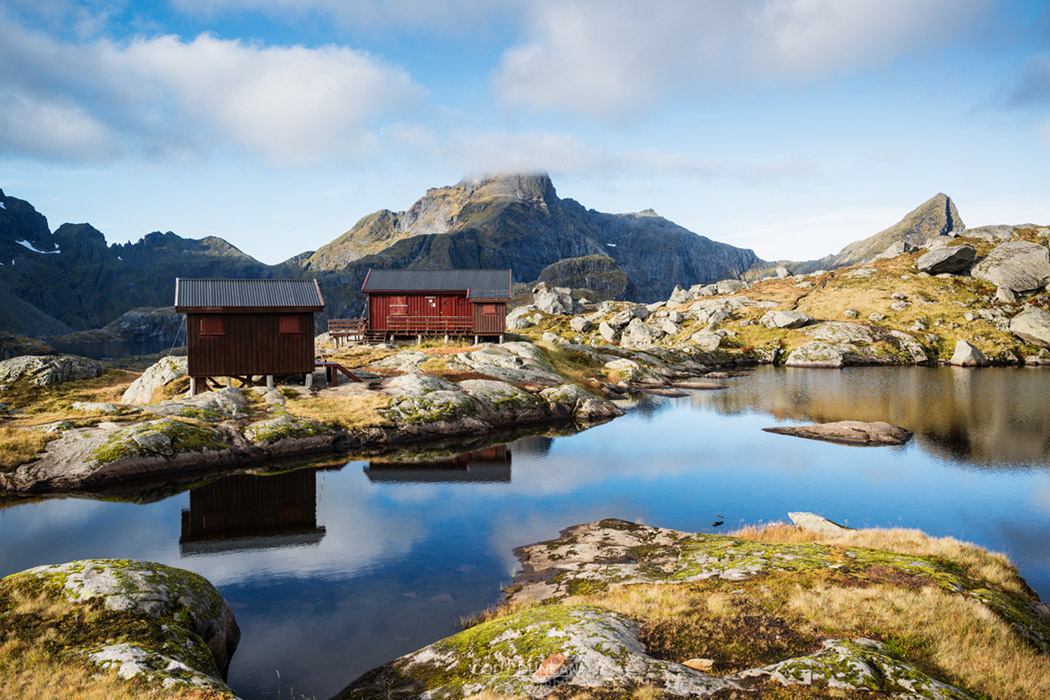
Munkebu mountain hut with Hermannsdalstinen peak in distance, Moskenesøya, Lofoten Islands, Norway

Photo: Munkebu hut and Hermannsdalstind in Autumn, Moskenesøya, Lofoten Islands, Norway.  Oct 7, 2012.  13:27

My last full day on the islands for 2012.  After a rather stormy last few days, the weather cleared up and I decided to make one last journey into the hills.  I had originally planned on getting an early start to the day and maybe making an attempt on Hermannsdalstind, but that didn’t happen; perhaps because I stayed up too late the previous night looking for Northern Lights.

By this time in the year, end of the first week of October, nearly all the trees across the islands had lost their leaves.  While this left much of the islands somewhat barren looking as they awaited the arrival of the first snows, the low, ground foliage still had some nice color to be seen.

I had actually planned at staying a night or two in the Munkebu hut in August or September, but someone decided to infect the place with bed bugs (eeeekkk!), so it was closed the majority of the 2012 Summer season (as far as I have read, it has been re-opened for 2013, but that’s probably a bit late news for you if you’re reading this now).  But as I’d never been up here before, I decided just to start hiking and see where I ended up for the day.

While I think this area is quite a beautiful part of the islands, and one of the the most isolated parts of Moskenesøya, one of the landscape photographers greatest nemeses is present, power lines!  grrr!  There would be some beautiful, untouched views from up here, yet a row of power lines always seem to find their way into the best composition.  And I’m not even sure what they’re doing way out here, and the poor guys that had to put them in in the first place, but they’re there.

Camera Info:
Nikon D800
Nikon 24-70f/2.8
29mm
ISO 200
f 8
1/200 sec
WB Daylight
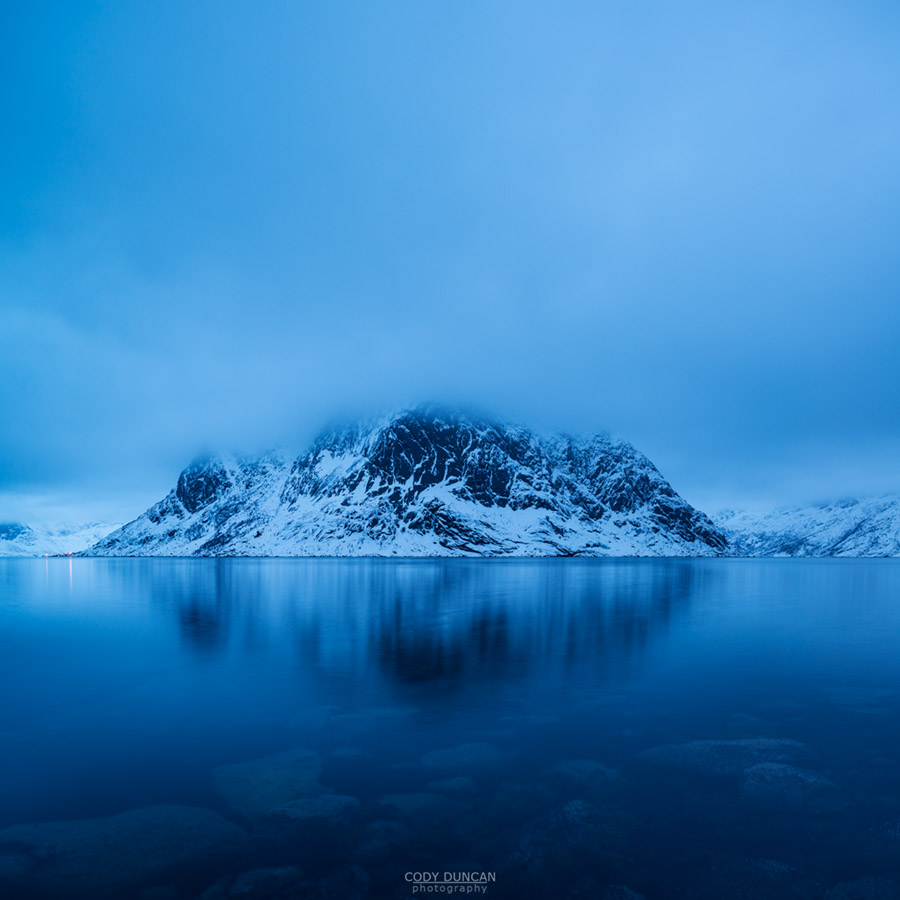
Heavy clouds conceal summit of Olstind mountain peak rising from fjord, Reine, Moskenesøy, Lofoten Islands, Norway

Photo:  Olstind hidden in Winter Clouds, Moskenesøya, Lofoten Islands, Norway.  Feb 17, 2013.  17:11

Olstind, probably the most iconic peak of the Lofoten Islands, when you can see it.  Taken at the same time an location as last weeks Friday Photo, another gloomy image during the fading light of a short February winter day.

For some reason I don’t imagine I’ll ever have enough images of Osltind.  While often times I pass the mountain by if it’s a scene and lighting conditions I’ve previously photographed, when something new is to be found I’ll usually make the effort to hop out of the car, or walk, and see what I can come up with.

I think the calmness of the evening drew me out here on this particular day.  I’ve seen the mountain hidden in clouds enough times before, but for some reason, there was something a bit more interesting this time.  The sky was heavy, as indeed, rain started falling only a few minutes after this image.  But at the moment, the islands were calm.  The waters of the fjord sat flat and silent, hardly making a sound on the barnacle covered rocks I was standing on.  And so yet another photo of Olstind was taken.

Camera Info:
Nikon D800
Nikon 24mm f/3.5 tilt-shift
24mm
ISO 100
f 8
8 seconds
WB Daylight
2 Images – Top/Bottom

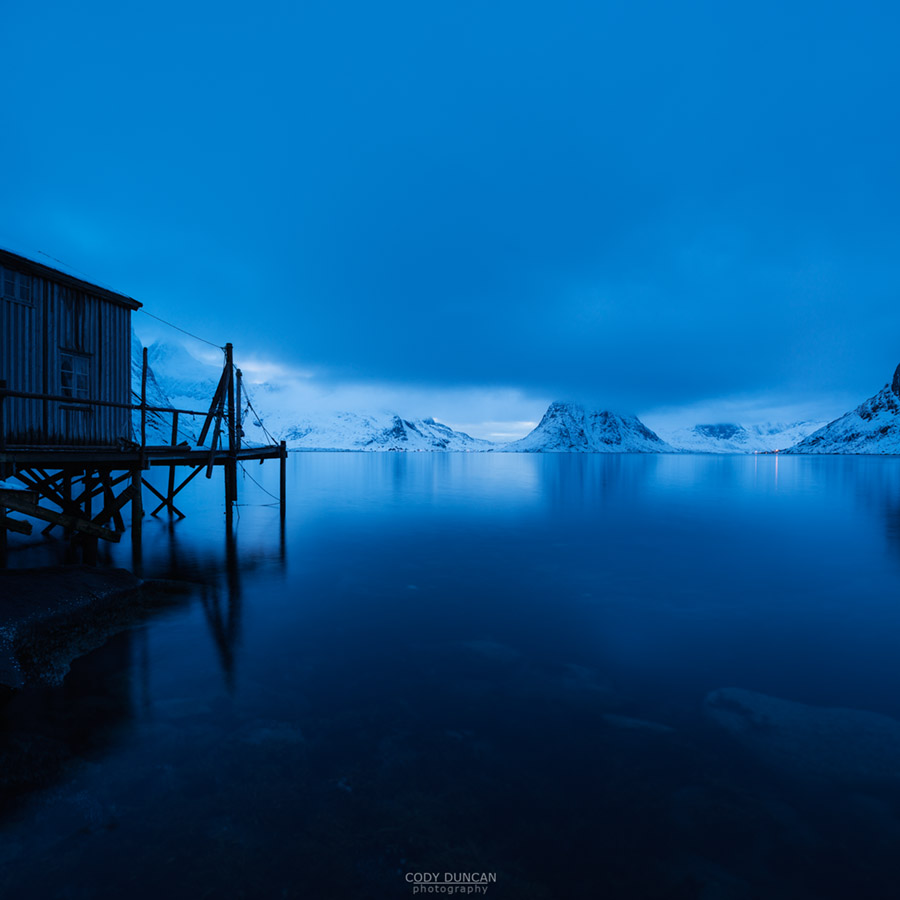
Derelict Rorbu sits on edge of fjord, Vestvalen, Reine, Moskenesøy, Lofoten Islands, Norway

Photo: Abandoned Rorbu, Vestvalen, Moskenesøya, Lofoten Islands, Norway.  Feb 17, 2013.  17:12

Like last weeks Friday Photo, this is a location I’m so familiar with that I’ve never thought of taking a photo of it before.  I’ve stood in front of this building a dozen times or more, with my camera pointed at Olstind – one of my favorite locations to shoot Olstind from as you can get away from all the power lines – yet I’ve never turned around and given much though to the building itself.  Perhaps I just needed the right conditions.

I find something haunting about this image.  It is dark and subtle, far from the typical ‘hero’ type Lofoten photos I and others normally take.  It feels lonely and forlorn, yet with a glimmer of something. A future.

Perhaps on most occasions I would not have even been here as the last traces of light faded from a February day while a gentle rain began to fall just as I put my camera in my backpack and wandered back to the car.  I was merely killing a bit of time before being graciously invited by another photographer I had met for a cup of tea in his Rorbu just down the road – an invitation not to be passed up while sleeping in a car in winter.  And so, I ended up with what is probably one of my favorite images of the trip.

Camera Info:
Nikon D800
Nikon 24mm f/3.5 tilt-shift
24mm
ISO 100
f 8
8 seconds
WB Daylight
2 Images – Top/Bottom

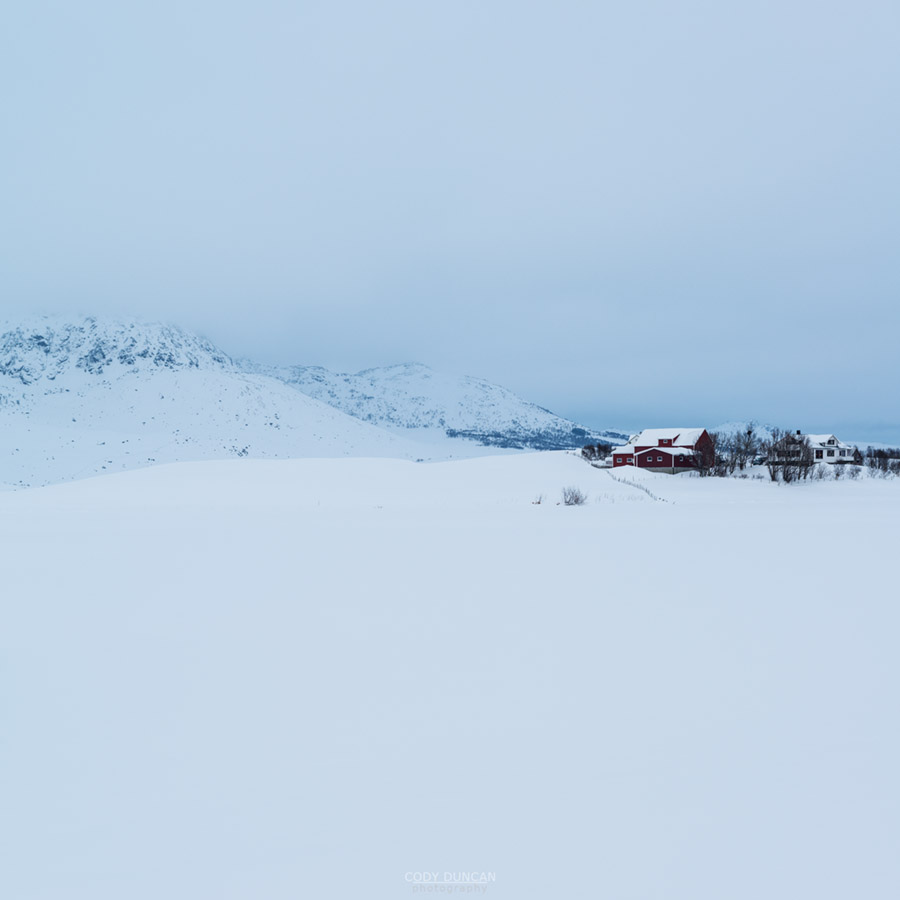
Farm building in snowy winter landscape, Farstad, Vestvågøy, Lofoten Islands, Norway

Photo: Winter farm, Vestvågøya, Lofoten Islands, Norway.  Feb 16, 2013.  14:21

It had now been several days of heavy, mountain concealing clouds covering the islands.  Exactly the opposite of what I want, but often what is there.  At least it was still cold, and the snow remained, so there is that to be thankful for.  But it was one of those days where the needle on the gas tank drops lower and lower, yet the camera rarely makes it out of the bag.

I’ve driven by this lake and farm a hundred times or more, and never taken a photo, likely since I was headed towards something better.  But for some reason on this particular day, a day of otherwise almost nothing photographically, the emptiness of this scene caught my eye.  There is almost nothing but white and gray, save for a single farmstead.  Somehow I can almost feel the cold and the bleakness of the Lofoten winter in this image.  I’ll probably drive by a hundred more times and never take another photo.

Camera Info:
Nikon D800
Nikon 24-70mm f/2.8
70mm
ISO 200
f 11
1/100 sec
WB Daylight
2 Images – Top/Bottom

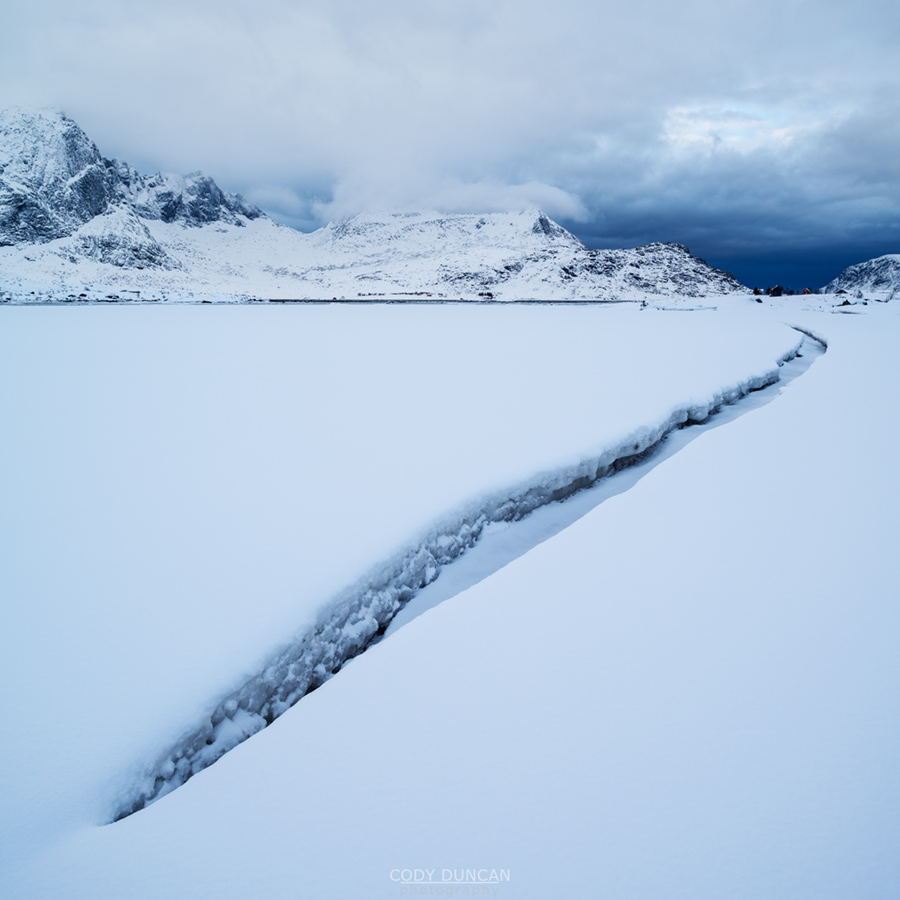
Snow covers sea ice in inner Flakstadpollen, Kilan, Flakstadøy, Lofoten Islands, Norway

Photo: Frozen Sea ice in Inner Flakstadpollen, Flakstadøya, Lofoten Islands, Norway.  Feb 14, 2013.  09:01

As the second half of February arrived this year, the previous weeks of cold, but clear and calm weather came to an abrupt end.  Heavy clouds rolled across the islands and the beautiful light of the low winter sun was taken over by a flat, dull gray.  At least there was still a decent coat of snow that had yet to be too covered in footprints.

I often arrive to the islands in less than ideal conditions, often missing some brilliant light by a day or two.  But I always feel a need to get those first few photos.  I have been to the islands enough now to know that I need to be patient, but as days 1, 2, 3 pass by and I’ve hardly touched my camera, I sense a growing frustration within myself to get out and shoot something.  Oftentimes this can be a fruitless quest, but every once in a while, something interesting will appear despite all efforts of the light working against me.

This image only existed for a few day.  Thanks to a fresh coating of snow that had fallen overnight, ‘cleaning’ up the sea ice, which by itself, was not especially photogenic.  Luckily, despite the crowd of photographers on the islands this February, I was the first to come across this scene, finding it still untouched; though most groups only hang around Reine anyways, going for the ‘hero’ shots made popular by several photographers better known than myself.  But that is good, as I often find that I have the rest of the islands to myself.  Free of footprints in the snow, and to wander as I please.   Perhaps I shouldn’t give away too many secrets though…

Without the crack in the ice, this scene would not have worked at all as it would have been too flat and boring.  And I think in situations like this, one needs to resist the urge to punch up the contrast to some hyper-realism that didn’t exist.  The light was shit, as it often is on Lofoten in winter.  But using shape and form, there is still the possibility to find something interesting.

This is a scene where the 24mm tilt-shift lens is really is a valuable lens for Lofoten, often due the the sheer vertical relief of 800-1000m mountains rising directly from the sea.  Much winder than 24mm, and there are distracting elements on the edges of the frame.  But with a normal 2/3 crop, the tops of the mountains would be lost, unless getting low enough to the snow where the crack would then lose separation and definition.  I guess one could always crop from a wider lens, but I don’t really like to do that.

Camera Info:
Nikon D800
Nikon 24mm f/3.5 tilt-shift
24mm
ISO 100
f 13
1/30 sec
WB Daylight
2 Images – Top/Bottom

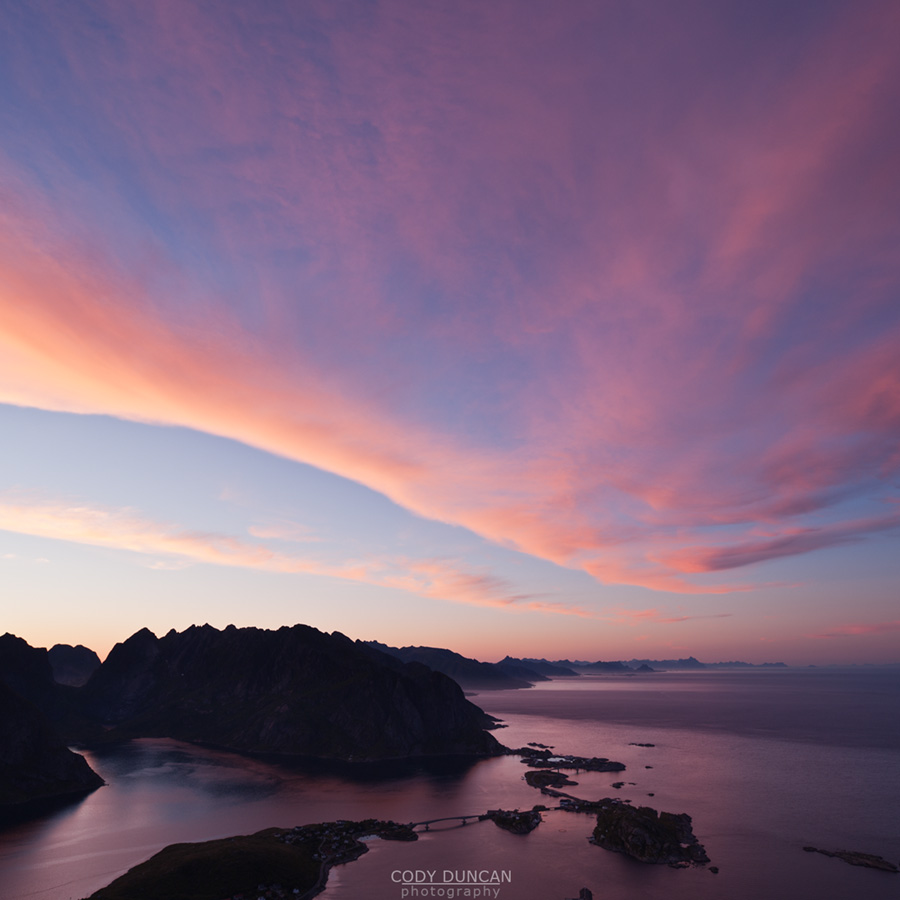
Sunset over Reine and Hamnoy from Reinebringen, Lofoten islands, Norway

Photo: Reinebringen Mountain Sunset, Moskenesøya, Lofoten Islands, Norway.  July 26, 2010.  00:35

The sky was a perfect blue as my friend Søren and I arrived back in Reine after two nights camping at Bunes beach.  The original plan was to head back to Stamsund, but such a day was too good to spend sitting on buses and waiting around Leknes.  Not having planned ahead for such a situation when leaving Bunes, my water bottles were empty and so I resorted to purchasing 1 liter of overpriced water from the small store in Reine.  And at that, we were on our way towards Reinebringen.

Despite our heavy overnight packs we made good time up the mountain, with a few odd comments and looks of surprise from the people we managed to pass.  We were on the summit before noon, with hardly a cloud in the sky and barely a wisp of wind to be felt.  Absolute perfection!  After some time of sitting in the sun, I set up my tent for the sole purpose have having some shade.  And by mid afternoon I was down to about 200ml of water.  But we were determined to stay on the mountain and so the hours slowly passed by as the sun sunk lower and lower on the horizon.

Not trusting if the weather would last, I took the tent down around 11pm, deciding that it would be safer just to sleep in the open; allowing a faster escape if the weather turned.  By midnight I was in my sleeping back, trying to get a few hours sleep before our 5am wake up call.  Though some 20 minutes later I opened my eyes to this scene emerging. Shit!  Time to get up…

I didn’t even bother getting dressed or putting shoes on.  So there I stood, barefooted and only in my underwear on the summit of Reinebringen as I photographed a midnight sunset.  It probably would have been a pretty funny looking scene had someone else decided to show up then.  By 5am we were on the way back down the mountain for the 6am bus back to Stamsund, where I slept the rest of the morning away on the deck outside.

Camera Info:
Nikon D700
Nikon 24mm f/3.5 tilt-shift
24mm
ISO 200
f 8
1/40 sec
WB Daylight
2 Images – Top/Bottom

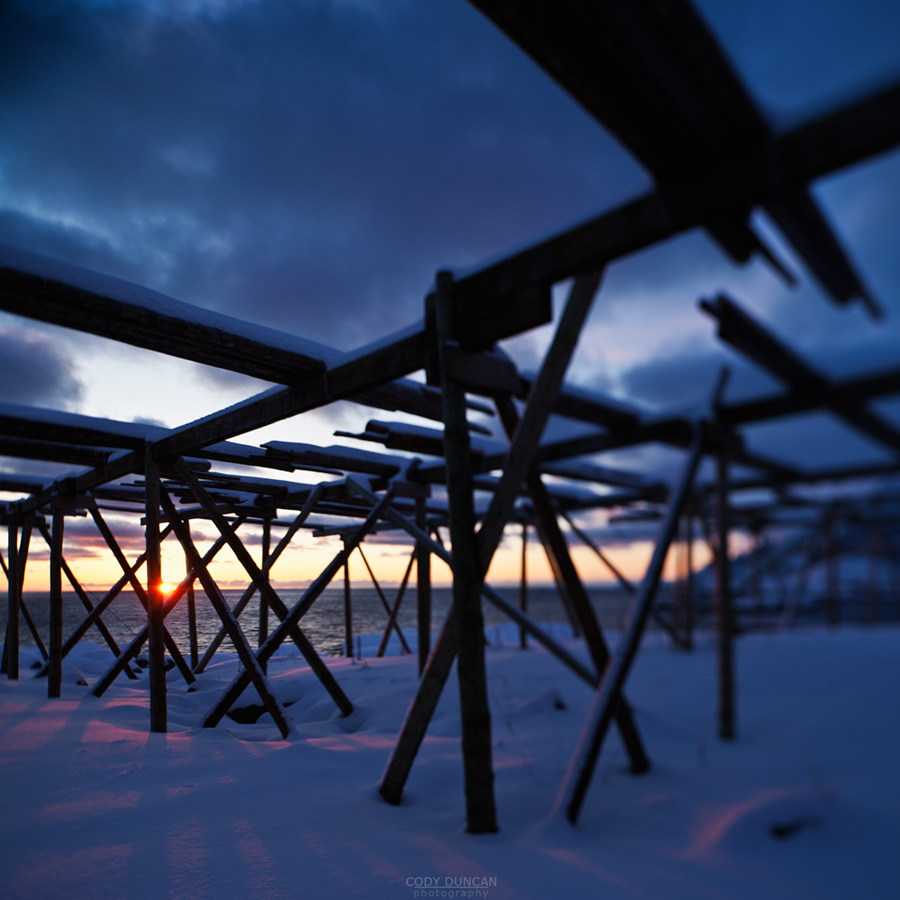
Winter sun silhouettes empty stockfish drying racks, Lofoten Islands, Norway

Photo: Winter sun at midday, Hamnøya, Lofoten Islands, Norway. January 6, 2010. 12:50

By the end of the first week of January, the sun is just barely beginning to wake from its winter hibernation. Not even fully crossing the horizon, the sun slowly arcs the southern sky before the long winter night returns by mid afternoon. While I had already made a half dozen trips to the islands by this point, this was my first real journey into the heart of winter.

Alone and cold, my only shelter from the fierce storms that blasted the islands was my tiny rental car, unable to even fully recline the seats to sleep. I spent and average of 20 hours per day wrapped in my sleeping bag, reading by the light of my headlamp to pass the time, drifting in and out of sleep when I could. Snow fell so heavily on several days that the only place I could park so sleep for the night was next to bus stops on the E10 where a snow plow would hopefully arrive by mid morning to dig me most of the way out. But it was over these 5 days that I took some of my brilliant photos of the islands to date. I embraced to cold and the darkness and used it to my advantage.

This image is from my first full day on the islands. The night had been turbulent and stormy (I had yet to learn that Utakleiv is generally not a good place to sleep in a car in winter), but as dawn arrived, the islands clear and calm. By midday I found myself in the west as the sun was beginning to break the horizon. It seemed to just sit there, halfway between sea and sky.

Despite the fact that the horizon was clear, the clouds overhead never developed much color. The mountain behind me were glowing a brilliant pink, but I also wanted to capture something looking towards the sun, even though the scene was actually somewhat boring to tell the truth. So after unknowing getting my car stuck in the snow (I had to get pulled by some guy in a tractor I found clearing the streets a little later), I walked over to the cod drying rack, still sitting empty this early in the year. Trying a few composition, I eventually decided something a bit more abstract might fit the scene better. So I ’tilted’ the lens all the way to throw most of the frame out of focus and help lead the viewer towards the sun.

Camera Info:
Nikon D700
Nikon 24mm f/3.5 tilt-shift
24mm
ISO 200
f 5.6
1/160 sec
WB Daylight
2 images – top/bottom
Full lens tilt

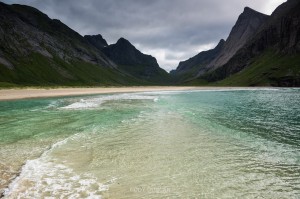
Horseid beach, Lofoten Islands, Norway

Photo: Dark skies over Horseid beach, Moskenesøya, Lofoten Islands, Norway.  August 22, 2012.  15:51

I arrived on Lofoten early the previous morning and immediately caught the ferry to Kierkefjord to make the hike to Horseid beach.  Exhausted, I fell asleep in the early afternoon to the sound of a gently rain falling on my tent.  15 hours later I finally emerged.  The sky was still gray, but at least the clouds had risen and the rain was now only arriving in passing showers several times per hour.  As time passed the northwestern sky began to clear and moving beams of light would shine across the beach.

With the right tide (high), the small peninsula of land at the far end of Horseid beach provides an almost perfect view directly back towards the pass; the mountains in almost perfect symmetry.  Now it was my task to wait around for a bit of light.  When the sun happened to pass across the beach, the water was a brilliant turquoise. I knew I wanted to highlight this aspect of the scene, while not minding so much about the lighting on the background, or actually preferring it to remain dark and dramatic.

With the quickly moving light, I first shot with ‘normal’ exposures, but wasn’t getting the mood I was looking for out of the scene.  So I added my 10 stop B+W neutral density filter and then waited for the next found of light.  Shooting with 30 second exposures, it took a while for the elements to align themselves: a pleasing blur in the water with the correct timing of the waves and a long enough moment of sunlight across the beach to bring out the exposure and add some contrast against the mountains in the distance.  And even though the wind was fairly soft by this time, the 30 second exposure helps soften up the clouds a little, giving a bit more separate between them and the mountains.

For reference, I’ve included the following ‘outtake’ photo of the scene exposed at 1/250 sec.  While you can tell it would be something pleasant to sit there and look at in person (albeit a bit on the chilly side), visually, there is nowhere near the impact of the above photo.

Camera Info:
Nikon D800
Nikon 24mm f/3.5 tilt-shift
24mm
ISO 80
f 11
30 sec
WB Daylight
2 images – top/bottom
10 stop ND filter

horseid beach, lofoten islands, norway

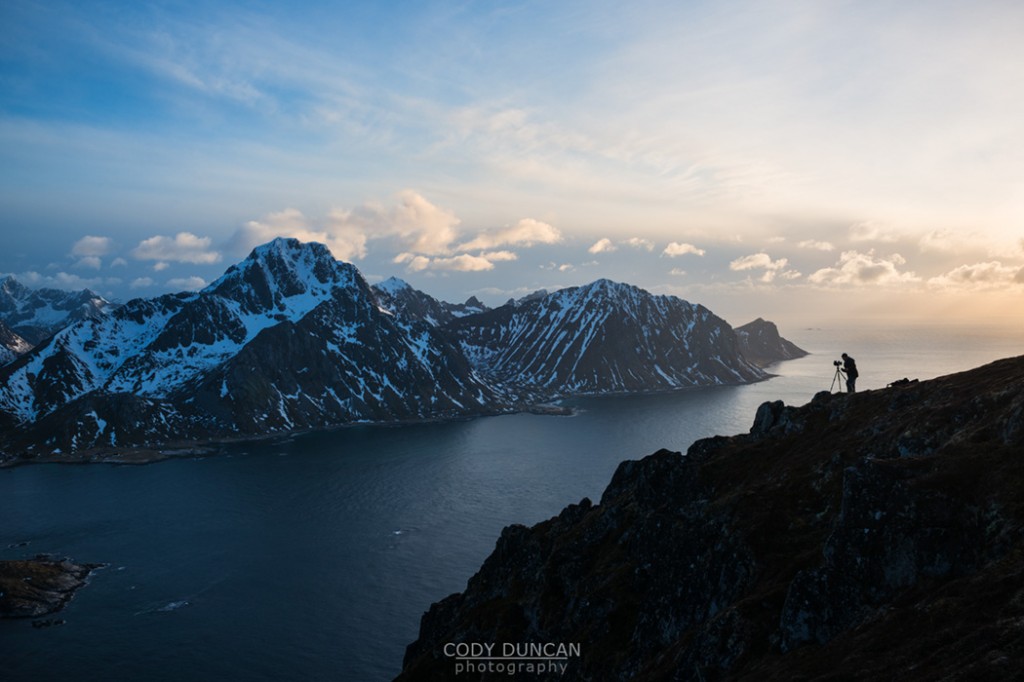
Silhouette of landscape photographer on summit of Offersoykammen with Flakstadoy in background, Lofoten Islands, Norway

Photo: Photographer at Sunset on Offersøykammen, Vestvågøya, Lofoten Islands, Norway. May 4, 2013. 20:36

[I’m barely squeaking in under this deadline this week. I should probably write these out a day or two in advance to be on the safe side…]

I’ve come the appreciate the small peak of Offersøykammen as a relatively easy spot to reach which provides the willing photographer with a number of possible compositions. The most dramatic of which is perhaps the view towards Flakstadøya, as the wall of mountains rise out of the turbulent waters of the Nappstraumen.

Never knowing exactly what the light might do, I always this it’s best to head up into the hills with a bit of extra time to spare. 10 days into this trip, and any sort of decent sunset had yet to materialize, no matter how brilliant the day, as a perpetual wall of cloud blocked the horizon.

And so the three of us found ourselves sitting on top of the mountain, in the freezing wind, for hours, waiting in hope for the arrival of some light. But alas, as the sun neared the horizon, the clouds took over and the light and color faded in another anticlimactic finish of the day. And so we headed down, slightly defeated, but better than having sat at another beach, again…

Camera Info:
Nikon D800
Nikon 27-70 f 2.8
32mm
ISO 100
f 13
1/100 sec
WB Daylight

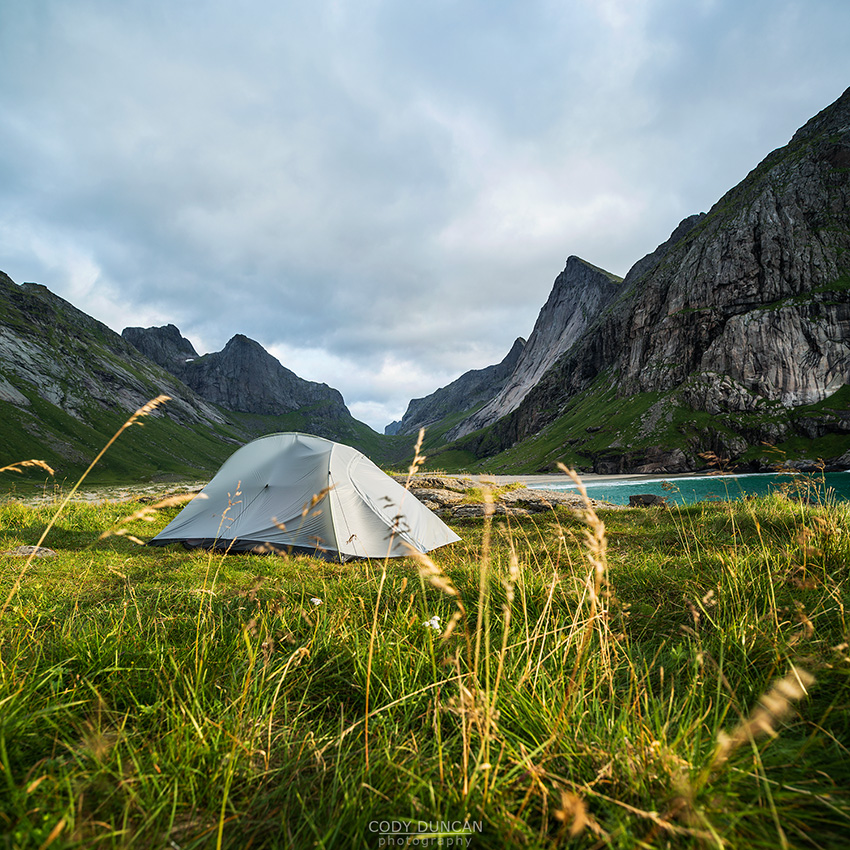
Tent camping at Horseid beach, Lofoten Islands, Norway
Photo: Camping at Horseid Beach, Moskenesøya, Lofoten Islands, Norway.  August 22, 2012.  19:32

I think Horseid beach is one of the more wild and dramatic locations on the Lofoten Islands to set up a tent.   With a multitude of camping places available, heading out to the furthest reaches of the beach to a small grassy headland is a slightly exposed, but unforgettable place to pitch your tent.

Normally I don’t like to hike in the rain, but immediately upon departing the ferry in Moskenes on a late August morning I was already changing into my rain gear.  A steady line of cold, tired looking backpackers was waiting for their departures from the islands, the Summer in the north quickly coming to its end.  My journey was just beginning however…

The Reine ferry to Kierkefjord – Vindstad was more crowded than I was expecting, however only three of us exited in Kierkefjord.  Despite the fact that the pass through the mountains is quite low, it was thoroughly concealed in clouds.  Heading higher and higher up the trail the rain fell harder and the visibility dimmed, until it was barely possible to follow the trail.  At one point I wasn’t sure if I was still going the right direction and it was only until I stopped for a second and heard the faint crashing of waves in the distance that I knew I was still on the right path (there is really only one way to go, so it’s a bit hard to get too lost.).  Finally I descended below the clouds and could see the beach, still a few kilometers away.

From the distance, Horseid beach doesn’t appear all that big, but it is a deceptively long hike from the back of the beach until finally reaching the edge of the sea.  Still raining, I immediately set up my tent and crawled into my sleeping bag.  And due to my exhaustion from 30 hours of travel, I was quickly asleep.  Not that I was missing any photo opportunities anyhow.

Gray skies greeted the next morning, with elusive moments of sunlight appearing every now and again between passing bands of rain.  Most of my time was spend gathering wood for a campfire and figuring out the best place to gather fresh water (the small waterfalls on the right side of the beach).  But every time the sun would pop out for more than a minute, I’d grab my camera and try to get a photo or two.  And hence, sometime in the early summer evening, I turned my attention to my tent as a bit of weak light arrived.

Camera Info:
Nikon D800
Nikon 24mm f/3.5 tilt-shift
24mm
ISO 100
f 5.6
1/80 sec
WB Daylight
2 images – top/bottom