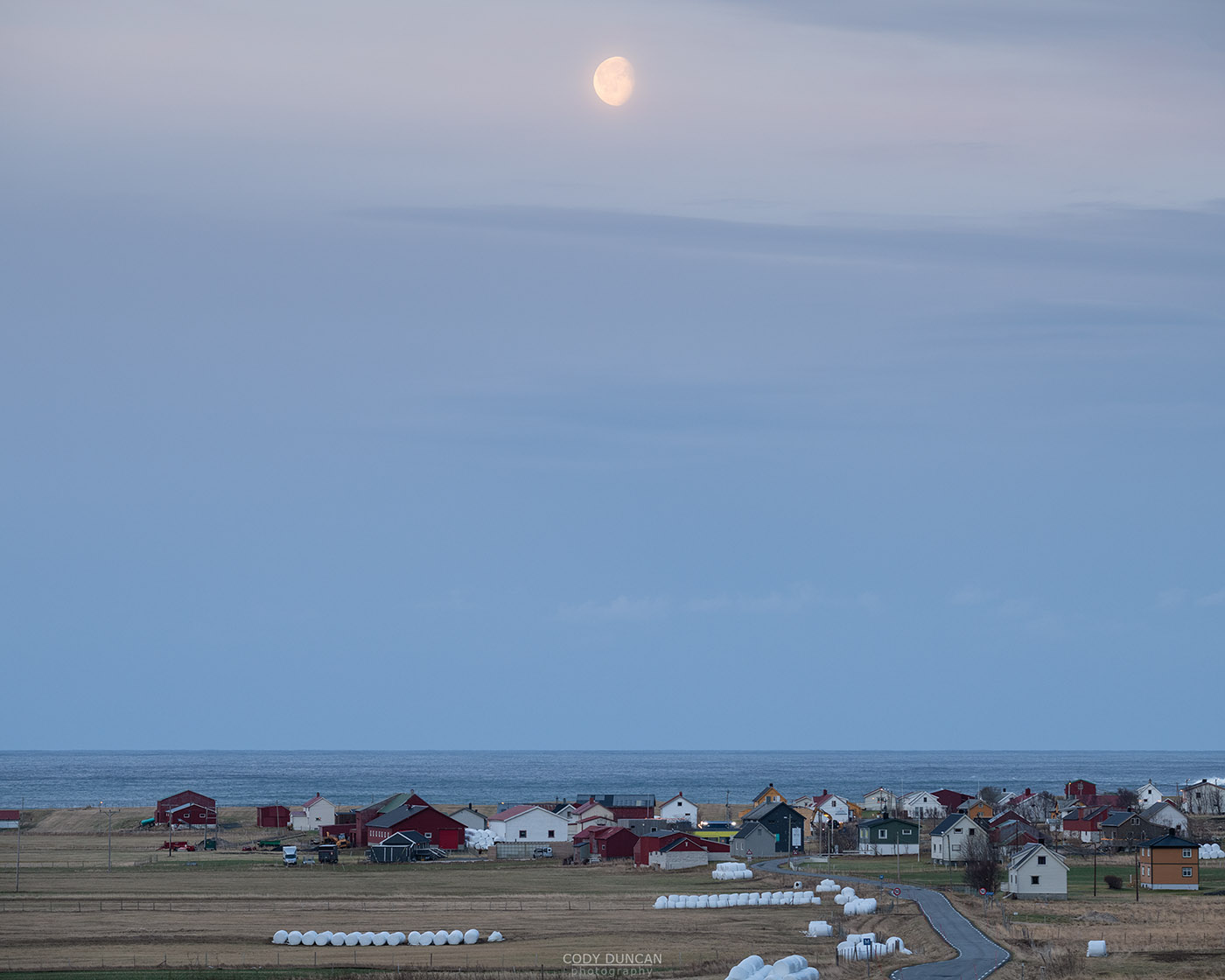
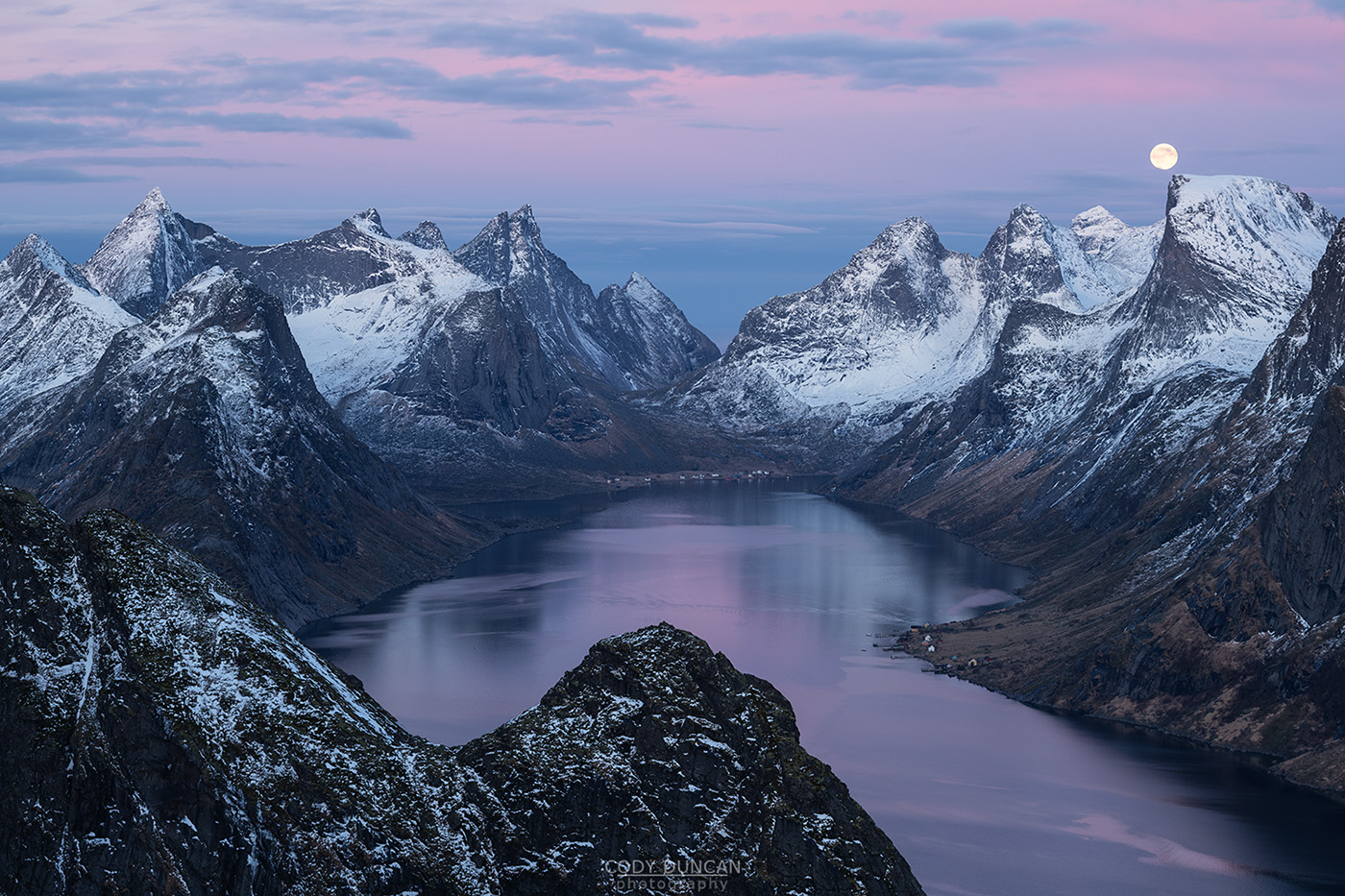
Photo: Twilight moon over Kirkefjord from the summit of Reinebringen, Moskenesøy, Lofoten Islands, Norway. December 30, 2020. 11:32

I generally don’t pay too much attention to the moon here on Lofoten. On this morning I should have! My first thought upon reaching the summit ridge of Reinebringen and seeing the full moon over the mountains in the twilight sky was that I should have arrived an hour or so earlier!

Lofoten’s northern latitude means that the moon has a somewhat ‘odd’ orbit, to put it simply and without going into technical details. So in general, the moon is not part of my active photography consciousness most of the time. Usually I’ll just randomly see it from time to time, and maybe it happens to be in a good location for a photo, though usually not.

In the summer, I’m quite aware of the sun’s elevation in the sky throughout the weeks around midsummer, where the sun never sets. For me, this is easier to plan for as it doesn’t move as quickly as the moon, so there is a little more of a buffer in regards to weather and other conditions, making the timing not so critical. But with the moon; there is only 1 full moon a month.

On this morning, I wish I had arrived earlier so that the full moon would have been in the centre of the mountain pass over Kirkefjord, instead of somewhat out of place on the right side of the image. In its current location I feel it doesn’t really and much to the scene, and is perhaps even a distraction.

Although had I been on Lofoten earlier, perhaps the moon would have been behind the small layer of clouds lower on the horizon. And, still being a week away from the return of the sun, it perhaps would have been more of a blue hour type light instead of the soft pink twilight. I’ll never know.

Head over to my Instagram account for (almost) daily postings of the local conditions here on Lofoten: @distant.north

Camera Info:
Nikon D850
Nikon 70-200mm f/4
80mm
ISO 100
f 6.3
1/15 second
WB Daylight
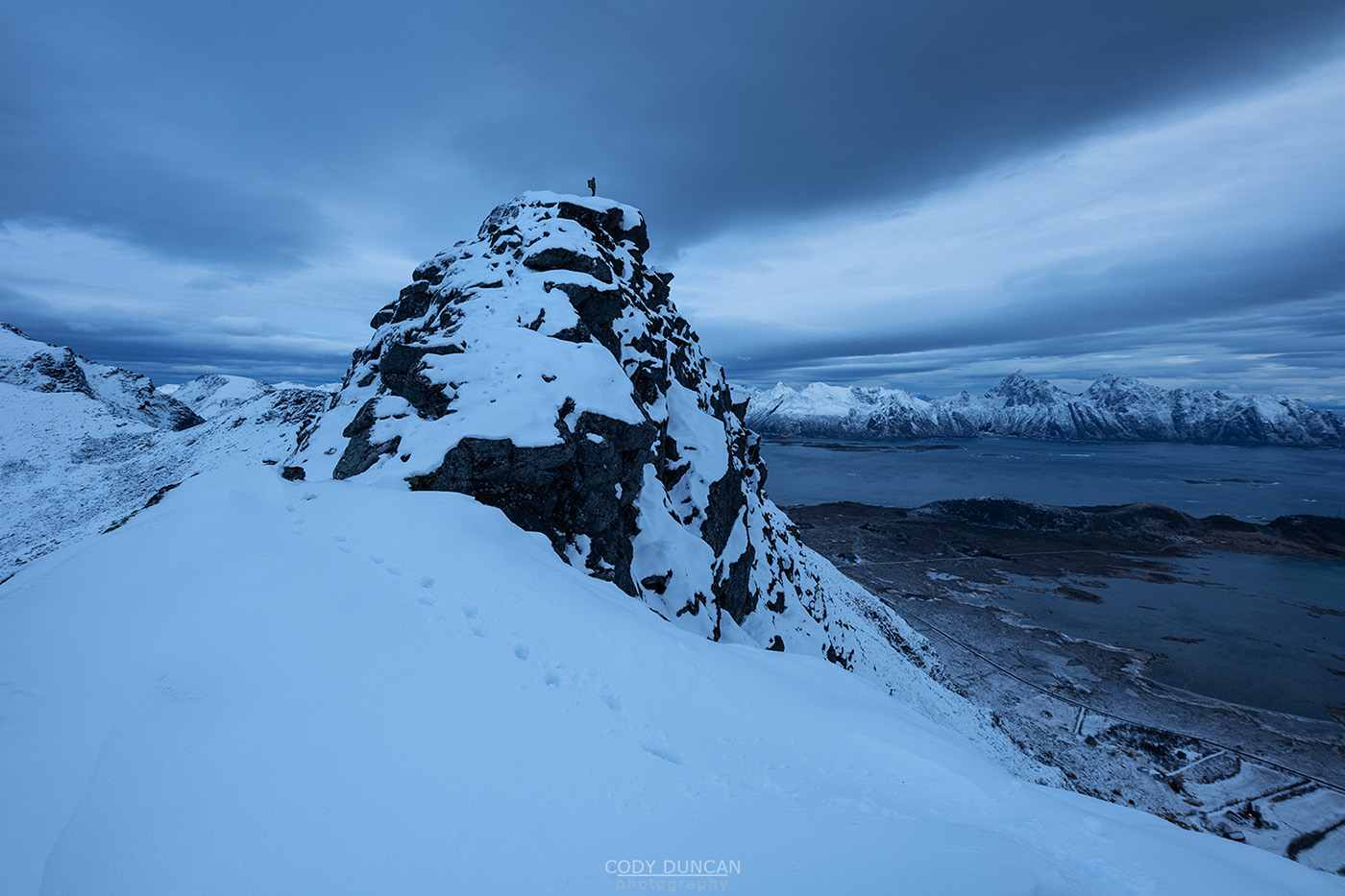
Photo: Hiker on the snowy ridge towards Vikjordtinden under a dark December sky, Vestvågøy, Lofoten Islands, Norway. December 28, 2020. 12:50

Hiking days start early in December. And even then, there still might not be enough time to get to where you were planning to go. On the case of this dark and windy December day, the objective was Vikjordtinden on the southern side of Vestvågøy. We never made it.

Every day in December we wake up before sunrise here in Lofoten. If it is just a working day on the computer, then the time doesn’t matter too much. If I’m actually planning to go outside and do something, then this needs to be as a reasonable hour in the morning as the hours of visible light are preciously short – there is no time to waste!

Heavy clouds make December’s world even darker, so even just before 10:00 we were walking through the icy forest in near darkness. Luckily, there was no snow on the lower elevations and the boggy areas were mostly frozen, making for fairly easy hiking. But soon we left what little there was of a trail and headed cross country up a steep mountain ridge. The hiking here was somewhat slow and the warm-ish thin layer of snow that we eventually climbed into the heavy, wet, and slippery. And just deep enough to fill in the dozens of holes between rocks and the bushes.

The wind was blowing strong from the south, though not terribly cold. Continuing along the ridge, the snow deepened just enough to make route finding difficult as we climbed over rocky steps, careful not to slip. This took time. It was just before 13:00 by the time we reached the first high point along the ridge, before a long descent then another long climb to the summit. Not much light left on this dark December day.

And so I took a few photos before we turned around and began the slow descent. Returning to my van by headlamp.

Head over to my Instagram account for (almost) daily postings of the local conditions here on Lofoten: @distant.north

Camera Info:
Nikon D850
Sigma 14mm f/1.8
14mm
ISO 400
f 5.6
1/13 second
WB Daylight

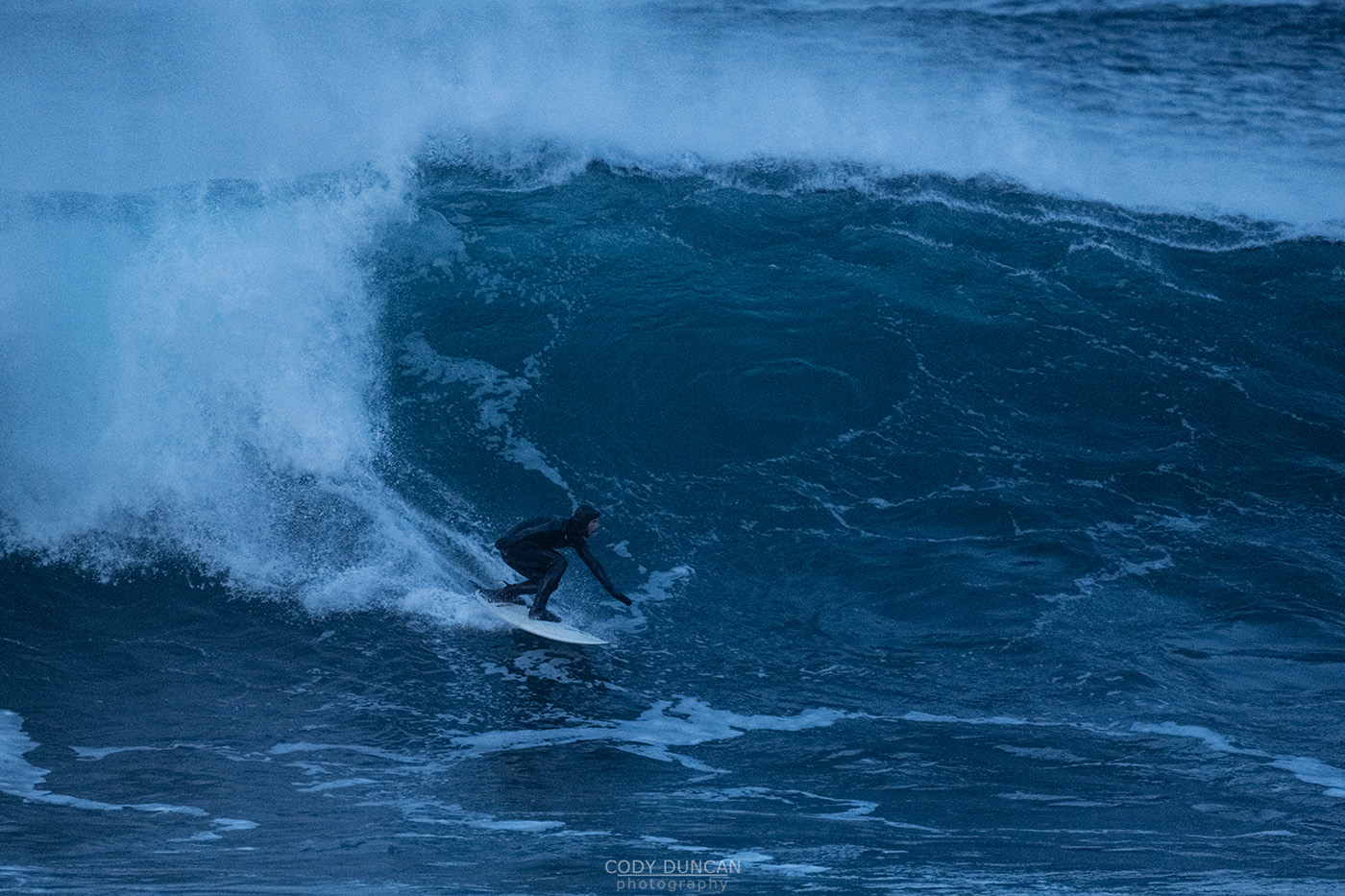
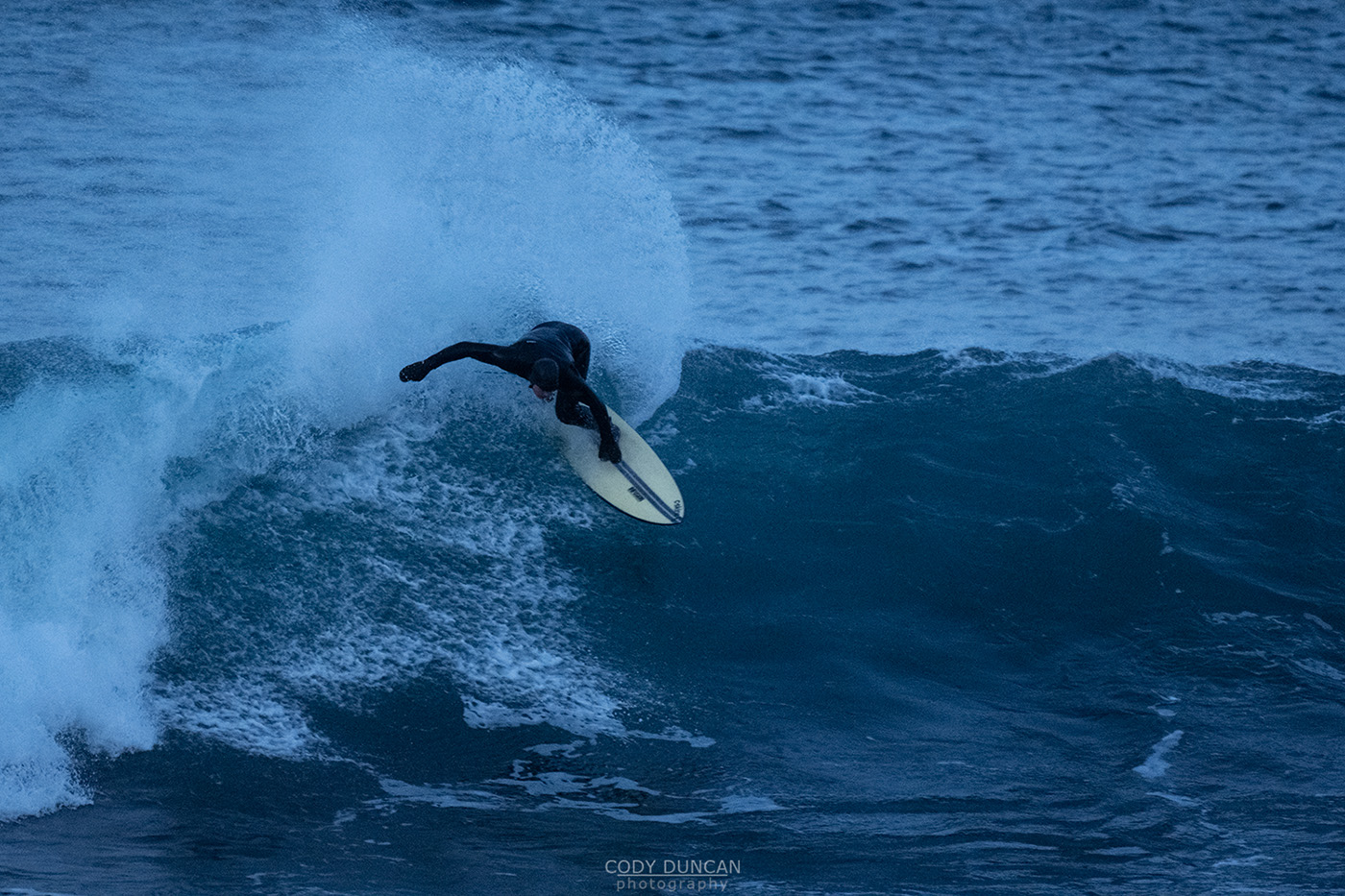
Photo: Arctic surfing on Monday’s 4+ meter swell at Unstad beach, Vestvågøy, Lofoten Islands, Norway. December 13, 2021. 12:21

A nice and clean looking 4-5 meter west swell was forecast to hit Lofoten on Monday so I decided to head out to Unstad to checkout the action. I don’t shoot surfing too often, but when the waves are big here, there’s usually some good stuff to watch. There was only one problem this week…

It is the middle of December and Lofoten is in the period of the Polar Night – Mørketid – when the sun does not rise above the horizon. And although the sky was clear to the north, there was a heavy layer of clouds over the southern side of the islands, blocking much of what reflected light might have made it over the mountains to Unstad. So it was dark. ISO 4000 dark at noon!

I generally try to shoot surfing at 1/1000 second, and ideally closer to 1/2000 second. But in the middle of December, 200km north of the artic circle, that is not really possible. So 1/640 was the best I could manage without turning the waves into sand dunes from all the grain of a higher ISO.

Eventually, I switched to video, which was more manageable due to the lower shutter speed required. I’m still very much a beginner when it comes to video stuff, so it was at least some good practice under difficult light…

Head over to my Instagram account for (almost) daily postings of the local conditions here on Lofoten: @distant.north

Camera Info:
Nikon Z7 II
Nikon 200-500 f/5.6
500mm
ISO 4000
f 5.6
1/640 second
WB Daylight

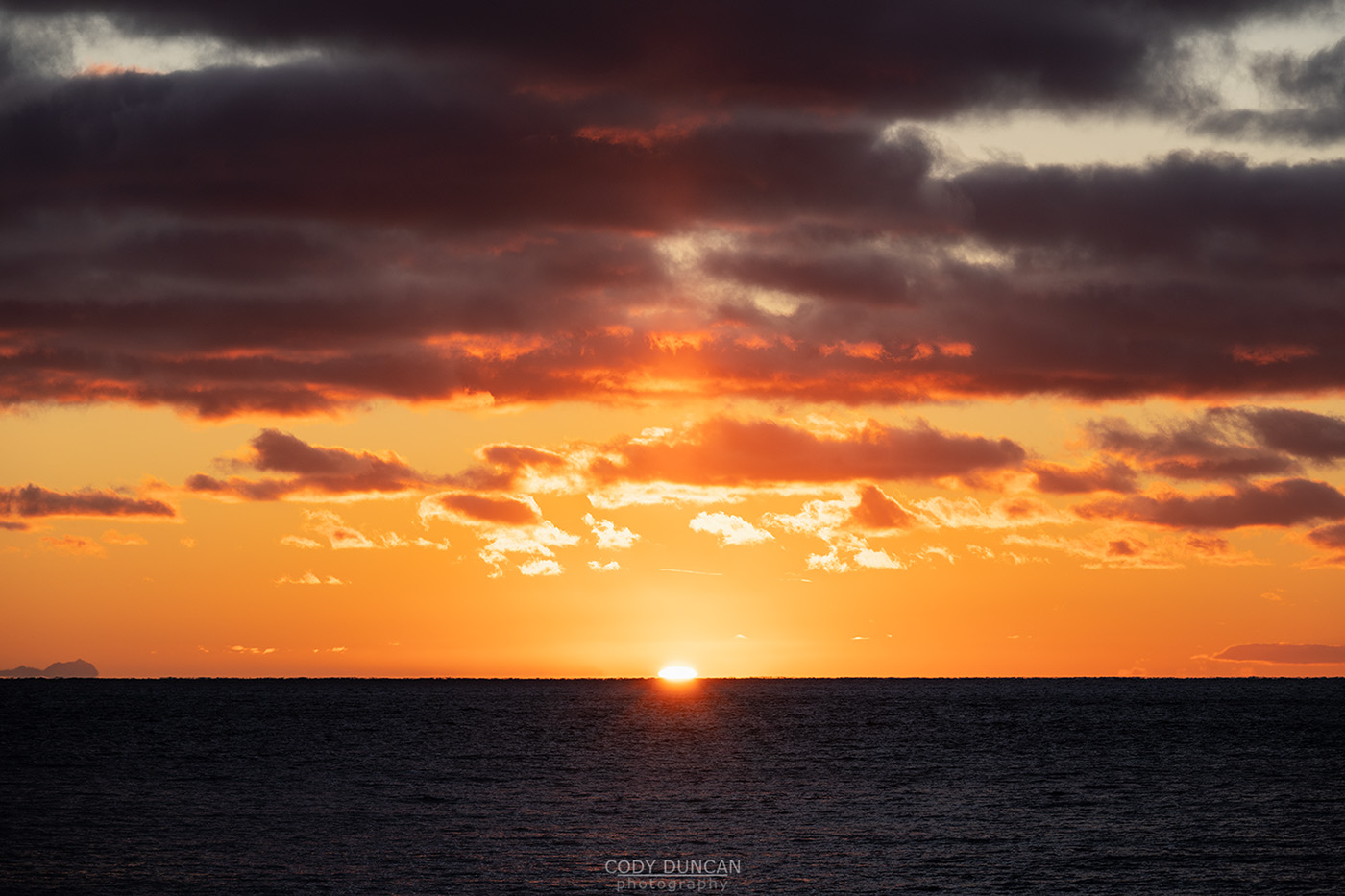
Photo: The last visible sun peaking over the southern horizon before the beginning of the polar night, Stamsund, Vestvågøy, Lofoten Islands, Norway. December 8, 2021. 11:56

The polar night has officially begun on Lofoten this week – the time of year where the sun no longer rises over the horizon. We won’t see the sun again until January 5th at the earliest. And I say earliest, because the return of the sun is as weather dependant as its departure. The latest ‘first sun’ for me has been January 18th.

Lofoten has experienced an early winter cold spell over the last two weeks. A big improvement to last years endless rain – though that will be back after the weekend, unfortunately. With the cold often comes clearer skies and horizon. However, I have actually been enjoying a semi-tropical sun down in Madeira for the last two weeks, so as I flew home to Lofoten on Wednesday, I figured I had already seen my last sun of the year.

But as a friend was driving me to Stamsund to pickup my van, I could seen the horizon glowing bright. Soon enough, a glimmer of sunlight poked above the horizon. I quickly cleared the snow from my van and headed to a spot on the road towards Steine. I didn’t have time for any sort of spectacular photo, and the mountains were glowing quite nicely. But it was simply enough to get an image of the sun (partially) above the horizon on my return to Lofoten. December 8th, this is now the latest I have seen the sun in the year.

Moving almost parallel to the horizon, the light didn’t last long before the sun sunk below the sea again, for its final time in 2021.

Head over to my Instagram account for (almost) daily postings of the local conditions here on Lofoten: @distant.north

Camera Info:
Nikon Z7 II
Nikon 24-200mm f/4-6.3
145mm
ISO 100
f 8
1/160 second
WB Daylight

Photo: Noon twilight over Unstad, Vestvågøy, Lofoten Islands, Norway. December 4, 2020. 12:15

This is the last weekend of the year with (possible) sunlight on Lofoten as next week is the beginning of the polar night – the period of time when the sun no longer rises above the horizon. That is not to say that it is ‘night’ the entire time, but the nights are long after the twilight of the day begins to fade around 14:00.

Without direct sunlight, however, there is no proper blue sky ‘daylight.’ And while the southern horizon can glow brightly on clear days – as the sun is never too far away, for the northern side of Lofoten, the world is just a soft pastel glow.

For northern locations like Unstad, the village will already have been in the shadow of mountains for several weeks before the polar night officially begins. So for day to day life in the village, there is no real change from late November vs. early December. Or, perhaps only on a clear day where the sun might be shining on some of the surrounding mountains. The last visible sun at my house is October 20th, and it doesn’t return until February 19th. So unless I’m away from home, it can be long periods without sunlight for me. Almost makes me want to have a house on the southern side of Lofoten for the winters, or perhaps Spain!

Head over to my Instagram account for (almost) daily postings of the local conditions here on Lofoten: @distant.north

Camera Info:
Nikon D850
Nikon 70-200mm f/4
130mm
ISO 400
f 5.6
1/50 second
WB Daylight

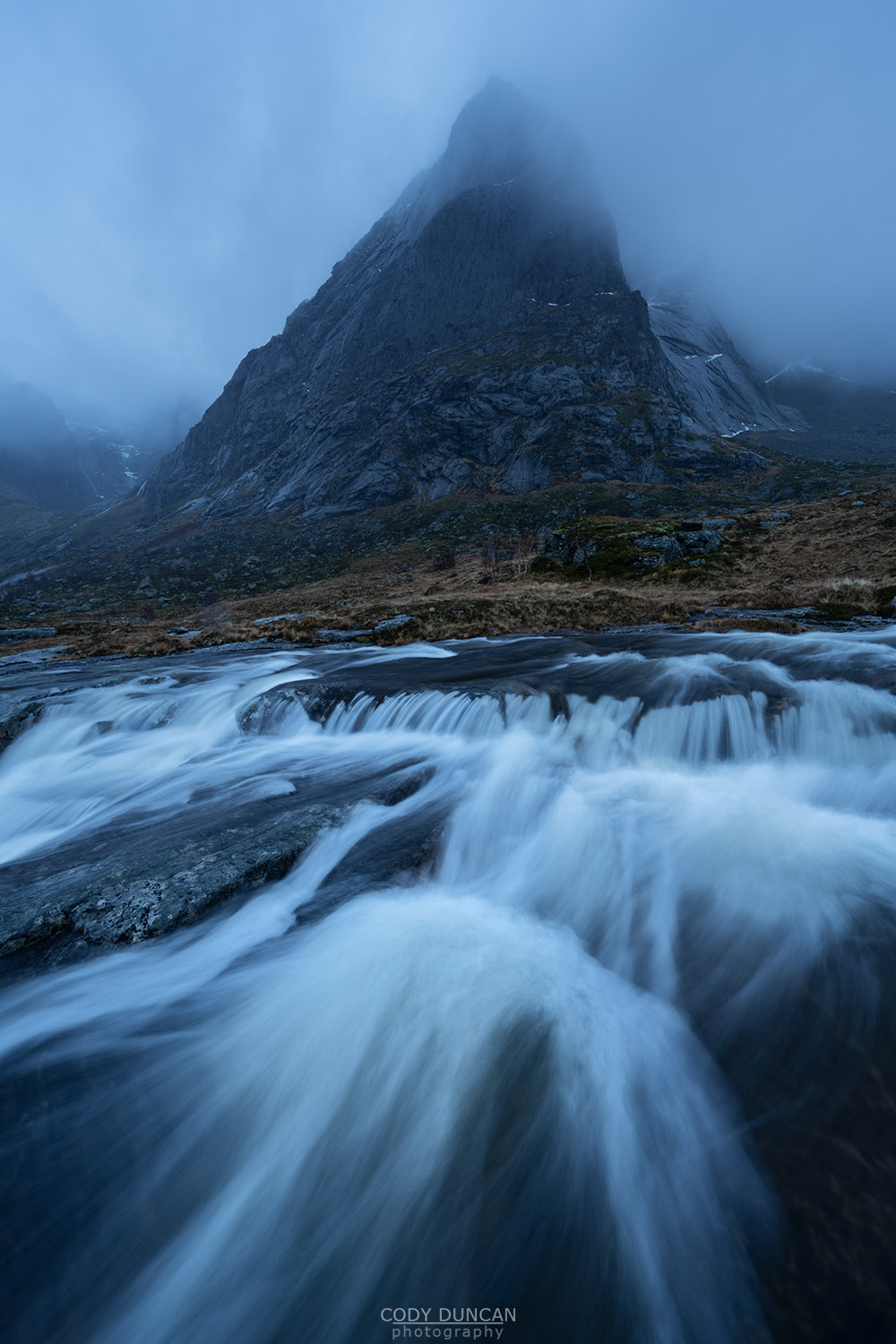
Photo: Mølnelva river flows below Stortind mountain peak after days of heavy rain, Flakstadøy, Lofoten Islands, Norway. November 16, 2021. 12:52

In what seems like a repeat of last year, it has so far been a windy and wet November. Looking back over the last month, it has rained/snowed on 27 out of 30 days! The last few days in particular have brought some quite heaving rain, with localised flooding across some parts of Lofoten and elsewhere in northern Norway.

It was only a month ago (Friday photo #459) that I posted a picture of this location – Mølnelva flowing below Stortinden. But in heavy rain, or should I say, just after the rain has stopped, its an easy location for me to access that always seems to have something new to offer. Usually if I’m passing by to elsewhere and I see the the water level is high, I’ll stop and go wander around for a bit. Though, much of the scene depends on what the clouds are doing around Stortinden, and if the summit is even visible. If not, then its not worth stopping for the most part.

Tuesday, after a night and morning of heavy rain, the clouds eased off slightly for the afternoon – and by slightly, I mean just not torrential rain. The mountains had come alive with tiny ribbons of water flowing down seemingly every rock face. And so as I passed by Mølnelva on my way back from checking things out a bit further west, I made a brief stop.

With the polar night still a few weeks away, November is already a pretty dark month. More sun under heavy clouds. Even shooting at 13:00, I could already achieve a shutter speed over a second without the need for any filters – though I liked the flow of the water better in this image with a shutter speed of 0.6 second.

Hopefully the rain stops soon and I don’t have to shoot this location too many more times over the next months!

Head over to my Instagram account for (almost) daily postings of the local conditions here on Lofoten: @distant.north

Camera Info:
Nikon Z7 II
Nikon 14-30mm f/4
14mm
ISO 31
f 13
0.6 second
WB Daylight

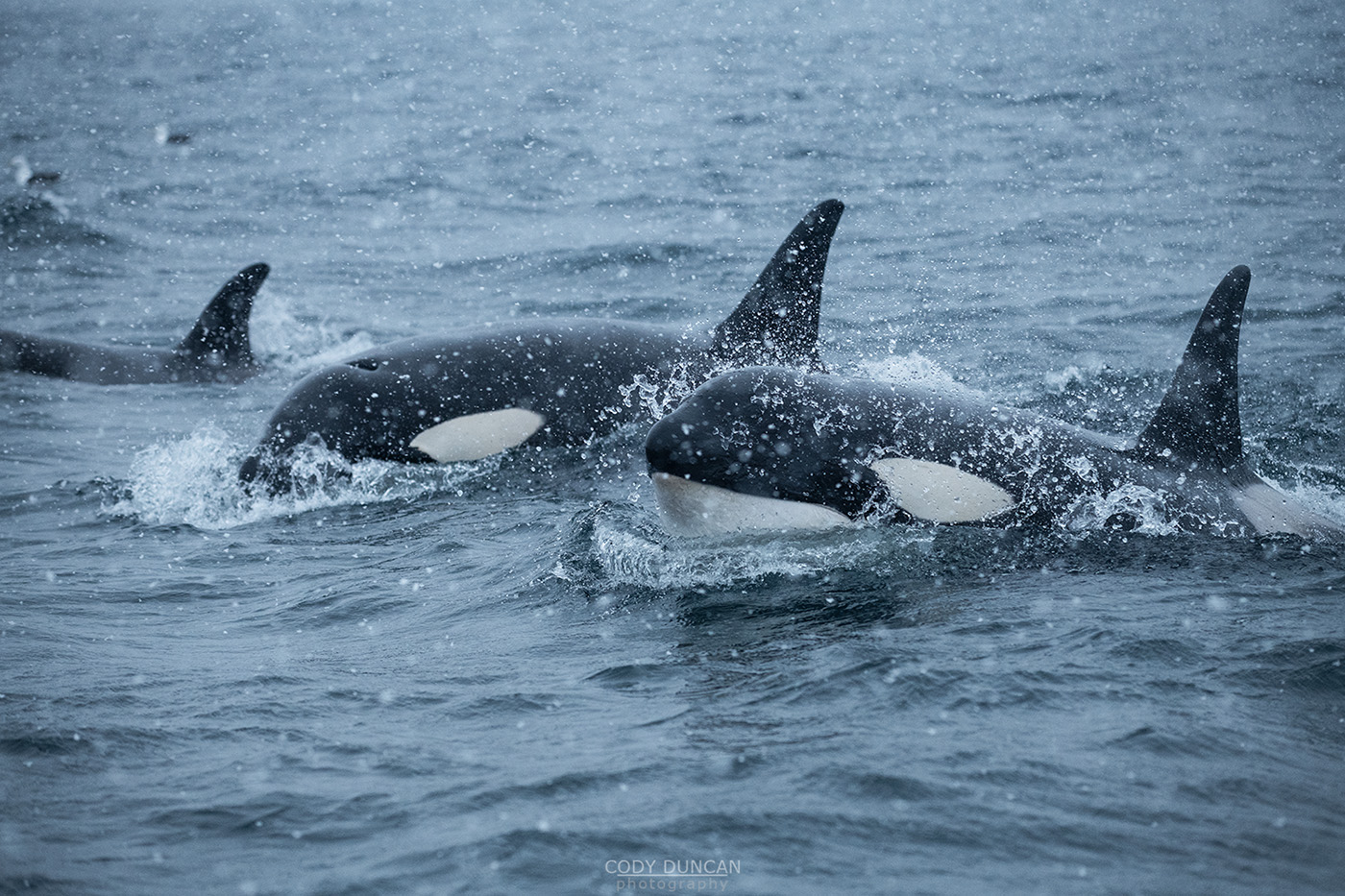
Photo: Orcas in the snow on the coast outside Nusfjord, Flakstadøy, Lofoten Islands, Norway. April 5, 2021. 17:20

For the last week I’ve been hearing various reports that the killer whales have returned to the Lofoten coast for their spring herring feeding. On Sunday, while planning to go out for a hike from Nesland, I finally spotted them in Skjelfjord – but they were on the far side and barely visible from land. I need a boat, I thought.

Monday I was out with some friends fishing near Stamsund when I got a text that the orcas were back in the bay at Nusfjord. Typical situation for me, that I’m usually occupied with some other activity when they are in a good location. But fortunately, there weren’t many fish to be found (I don’t eat fish myself anyhow, was just along for the ride), so we returned early to Stamsund, where I quickly said goodbye and headed to Nusfjord.

I arrived to the news that they had already left and were further along the coast. But, I was also informed that a boat would be coming, so I asked if I could join along. Having already been at sea outside of Stamsund, I knew it was going to be rough sailing in the choppy water. And even more difficult trying to photograph the orcas with a telephoto lens from a wildly bouncing boat. And soon enough, a large front of snow arrived, making photography even more difficult by limiting which direction we could shoot in.

But luckily enough, the orcas were just hanging around and feasting on the herring. As we drifted in the boat, occasionally they would surface nearby and swim around us. Then it is a matter to try and point the camera in the right direction and hope it focuses on the orcas and not the falling snow.

Hopefully this is just the first chance of the year and there are more times ahead as they hang around the coastline over the next couple months.

Head over to my Instagram account for (almost) daily postings of the local conditions here on Lofoten: @distant.north

Camera Info:
Nikon D850
Nikon 70-200mm f/4
140mm
ISO 1000
f 4.5
1/1600 second
WB Daylight

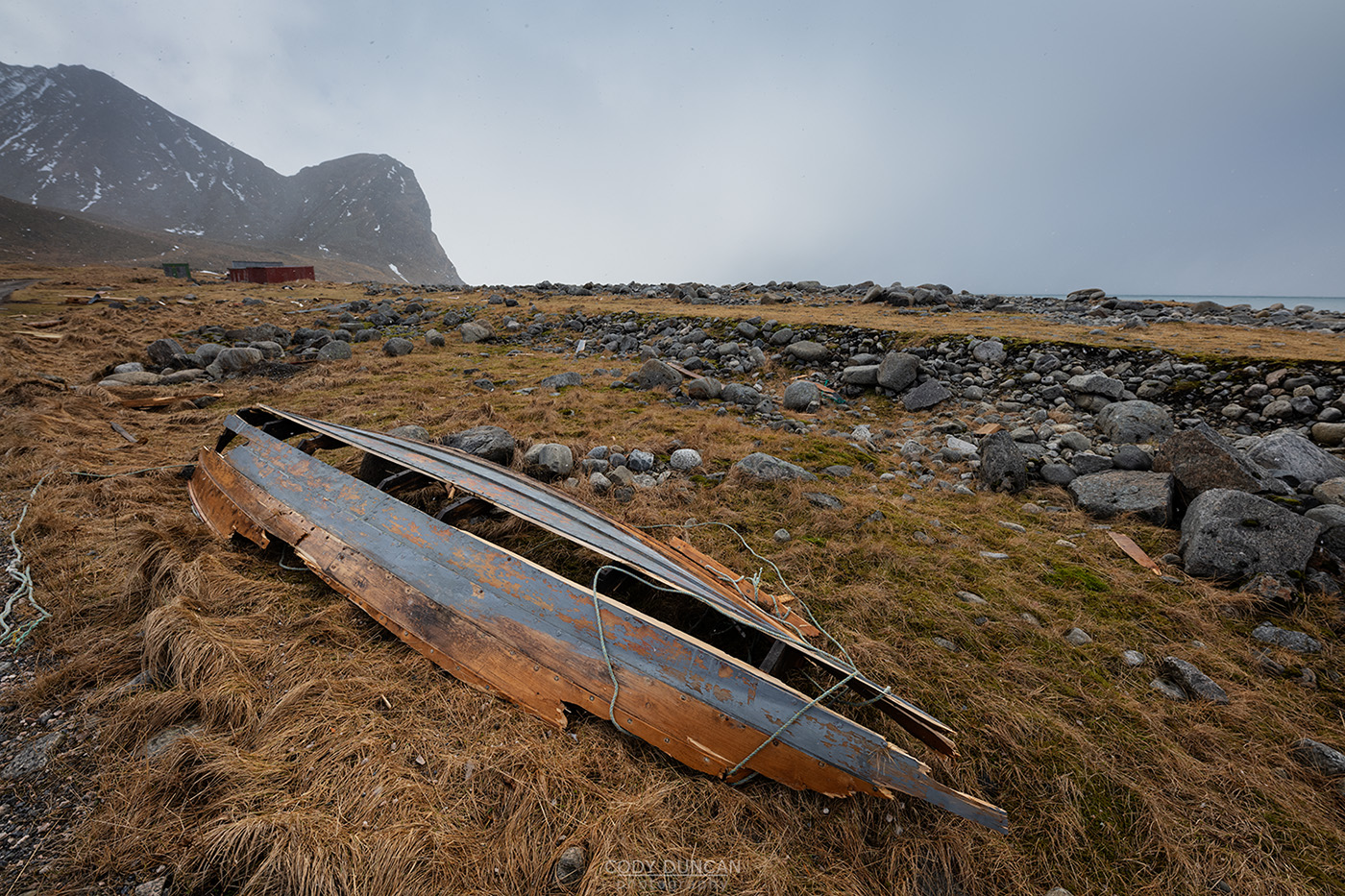
Photo: Lost in the storm, broken row boat on the Unstad coast, Vestvågøy, Lofoten Islands, Norway. March 25, 2021. 12:14

After a mostly calm winter, two back-to-back storms swept over Lofoten on Tuesday and Wednesday, with the 2nd one brining hurricane force winds to the islands. Wednesday was the first time this winter I saw 30+ meter/second wind gusts on my weather station, and in Stamsund wind was recoded at over 40 m/s (for note: over 33 m/s is hurricane force wind). While intense, luckily the storm seemed to pass by quickly, with the strong winds only lasting 8 hours or so. But that was enough to bring structural damage across the islands.

One of the losses was one of the red boat houses on the left side of the beach at Unstad, which you can see in the left background of the photo. It is strange to think of how many long winters and storms the buildings have witnessed, and then one day, it has been one storm too many. I guess that is one reason there aren’t too many old, or historic buildings around Lofoten, they just don’t last that long in the weather out here.

I had been sitting on the beach at Unstad on Thursday morning, a completely calm day compared to the previous 24 hours. It was actually the first day I have sat outside this year and noticed the warmth from the sun heating up my back as I watched the still slightly stormy waves in front of me. Sitting there, I noticed an unusually large amount of pained red wood broken apart across the rocks at the upper tide line. Usually storms bring in a lot of debris to the beaches, but this wood looked a little too clean to have been out at sea very long. Then, looking to the left, I noticed a few people walking around the boat houses, picking stuff up.

The old row boat here was lying a little ways away, just next to the road. I’m not sure if it had been blown here, or moved up from further down on the rocks. Either way, it is a piece of Lofoten history now lost to the storms.

Head over to my Instagram account for (almost) daily postings of the local conditions here on Lofoten: @distant.north

Camera Info:
Nikon D850
Sigma 14mm f/1.8
14mm
ISO 100
f 7.1
1/250 second
WB Daylight

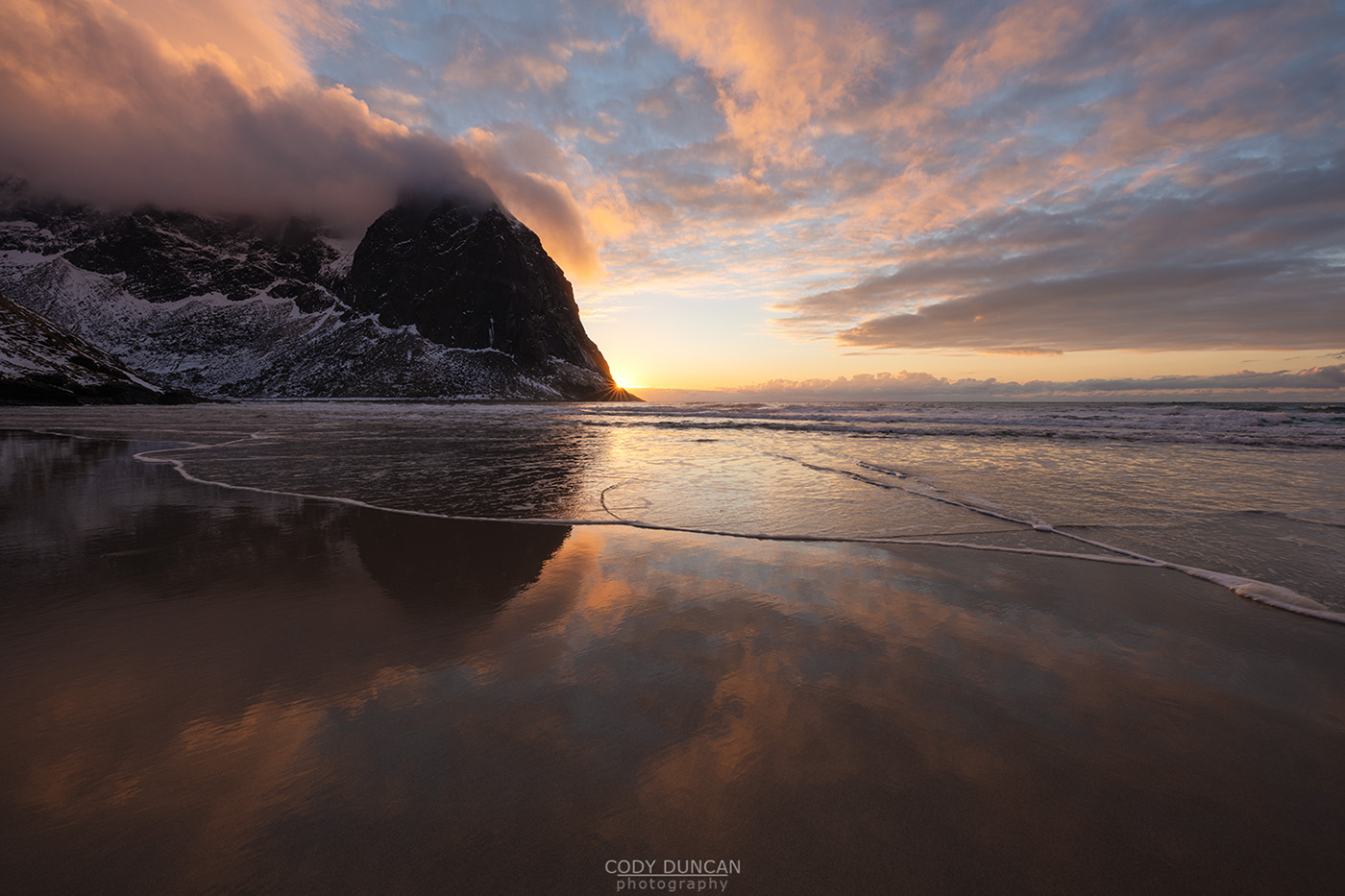
Photo: Setting sun behind Kjerrina from Kvalvika beach, Lofotodden national park, Moskenesøy, Lofoten Islands, Norway. March 14, 2021. 17:37

Tomorrow, March 20th, is the vernal equinox and the sun will pass north of the equator for the first time since September – spring and summer are on the way! Even the first of the migratory birds have started to find their places along the beaches and coastline of Lofoten, and the evenings are finally feeling a little lighter after the long dark months of winter.

From a photographic point of view, this means the sun is finally leaving the southern part of the sky and reaching into more northern facing locations. Today’s photo, of the setting sun at Kvalvika beach from last Sunday would not have been possible just 2 weeks ago, as the sun would have set just behind the mountain and not been visible from the beach. Over the coming weeks, the setting sun will move further the the right (north) of this scene until it reaches true north in late May – the beginning of the midnight sun season here on Lofoten.

As the sun rises and sets further to the north, more and more locations on Lofoten will emerge from the long shadows of winter. Especially important for this are the beaches, most of which are on the northern sides of the islands and surrounded by steep mountains.

Last Sunday, I decided to head to Kvalvika with a pair of journalism students who are including me in one of their university projects. Knowing it was one of the first days with the setting sun on the beach, it seemed like a pretty good option. Although leaving the parking lot for the short 1 hour hike, it was one of those days where the weather forecast was more optimistic than reality, as heavy clouds cloaked most of Lofoten. Arriving at the beach in mid afternoon I could see some small areas of clear sky along the lower horizon. I gave it a 50/50 chance of seeing a sunset vs. having a grey set.

Time seemed to pass slowly, and even the surrounding mountains where not receiving any light and with the sun behind the mountain Kjerringa, I couldn’t see what was going to happen, we could only wait. But finally, I could see the steep cliffs of Ryten begin to lighten, and then glow bright in direct light! As the minutes passed the sunlight moved towards us, eventually shining across the northern half of the beach. Luck was on our side.

Head over to my Instagram account for (almost) daily postings of the local conditions here on Lofoten: @distant.north

Camera Info:
Nikon D850
Sigma 14mm f/1.8
14mm
ISO 31
f 13
120 second
WB Daylight

Photo: Soft winter twilight over Himmeltindan, Vestvågøy, Lofoten Islands, Norway. March 8, 2021. 17:23

After a windy weekend, Monday arrived with near absolute stillness. Slow, almost ghost like snow showers were gently floating across the islands throughout the day, bringing the mountains in and out of the clouds from time to time.

My original plan had been to go skiing, as the wind was forecast to increase during the week, blowing away the already thin layer of snow western Lofoten has at the moment. But as I arrived at the parking lot, I noticed I managed to forget my ski boots at home! Doh!!!

I also had my cross-county ski gear in my van, so I eventually made my way to Leknes after photographing a bit in the Fredvang area. In the late afternoon I took a quick lap on the Leknes skiløypa, not wanting to miss out on any movement for the day. This turned out to be a good choice anyhow, as it kept me in town later than I otherwise would have been and so I found myself driving home a little before sunset.

In the low areas west of Leknes, I noticed some thin wisps of fog floating over the frozen landscape. Usually this is more common in autumn, but not so much in winter. A little further and I noticed on of the lakes had a thick layer of fog, with barely visible trees on the far shore. I was already content with the photos I had shot for the day, but this was potentially not something to miss, so I turned around and parked nearby the lake.

While this lake had been well frozen back in February, the weather has been mild for the last weeks, so I wasn’t sure what to expect. As I got to the edge, I could see that I was breaking through the ice and into boggy ground underneath. I should note, that I know this area, and that the edge of the lake is not deep. If it was another, deeper lake or with a steeper drop off at the shoreline, I would not have continued.

I could barely see the trees on the far side, looking like ghosts in the thick mist. I tried to get a little closer, but still mostly breaking through the ice and sinking into the boggy terrain with each step. Finally I took one step too far and sank past my knees, completely flooding my boots with water and soaking my pants. Ok, that is far enough, and I went slightly back onto shallower terrain.

Ideally, I would have liked to go out to the middle of the lake so the trees in the foreground would be a bit more visible, but I defiantly was not going to risk that! So I had to be content to remain close to the shore where it wasn’t deep. Even with my lower half soaking wet, I took photos for another 20 minutes or so, as the fog was drifting back on forth on occasion.

Head over to my Instagram account for (almost) daily postings of the local conditions here on Lofoten: @distant.north

Camera Info:
Nikon D850
Nikon 70-200 f/4
165mm
ISO 100
f 7.1
1/60 second
WB Daylight